
FAQ Schema SEO: Maximizing LLM Citations on WordPress
Quick answer
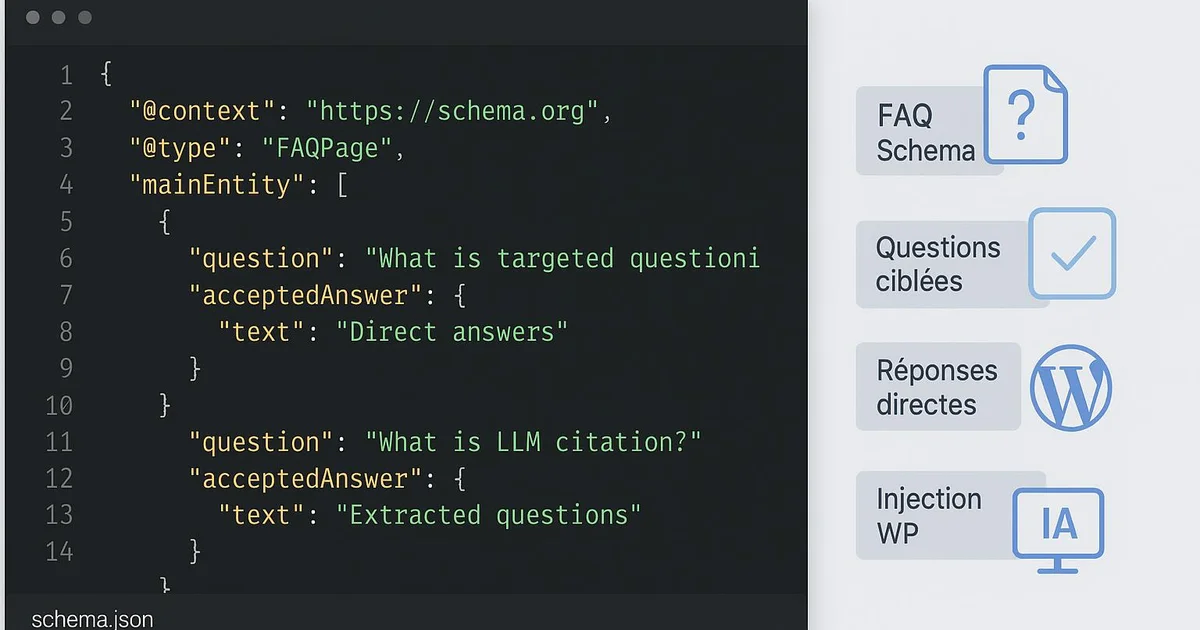
FAQ Schema SEO is structured markup (FAQPage, JSON-LD) that exposes question-answer pairs to engines. On WordPress, it is added via Yoast, RankMath or a Schema plugin. This segmented format is frequently reused by LLMs like ChatGPT or Perplexity because it isolates short, citable answers, which can contribute to more citations.
Generative engines like ChatGPT, Gemini, Perplexity or Google's AI Overviews don't read a page like a human: they look for short, self-contained units of meaning clearly attributable to a question. The question-answer format of a FAQ matches almost exactly what these systems reuse to compose a cited answer. On WordPress, the challenge is not theoretical but operational: how do you produce this markup at scale, keep it compliant, and connect it to the rest of your content? Most editors add a visual FAQ without JSON-LD, or the reverse, and lose the advantage. This article details how to structure FAQ Schema on WordPress with Yoast or RankMath, why this format is particularly citable by LLMs, and how Selfhook automatically generates this layer in every article to maximize citation chances, then measurable in Search Console.
Definition
FAQ Schema is structured markup of type FAQPage, expressed in JSON-LD, that explicitly links a question to its answer so engines and LLMs can extract them as standalone units.
Why does FAQ Schema favor LLM citations?
An LLM building an answer tries to minimize ambiguity: it favors passages where the question asked and the answer provided are explicitly coupled. A FAQ section marked up as FAQPage exposes exactly this structure. Each question-answer pair becomes a standalone, short, factual unit, detachable from the rest of the page without loss of context — precisely the type of fragment an engine like Perplexity readily cites with attribution. Without this markup, the model must reconstruct the boundary between question and answer from the prose, which increases the risk of paraphrase without citation. Segmented-format content is generally observed to be reused more often in generative answers, though no ensure exists and behavior varies by topic and engine. FAQ Schema acts on two complementary levers. First the JSON-LD, which helps Google understand the FAQPage nature of the block and can feed AI Overviews. Second the editorial form: a question phrased as a user would type it, followed by a direct answer of two to four sentences, without detours. On WordPress, these two dimensions must coexist: the text visible to the reader and the machine markup must describe the same pair. It is precisely this consistency that Schema plugins and tools like Selfhook aim to ensure automatically, so each question becomes a citable anchor point.
How do you add FAQ Schema on WordPress?
On WordPress, several paths allow you to implement valid FAQ Schema, from the native block to a dedicated plugin. The most direct remains the FAQ block built into Yoast SEO: in the Gutenberg editor, you insert a "Yoast FAQ" block, add your question-answer pairs, and Yoast automatically generates the corresponding FAQPage JSON-LD, integrated into its global Schema graph. RankMath offers an equivalent block, "FAQ by RankMath," with the same coupling principle between visible text and markup. For finer needs, a dedicated Schema plugin lets you manually control the JSON-LD structure, useful if you manage nested types or linked entities. The most common mistake is writing a FAQ in plain text without a structured block: the reader sees the questions, but neither Google nor LLMs receive the explicit FAQPage signal. A few points to check for a clean implementation:
- Each question must reflect a real query, not a marketing rephrasing of the title
- The visible answer and the marked-up answer must be identical, with no content divergence
- A single FAQPage block per page to avoid validation conflicts
- Validate rendering with Google's Rich Results Test before publishing
- Link the FAQ to main sections via internal links from the WordPress GEO cluster
What editorial structure gets cited by ChatGPT and Perplexity?
Markup alone is not enough: the wording of questions and answers largely determines citability. An effective question mimics how a real user phrases things, often interrogative and specific, rather than a condensed title. Compare "Pricing" to "How much does managed WordPress hosting cost?": only the second matches a query ChatGPT or Perplexity might receive and then map to your content. The answer must deliver the essential information in its first sentence, because LLMs frequently truncate and favor the beginning. Aim for two to four sentences: the first answers directly, the following ones nuance or contextualize. Avoid answers that redirect elsewhere without their own content ("see our guide"), since they offer nothing extractable. On WordPress, this editorial discipline combines with markup: you write the pair in the Yoast or RankMath block, then verify the answer stays self-contained once removed from its page context. This logic is close to the one described in our optimiser-contenu-pour-llm guide, where each passage must be able to travel alone. FAQ Schema pushes this logic to completion, since the FAQPage structure already delimits the citable unit. In practice, a FAQ of three to six well-targeted questions, placed at the end of the article and marked up, can contribute to widening the page's citation surface without diluting the main body. The effect remains to be measured in Search Console and in generative referrer logs, depending on the topic.
With Selfhook, the FAQ section is not a manual step: when generating content for a WordPress article, Selfhook automatically produces three to six question-answer pairs phrased as real queries, then publishes them with structured FAQPage markup. The automated WordPress publishing integrates this JSON-LD directly, so visible text and Schema stay consistent. Selfhook's SEO audit then checks markup validity and flags answers that are too short or not self-contained. The goal is to maximize the surface citable by LLMs like ChatGPT or Perplexity, relying on a structure these engines frequently reuse, without repeated editor intervention.
Selfhook centralizes content generation, SEO/GEO optimization, WordPress publishing and tracking in a single workflow.
See all features →Since 2023, Google has restricted FAQ rich results to recognized government and health sites: your FAQPage markup will therefore likely no longer produce a visible accordion in classic SERPs. But this does not make it useless. The JSON-LD is still read by the systems feeding AI Overviews and by LLM crawlers, which exploit the semantic structure independently of display. In other words, the value has shifted from the rich result to machine citability — a point many still confuse.
Sources
- Schema.org documentation (FAQPage) — Canonical definition of the FAQPage type and its mainEntity, acceptedAnswer properties.
- Google Search Central — Rich Results & FAQ — Specifies eligibility conditions and display restrictions for enriched FAQs.
- Yoast SEO documentation — FAQ block — Explains automatic FAQPage JSON-LD generation from Gutenberg.
FAQ
Does FAQ Schema still improve SEO despite Google's restrictions?
Yes, but its role has evolved. It no longer displays an enriched accordion for most sites, but the markup is still used by AI Overviews and LLM crawlers. Its main value is now machine citability rather than the visible rich result.
Do you need a plugin to add FAQ Schema on WordPress?
Not necessarily a dedicated plugin: Yoast SEO and RankMath include a native FAQ block that generates the JSON-LD automatically. A specialized Schema plugin is only useful for complex structures or nested entities.
How many questions should a FAQ include to maximize citations?
Three to six targeted questions are generally enough. Beyond that, you risk diluting relevance or repeating the article body. Better to have few well-phrased questions, each answering a distinct real query.
Must the visible text exactly match the FAQ Schema?
Yes. Google requires the marked-up answer to match the content visible to the user. A divergence can invalidate the Schema and is a bad practice. Yoast and RankMath blocks ensure this correspondence automatically.
Related cluster articles
Reference guides
Automate with Selfhook
Conclusion
FAQ Schema is no longer a visible rich result lever, but it remains a favored format for citability by generative engines. On WordPress, implementation is accessible via Yoast or RankMath, provided you ensure consistency between visible text and JSON-LD, and write questions that mimic real queries. The effect on LLM citations varies by topic and remains to be measured in Search Console. Selfhook automates this structured FAQ layer in every generated article, so each page exposes citable question-answer units without repeated manual work — to combine with the practices in our generative-engine-optimization-guide.
Ready to automate your SEO content?
Book a 30-minute video demo: we show you Selfhook on your WordPress site, from SEO audit to publishing.
Request a demo