
Original Statistics: The SEO/GEO Lever to Get Cited by AI

Quick answer
Original statistics are proprietary data (studies, benchmarks, internal corpora) published to be cited. In SEO and GEO, they can help generate backlinks and become sources referenced by ChatGPT, Perplexity and Google AI Overviews, which generally favor quantified, verifiable content attributable to an identified entity.
Most blog articles repeat the same figures borrowed from others. As a result, they add little new value and rarely become primary sources. Yet generative engines — ChatGPT, Perplexity, Google AI Overviews — look for attributable factual anchors. An original figure, dated and methodologically documented, provides exactly that kind of anchor. Publishing statistics drawn from your own activity can therefore contribute both to classic ranking and to visibility in AI answers. The challenge is producing this data cleanly, presenting it in a citable form and distributing it in the right place. This article details the method, its limits and how to measure the effects in Search Console. Selfhook can support this process by turning its users' corpus — generated articles, observed performance, usage data — into statistical studies ready to publish on WordPress.

Definition
Original statistics are novel quantitative data, produced from your own corpus or measurements, published in a format that is citable by both humans and generative search engines.
Why are original statistics cited by AI?
Generative search engines build their answers by aggregating sources they deem reliable and verifiable. A quantified figure poses a specific challenge: it must be attributed to an origin. Unlike an opinion, a number cannot be paraphrased without risk, which generally pushes systems like ChatGPT or Perplexity to cite the source of the statistic. It is precisely this attribution mechanism that makes original data valuable in Generative Engine Optimization. A statistic reused across ten other sites loses its anchoring value: the engine no longer knows whom to attribute it to, or cites the most authoritative source, rarely you. Conversely, a figure only you possess — because it comes from your internal corpus — has only one possible origin. In some observed cases, this increases the probability that your name appears in the generated answer. This reasoning aligns with Google's E-E-A-T principles: experience and expertise are demonstrated notably through the production of proprietary data. A publisher stating 'based on the analysis of 12,000 articles published through our platform' signals first-hand experience that is hard to fake. This authority signature can contribute to classic ranking while feeding AI citations. Still, caution is required. Citation is never recommended: generative engines evolve, their inclusion criteria remain partly opaque, and a poorly contextualized figure may be ignored. The realistic goal is to increase the probability of being retained as a source, not to ensure it. As with any strategy described in our generative engine optimization guide, the effect must be observed over time and confronted with real traffic and mention data.
Which proprietary data can be turned into statistics?
Almost any digital activity generates usable data, provided it is structured. The first step is inventorying what you already measure but do not publish. An e-commerce site has average order values, return rates and seasonality. An SEO agency holds ranking histories, observed indexing delays and conversion rates by sector. A content publisher accumulates writing times, Yoast readability scores and performance by article format. This raw data becomes citable statistics only after aggregation and anonymization. You do not publish an identifiable client's figures, but an average or distribution drawn from a sufficient sample. Sample size matters: a figure from 30 observations is less credible than one from several thousand, and must be presented as a cautious estimate. A few data categories lend themselves particularly well to this treatment:
- Performance benchmarks: average indexing time, observed traffic change after a specific action
- Aggregated behaviors: click-through rates by title type, best-performing article length by topic
- Costs and durations: average production time, cost per article, estimated return on investment
- Distributions: readability score spread, share of content reaching a ranking threshold
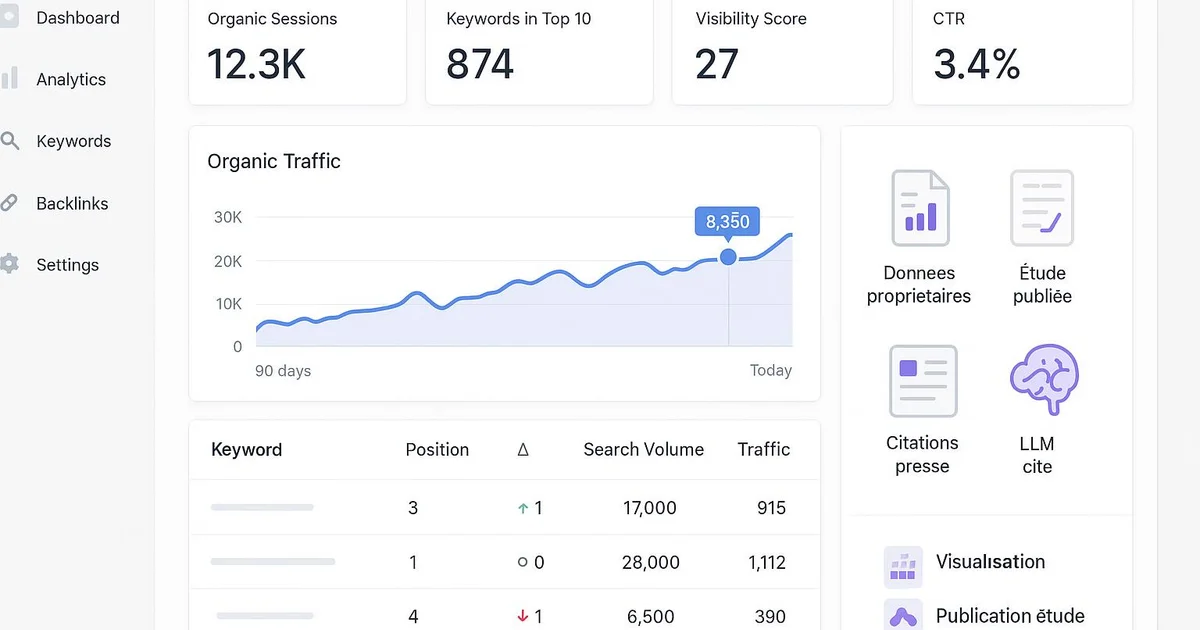
How to structure a citable statistical study?
Data is citable only if verifiable, and verifiable only if its method is transparent. Any statistical study intended for GEO should begin with a clear methodological note: period covered, sample size, data source, calculation method and acknowledged limits. This rigor is not cosmetic. Generative engines, like expert human readers, generally give more weight to a figure whose context is explicit. Presentation then plays a decisive role. An isolated figure in a dense paragraph is harder to extract than one highlighted and phrased as a standalone, self-contained sentence. The ideal wording contains the subject, the figure, the unit and the source in a single statement: 'Based on the analysis of 8,400 articles, the average observed indexing time was 4.2 days.' This structure is directly citable by ChatGPT or Perplexity without risky rephrasing. Technical markup reinforces extractability. Descriptive headings, clean HTML tables and, where relevant, structured data markup help Google understand the statistical nature of the content. It is also useful to visibly date the study and plan its update: 2024 data loses force in 2026, and engines often favor freshness. Finally, each key statistic deserves to be isolated as an answer sentence at the start of a section, to maximize its reuse in AI Overviews or snippets. This approach aligns with authoritative content and E-E-A-T principles: a figure's credibility depends as much on its production as on its editorial staging. A well-structured study can thus simultaneously serve classic ranking, backlink acquisition and citations in generative answers, provided it is distributed over the long term.
How to distribute and circulate your statistics?
Producing original data is not enough: its value depends on its circulation. A citable statistic is first a discoverable statistic. The starting point remains a dedicated, permanent page on your site, structured as a reference resource rather than a news article. This page must remain accessible over time, because citations and backlinks accumulate gradually. External distribution then amplifies the effect. Journalists and writers seek exclusive figures to illustrate their articles; a data release or a regularly updated 'statistics' page can attract natural editorial links. These backlinks retain their value in classic SEO and, indirectly, may strengthen the source's perceived authority in generative engines. This does not claim that links alone trigger an AI citation, but that a coherent set of signals increases the probability of being retained. Reuse across other formats extends a study's reach. The same dataset can feed a shareable infographic, a professional social thread, a short video or a newsletter. Each reuse should link back to the primary source, to concentrate authority on a single URL. This centralization matters: scattering data across multiple pages dilutes the attribution signal. Measuring real effects remains essential. In Search Console, you monitor the evolution of impressions and positions on queries related to the data. Tools like Semrush help track incoming backlinks, and manual monitoring on ChatGPT or Perplexity lets you observe whether your figure is cited and correctly attributed. These measures, collected over several months, turn intuition into a manageable strategy. They align with the logic described in our guide on how to get cited in ChatGPT.
What are the limits and risks of original statistics?
Publishing your own data is not without trade-offs, and a serious writer must make them explicit. The first risk is methodological: too small a sample, an unrepresentative period or a selection bias can produce a misleading figure. A poorly built statistic that circulates widely can lastingly harm the issuer's credibility, especially if it is reused then contradicted. Caution requires systematically presenting figures as estimates from a specific context, never as universal truths. The second risk concerns confidentiality. Turning an internal corpus into a public study requires rigorous anonymization. Publishing aggregated data must never allow reconstructing the performance of an identifiable client or user. This constraint is as much legal as ethical, and it sometimes limits the level of detail that can be published. A third point concerns uncertain attribution in AI engines. Even exclusive data is not recommended to be cited: ChatGPT, Gemini or Perplexity may integrate the figure into their answer without naming the source, or attribute it to a site that reused it. This phenomenon, regularly observed, reminds us that GEO remains an evolving field where attribution mechanisms are not fully controllable. Finally, there is a maintenance cost. An aging statistic loses force and can even become counterproductive if it contradicts more recent figures. A serious data strategy therefore implies a regular update cycle, with history retained to show evolution. This continuous work, more than one-off publishing, distinguishes a truly authoritative source from an isolated marketing move. Acknowledging these limits does not weaken the approach: it makes it credible, which is precisely the goal in E-E-A-T as in GEO.
How to measure the impact of your statistics on AI citations?
Measuring the effect of a statistical study requires combining several signals, because no single indicator captures SEO and GEO performance on its own. The foundation remains Google Search Console: you track the evolution of impressions, clicks and average positions on queries containing or surrounding the published data. A durable rise, correlated with the publication date, is a first signal of interest, to be interpreted cautiously since other factors may intervene. Backlink tracking complements this reading. Tools like Semrush or RankMath help identify sites reusing your figure and verify whether they link back to the primary source. The quality of referring domains matters more than their number: a few relevant editorial links generally weigh more than a multitude of automatic reuses. Specifically GEO measurement remains the trickiest. There is no standardized tool yet that certainly declares 'your statistic is cited by ChatGPT.' The realistic method is recurring manual monitoring: querying ChatGPT, Perplexity and Gemini on questions related to your data, then noting whether the figure appears and to whom it is attributed. Some analytics detect referral traffic from these platforms, an indirect sign of citation. By consolidating these observations over several months, you build a dashboard distinguishing studies that perform from those that stagnate. This measurement loop feeds subsequent publications: you reinvest in the formats and topics that genuinely generate citations and links. It is this analytical discipline, more than intuition, that turns the production of original statistics into a cumulative visibility asset, aligned with generative engine optimization goals and classic organic traffic.
With Selfhook, a publisher can turn its own corpus into citable studies. The platform aggregates anonymized data from generated and published articles — observed indexing times, Yoast readability scores, traffic evolution — then AI content generation shapes them into a structured statistical article. Automated WordPress publishing puts online a dedicated page, dated and marked up for extraction. The built-in SEO audit verifies heading structure and the presence of self-contained answer sentences. The result: a proprietary data resource, ready to attract backlinks and to be reused by ChatGPT or Perplexity, updated without starting from scratch each cycle.
Selfhook centralizes content generation, SEO/GEO optimization, WordPress publishing and tracking in a single workflow.
See all features →An overlooked point: generative engines poorly distinguish primary data from relayed data if both use identical wording. To maximize attribution, vary your phrasing from expected reuses and anchor each figure to an explicit named entity ('according to [your brand]'s analysis'). This nominal signature, repeated consistently across multiple pages and external sources, strengthens the statistical link between the figure and your brand within models, more so than an isolated hyperlink.
Sources
- Google Search Console — Tracking impressions, clicks and positions to measure a statistical study's SEO effect.
- Google E-E-A-T documentation — Official framework explaining why first-hand data strengthens perceived authority.
- Semrush — Analysis of incoming backlinks and referring domains citing a statistic.
FAQ
How much data is needed to publish a credible statistic?
There is no absolute threshold, but a sample of several thousand observations generally inspires more confidence than a dozen. The key is publishing the exact sample size and presenting the figure as a contextualized estimate rather than a general truth.
Does an original statistic ensure a citation in ChatGPT?
No. Citation depends on partly opaque and evolving factors. Exclusive data increases the probability of being retained as a source, but ChatGPT may also integrate the figure without naming the origin. The result must be observed over time.
Should statistical studies be updated?
Yes, regularly. Aging data loses force and engines often favor freshness. Keeping history also lets you show an evolution, which strengthens the source's authority over time.
How do you protect client data confidentiality?
By systematically aggregating and anonymizing. You publish averages or distributions from a sufficient sample, never figures allowing identification of a specific client or user. This is both a legal and ethical requirement.
An SEO agency managing about a hundred WordPress sites compiled, over twelve months, observed indexing delays after publication. After anonymization, it published a 'Indexing Benchmark 2026' page reporting a median delay estimated at 3.8 days across roughly 6,200 URLs. The page, structured with a methodological note and self-contained answer sentences, was relayed by two specialized blogs within six weeks. In Search Console, impressions on 'Google indexing time' queries rose over the following quarter. Manual monitoring spotted the figure reused in a Perplexity answer, with partial attribution to the agency — an encouraging result but one to consolidate over time.
Timeline
Before 2020
Original statistics mainly serve to earn backlinks and press coverage in a classic SEO logic.
2020-2022
Featured snippets reward well-worded figures, encouraging isolation of each statistic as an answer sentence.
2023-2024
The rise of ChatGPT and Perplexity makes attributable data a citation stake in generative answers.
2025 and beyond
GEO institutionalizes proprietary data as a visibility asset, with measurement methods still under construction.
A figure only you possess has just one possible origin: it is precisely this uniqueness that, in some cases, turns internal data into a source cited by generative engines.
Common mistakes
Recycling borrowed figures
Reusing statistics already published elsewhere deprives your content of any attribution power with AI engines.
Omitting methodology
Without period, sample and calculation method, data is not verifiable and loses credibility with readers and engines.
Scattering data across pages
Publishing the same figure on multiple URLs dilutes the attribution signal instead of concentrating authority.
Neglecting updates
An outdated statistic can become counterproductive if it contradicts more recent, reliable figures.
Promising recommended citation
No data ensures being cited by AI; presenting it as certain harms the approach's credibility.

Related cluster articles
Automate with Selfhook
Conclusion
Original statistics are one of the rare levers that serve classic SEO, backlink acquisition and citations in generative engines simultaneously. Their strength comes from uniqueness: data only you possess has a single possible origin. But the approach demands methodological rigor, anonymization, regular updates and continuous measurement in Search Console and through AI monitoring. No citation is recommended; the realistic goal is to increase the probability of being retained as a source. Selfhook can structure this production by turning its users' corpus into publishable studies, updated and ready to become citable references over time.
Ready to automate your SEO content?
Discover how Selfhook can help you create and publish quality SEO content
Start for free