
AI Overviews SEO: Optimizing Content for Google AI
Quick answer
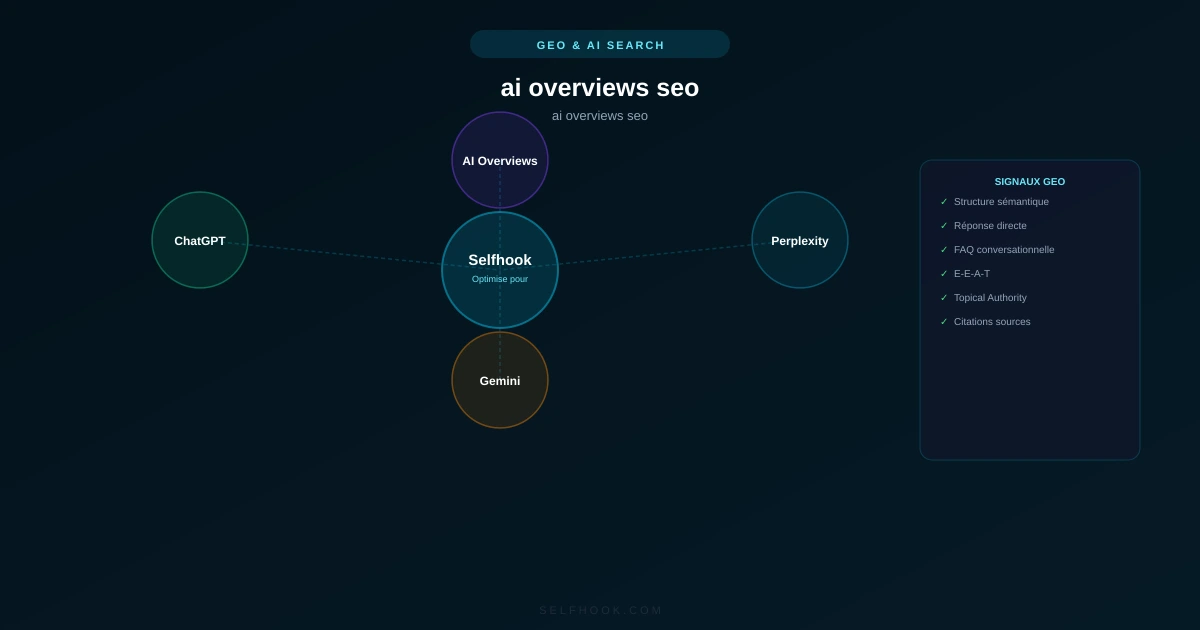
AI Overviews SEO means optimizing content to appear within Google's AI-generated answers. This relies on short, direct responses, a clear hierarchical structure (H2/H3), strong E-E-A-T signals and factual data. When well structured, content can contribute to being cited in these summaries, which should be measured in Search Console.
AI Overviews have reshaped the first page of Google: instead of a simple list of links, users now see an AI-generated synthetic answer, often at the very top of results. For WordPress publishers, freelancers and SEO agencies, this raises a concrete question: how do you stay visible when Google answers before the click even happens? The answer isn't to abandon classic SEO, but to adapt it. Structured, factual content that demonstrates genuine expertise generally has a better chance of being featured in these summaries. This article details optimization levers for AI Overviews, from structuring best practices to E-E-A-T signals, including how to measure impact in Search Console. We'll also see how Selfhook automates part of this work for WordPress sites, as a complement to a broader GEO strategy.
Understanding AI Overviews and Their SEO Impact
AI Overviews are answers generated by Google's AI, displayed at the top of results for certain queries. They draw on and synthesize several web sources, which they cite. For SEO, the stakes shift: ranking in the first blue link is no longer enough, you need to become a cited source. Depending on the topic, the appearance of an AI Overview may reduce click-through rates on classic links, but a citation within the summary can generate qualified traffic and strengthen perceived authority. The observed impact varies widely by industry and query type.
- Informational queries: strong AI Overview presence
- Transactional queries: more variable presence
- AI citation = brand visibility, even without an immediate click
Structuring Content to Be Cited by AI
Google's AI more easily extracts clear, well-delimited passages. A solid hierarchical structure (one H1, thematic H2s, H3s for details) helps models understand and isolate relevant information. Placing a short, direct answer at the start of a section increases, in some cases, the chances of being featured in a summary. Lists, tables and concise definitions are particularly valued because they are easily citable. This logic aligns with the principles of generative engine optimization: producing content that's not only readable by humans, but also usable by generative engines.
- Direct 40-80 word answer at the top of each section
- Descriptive headings using query variants
- Lists and tables for comparisons and steps
- Clear definitions of technical terms
Strengthening E-E-A-T Signals for AI Overviews
Google generally favors sources that demonstrate experience, expertise, authority and trustworthiness (E-E-A-T) to feed its AI summaries. In practice, this means identified and qualified authors, cited sources, up-to-date data and a technically healthy site. For content featured by AI, these signals can contribute to selection as a trusted source. A medical or financial article without an identified author will, in some cases, have less chance of being cited than equivalent content signed by a recognized expert. The site's thematic consistency (topical authority) also reinforces this overall credibility.
- Detailed author page with qualifications
- Verifiable sources and references
- Regular updates of dated content
- Thematic consistency across the entire site
Measuring Your Visibility in AI Overviews
Accurately measuring AI Overview citations remains complex, as Google does not yet provide a full dedicated report. However, several indicators are worth monitoring in Search Console: changes in impressions and CTR on informational queries, average position, and the appearance of CTR drops despite stable impressions, which may signal an AI Overview. Third-party tools are starting to detect AI citations, but their data should be considered estimates. Cross-analysis between Search Console, actual traffic and manual query testing remains the most reliable method to date.
- Track CTR vs impressions in Search Console
- Manual testing of target queries
- Third-party AI citation detection tools (estimates)
- Traffic analysis by query type
Consider a practical case: a WordPress HR consulting site publishes an article on calculating a final settlement payment. In Search Console, over the last 90 days, the query shows an estimated 12,000 impressions but a CTR that dropped from 4.2% to 2.1%, while average position stays at 3.4. This gap generally suggests the appearance of an AI Overview capturing some clicks. The team restructures the article: adding a 60-word definition in the intro, a table of settlement components, and an FAQ. After six weeks, the CTR partially recovers, a sign of possible citation in the AI summary, to be confirmed through regular manual testing.
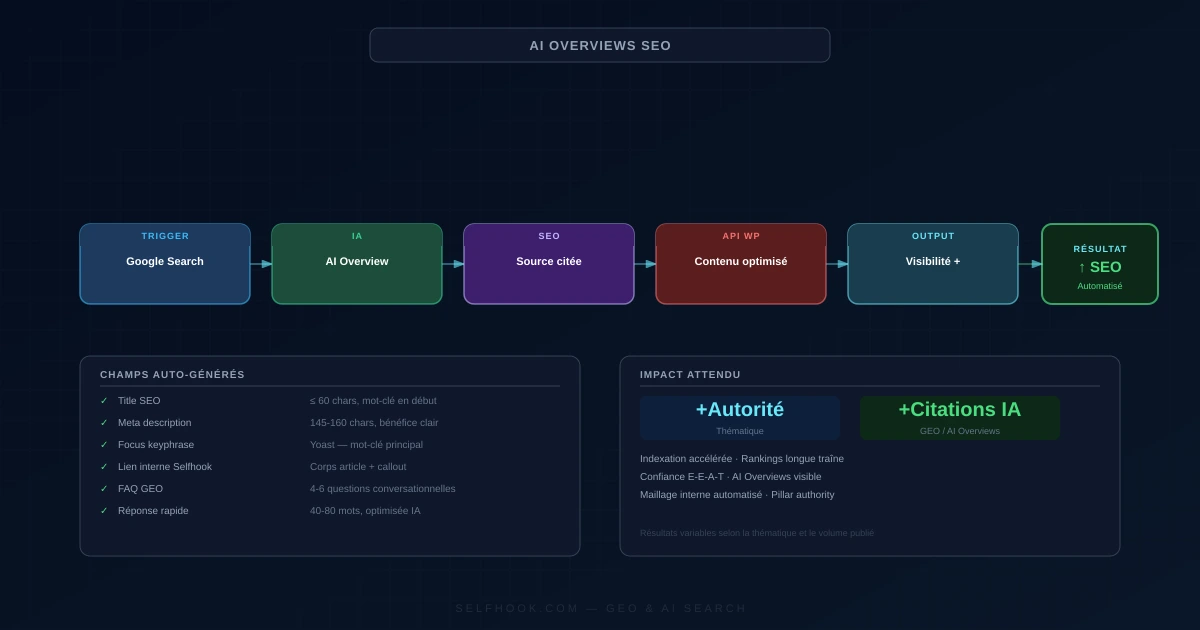
With Selfhook, every article generated for WordPress is structured from the writing stage to maximize the chances of appearing in an AI Overview: a short direct answer up top, a clean H2/H3 hierarchy, citable lists and built-in Yoast optimization. Selfhook also strengthens E-E-A-T signals by structuring content around a consistent theme (topical authority) and facilitating author attribution. Concretely, an agency can publish a full cluster of GEO-optimized content in a few hours, then track changes in impressions and CTR to assess the impact on its visibility within Google's AI answers.
Key takeaways
AI Overviews cite sources: aim for the citation, not just the click
Place a short, direct answer at the top of every section
Strengthen E-E-A-T: identified authors, sources and content freshness
Monitor the CTR/impressions gap in Search Console
A clear hierarchical structure makes AI extraction easier
Selfhook centralizes content generation, SEO/GEO optimization, WordPress publishing and tracking in a single workflow.
Discover Selfhook →FAQ
What is an AI Overview in SEO?
An AI Overview is a synthetic answer generated by Google's AI, displayed at the top of search results. It aggregates and cites several web sources. In SEO, the goal becomes being one of those cited sources, in addition to classic ranking.
How do you appear in Google's AI Overviews?
There is no recommended method, but certain practices increase the chances: structuring content with direct answers, using a clear hierarchy, strengthening E-E-A-T signals and providing factual data. Results should be measured in Search Console and vary by topic.
Do AI Overviews lower SEO traffic?
In some cases, yes: an AI Overview can capture clicks on informational queries. However, a citation in the summary can generate qualified traffic and strengthen brand awareness. The actual impact depends on the industry and query type.
How do I measure my presence in AI Overviews?
Google does not yet offer a full dedicated report. In Search Console, monitor the ratio between impressions and CTR: a CTR drop with stable impressions may signal an AI Overview. Manual tests and third-party tools complement this analysis, as estimates.
Is classic SEO still useful with AI Overviews?
Yes. AI Overviews rely on well-ranked, quality pages. Strong classic SEO generally remains the foundation for being considered a source by the AI. GEO optimization complements, rather than replaces, traditional SEO.
Operational checklist
Related articles in this cluster
Conclusion
AI Overviews are redefining SEO visibility: it's no longer just about ranking, but about being cited as a source by Google's AI. This relies on structured, factual and credible content, backed by strong E-E-A-T signals. No approach offers a ensure, but rigorous optimization, measured in Search Console, can contribute to durably strengthening your presence. Selfhook automates much of this work for WordPress sites, from structuring to GEO-optimized publishing. To go further, explore our guides on generative engine optimization and GEO integration on WordPress to build a coherent strategy in the face of AI-driven search.
Ready to automate your SEO content?
Discover how Selfhook can help you create and publish quality SEO content
Start for free