
How to Structure Content for AI Engines on WordPress
Quick answer
Structuring content for AI engines means placing a direct answer under each H2 heading, writing a factual body, adding numbered lists, an FAQ and a coherent JSON-LD Schema. On WordPress, Yoast or RankMath handle the markup while the Hn hierarchy structures extraction by ChatGPT, Gemini or Perplexity.
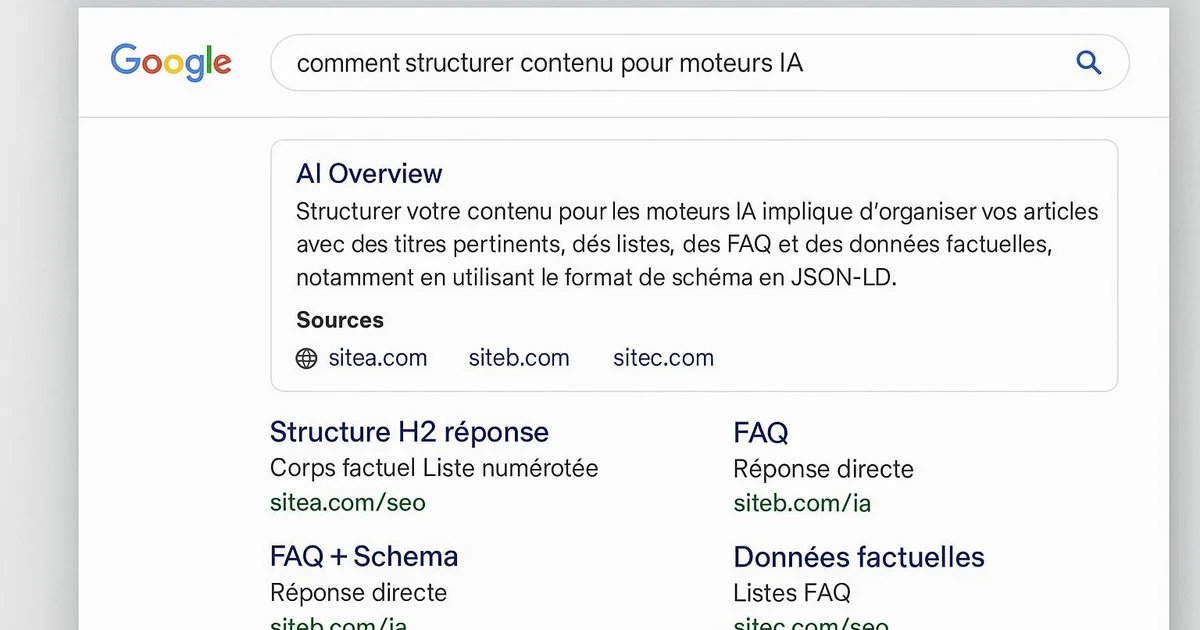
AI engines — Google's AI Overviews, ChatGPT, Gemini, Perplexity — don't read a page like a human. They extract citable segments: a definition, a concise answer, a list of steps, a table. A poorly structured WordPress article, however rich, may go unnoticed by these systems. Conversely, well-segmented, marked-up content increases the likelihood of being cited, in some cases, as a source. The question is no longer just "how to rank" but "how to become extractable." On WordPress, the answer combines heading hierarchy, Gutenberg blocks, plugins like Yoast or RankMath, and JSON-LD Schema. This article analyzes structuring principles commonly observed in content cited by LLMs, then applies them concretely within the WordPress ecosystem. Selfhook automates several of these steps during generation, but understanding the logic remains essential to measure effects in Search Console.
Definition
AI-engine structuring refers to organizing web content (Hn hierarchy, direct answers, lists, structured data) so that systems like AI Overviews, ChatGPT or Perplexity can easily extract and cite it.
Why does structure matter more than length for AI engines?
An AI engine seeks to answer an intent with minimal ambiguity. It therefore favors passages where a question finds an immediate, self-contained answer, independent of the rest of the article. This shifts editorial logic: a 3,000-word text without clear segmentation will be cited less often than a 1,200-word article where each section opens with a direct answer. On WordPress, this logic translates into how Gutenberg blocks are used. Each H2 heading should be immediately followed by a 40-60 word paragraph that answers before any development. Engines like Perplexity or AI Overviews frequently extract this first block. Yoast SEO also flags Hn hierarchy issues (level skips, missing H2s) that disrupt semantic analysis. Granularity matters too. Content segmented into coherent thematic units — one H2 = one idea — makes it easier to map a user query to a specific passage. This approach aligns with the principles detailed in our complete GEO WordPress guide.
- A direct 40-60 word answer under each H2
- One H1, thematic H2s, H3s for sub-points
- Short paragraphs (2-4 sentences) easy to isolate
- Avoid heading level skips flagged by Yoast
Which structural elements favor citation by ChatGPT and Perplexity?
Beyond hierarchy, certain formats are statistically more often reused by AI engines, depending on the topic. Numbered or bulleted lists offer discrete units the model can quote verbatim. Comparison tables condense structured data that's easy to rephrase. FAQ blocks, finally, align question and answer in a directly usable format. On WordPress, these elements are built natively with Gutenberg blocks: the "List" block, the "Table" block, and an FAQ block provided by Yoast SEO or RankMath. The advantage of these plugins is that they automatically generate the corresponding FAQPage Schema in JSON-LD, reinforcing coherence between visible content and structured data. A mismatch between the two can, in some cases, reduce the trust engines grant. Anchored factual data — figures, dates, named entities like Google, WordPress or Semrush — also increases citability, as they offer verification points. It remains preferable to present any figure as an estimate to measure in Search Console rather than a certainty. To dig deeper into adapting body text, see our article on optimizing content for LLMs.
- Numbered lists for procedures and steps
- Comparison tables for options and tools
- FAQ blocks generating a FAQPage Schema via Yoast or RankMath
- Named entities and dated data as anchor points
How to implement coherent JSON-LD Schema on WordPress?
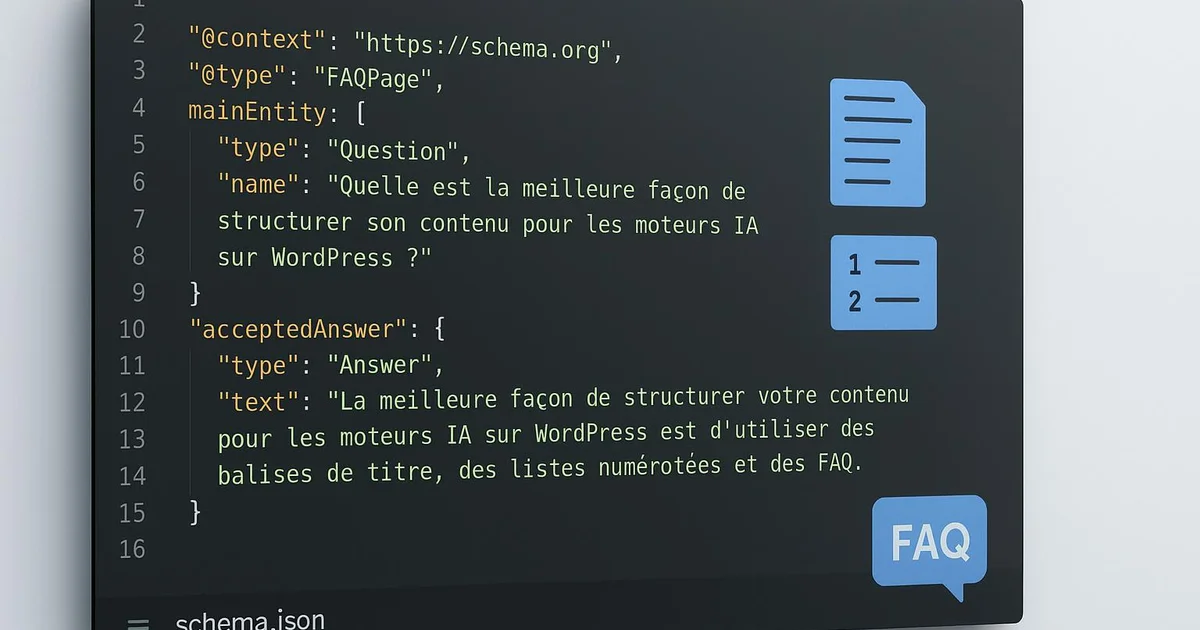
JSON-LD Schema explicitly describes the nature of each content type to engines: Article, FAQPage, HowTo, BreadcrumbList. This semantic layer isn't read by the visitor but can contribute to better interpretation by extraction systems, including those powering AI Overviews. On WordPress, implementation generally requires no code. Yoast SEO generates a unified Schema graph where each entity (organization, author, article) is linked by identifiers. RankMath offers a more granular Schema generator, with HowTo and FAQ types configurable per article. The observed rule: Schema must faithfully reflect visible content. Declaring a FAQPage without real questions in the page body creates a detectable inconsistency. Coherence between markup and content is the central point. An article structured with a direct answer under each H2, a visible FAQ and an aligned FAQPage Schema forms a coherent whole that AI engines can parse without ambiguity. Our dedicated guide to Schema for AI on WordPress details each markup type and its configuration within the plugins' interface.
- Article or BlogPosting for the main content
- FAQPage aligned with an actually visible FAQ
- HowTo for step-by-step tutorials
- BreadcrumbList to clarify position in the tree structure
With Selfhook, AI-engine structuring is built in from generation. The tool produces each article with an H2 followed by a direct answer, a factual body, numbered lists and an FAQ, then generates the corresponding JSON-LD Schema (Article, FAQPage). During automated WordPress publishing, Selfhook aligns this markup with the visible Gutenberg blocks and checks the Hn hierarchy via a Yoast-compatible SEO audit pass. Observed result in some cases: content ready to be extracted by ChatGPT or Perplexity without manual editing, with performance tracking to validate in Search Console.
Selfhook centralizes content generation, SEO/GEO optimization, WordPress publishing and tracking in a single workflow.
See all features →Classic structuring vs AI-engine structuring on WordPress
| Criterion | Classic content | AI-optimized content |
|---|---|---|
| Section opening | Long narrative introduction | Direct 40-60 word answer |
| Step format | Continuous paragraphs | Numbered Gutenberg lists |
| Structured data | None or Article only | Coherent Article + FAQPage + HowTo |
| Schema/content coherence | Often partial | Aligned via Yoast or RankMath |
| LLM citability | Low to moderate | Generally higher |
A WordPress publisher running a garden-tools blog restructures 20 existing articles. Each H2 is rewritten to open with a 50-word answer, an FAQ is added at the end of each article via RankMath, and the FAQPage Schema is enabled. No substantive change, only structure. Over three months, the publisher observes in Search Console an estimated rise in impressions on long-tail queries, and spots several citations of its passages in Perplexity during manual tests. The effect isn't isolable from the rest of its SEO, but the correlation between restructuring and increased visibility remains consistent with GEO principles. Interpret the result as a trend, not a recommended reproducible outcome.
An often-overlooked point: JSON-LD Schema doesn't "force" any citation. AI engines treat it as a contextual signal, not an instruction. Flawless FAQPage markup on thin content won't compensate for lack of informative value. Conversely, well-structured content without Schema can still be extracted, since LLMs also analyze raw semantic HTML (Hn tags, lists, tables). Schema optimizes coherence, not substance. On WordPress, avoid double FAQ markup (Yoast + RankMath simultaneously), which creates duplications in the graph.
Related cluster articles
Automate with Selfhook
Conclusion
Structuring content for AI engines isn't a one-off trick but an editorial discipline: a direct answer under each H2, a factual body, lists, an FAQ and coherent JSON-LD Schema. On WordPress, this logic relies on Gutenberg blocks and plugins like Yoast or RankMath, without code. None of these practices ensures citation by ChatGPT or AI Overviews, but they increase, in many cases, the probability of extraction — an effect to measure in Search Console. Selfhook builds this structure in from generation and aligns it at publishing, freeing up time for analysis rather than manual formatting.
Ready to automate your SEO content?
Discover how Selfhook can help you create and publish quality SEO content
Start for free