
Topical Depth for GEO: Getting Cited by LLMs
Quick answer
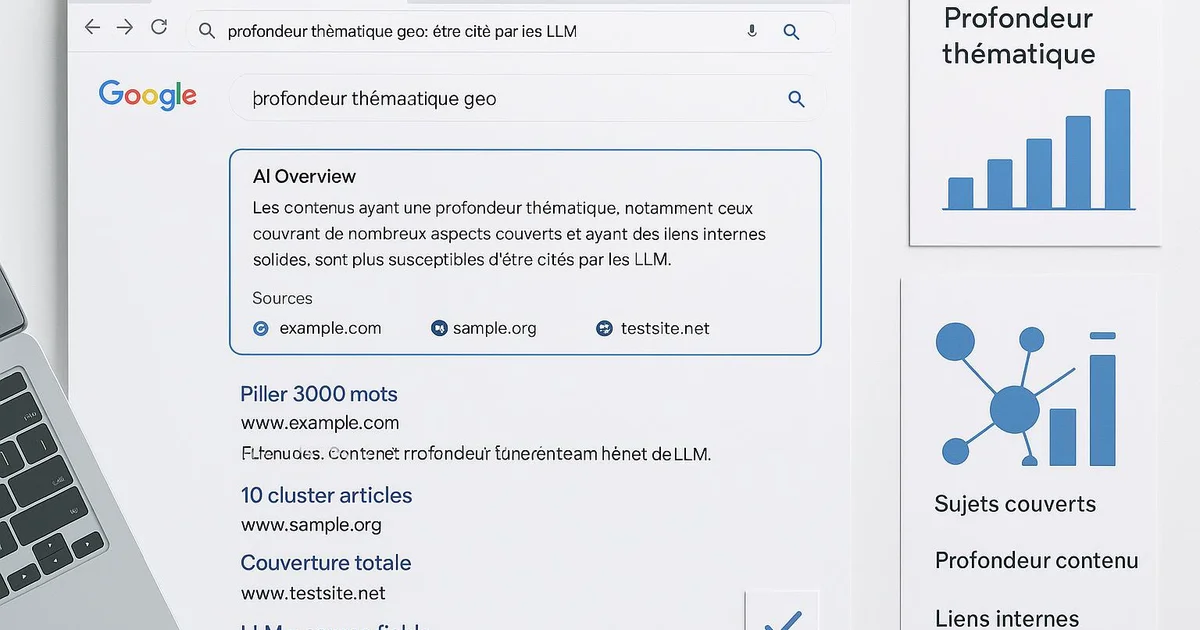
Topical depth refers to the exhaustive coverage of a subject across multiple interconnected pieces of content. In a GEO context, it can contribute to increasing the likelihood that a site is cited by LLMs such as ChatGPT or Perplexity, since these models appear to favor sources that treat a topic comprehensively and coherently.
Generative engines like ChatGPT, Gemini, Perplexity, and Google's AI Overviews don't just list links: they synthesize answers and cite specific sources. The central question of Generative Engine Optimization (GEO) then becomes: why does an LLM choose to cite one site over another? Among the most discussed hypotheses, topical depth holds an important place. A site that covers a topic superficially offers little usable material, whereas a site covering every angle in depth multiplies the opportunities to be identified as a reference. This article analyzes the likely mechanisms behind this phenomenon, compares approaches, and proposes a methodological framework. We'll see how the pillar + cluster structure, used notably by Selfhook, is in some cases one of the most legible depth signals for language models.
Definition
GEO topical depth is the extent to which a site covers all facets of a subject through linked content (pillar and clusters), a signal generally associated with a higher probability of citation by generative engines.
Why does topical depth influence LLM citations?
Large language models are trained and augmented (via retrieval systems) on vast text corpora. When a user asks a question, the engine searches for relevant passages, assesses their apparent reliability, then generates an answer citing certain sources. In this process, a site that treats a topic fragmentarily provides few usable, mutually consistent passages. Conversely, a domain that covers a subject in depth statistically increases the number of available relevant passages, which can contribute to its selection as a source. Several factors appear to play a role, though none is officially confirmed by LLM providers. First, semantic coherence: when multiple pieces of content from the same domain complement one another, they form a set that models may associate with expertise. Next, controlled redundancy: covering a concept from several angles reinforces the signal without falling into duplication. Finally, freshness and regular updates, often cited as criteria observed in empirical tests conducted by the SEO community. Caution is warranted: these mechanisms are largely inferred from observation, not from official documentation. What is measurable, however, is the presence or absence of citations in generated answers, which can be tracked manually or via dedicated tools. The logic remains close to that of topical authority in classic SEO, a concept we detail in our guide on topical authority for WordPress. The difference lies in the fact that the LLM does not rank pages: it selects passages to cite, which shifts the focus toward the informational density of each piece of content.
- Number of relevant passages available across the domain
- Semantic coherence between linked content
- Treatment of a concept from several complementary angles
- Freshness and regular updates observed in tests
Pillar and clusters: the architecture that signals depth
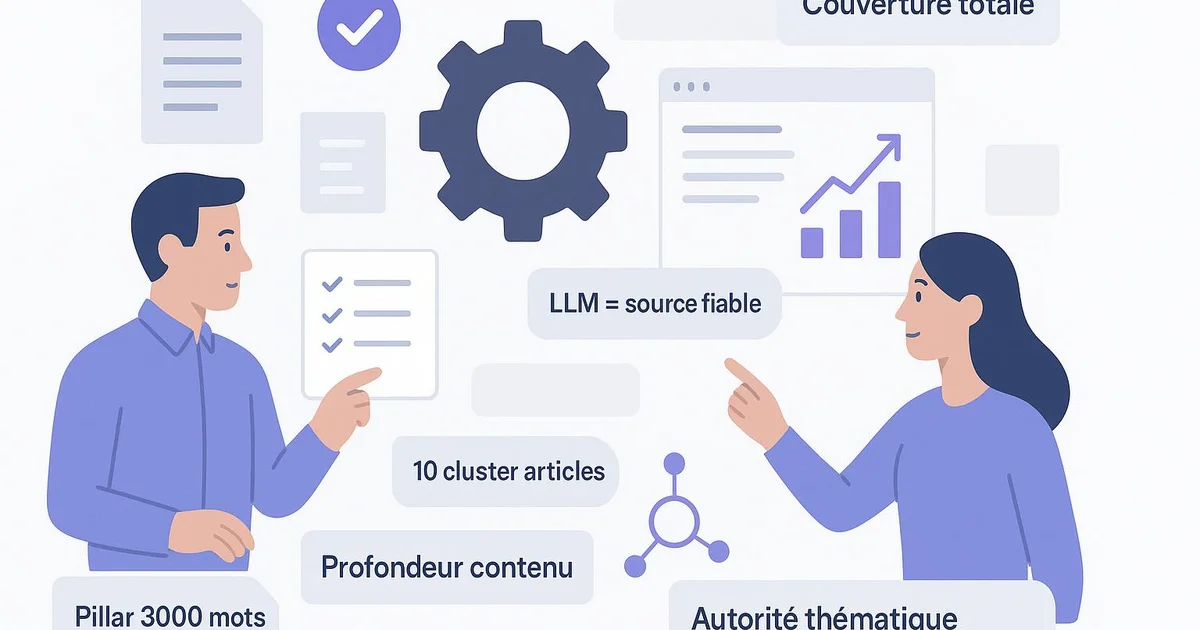
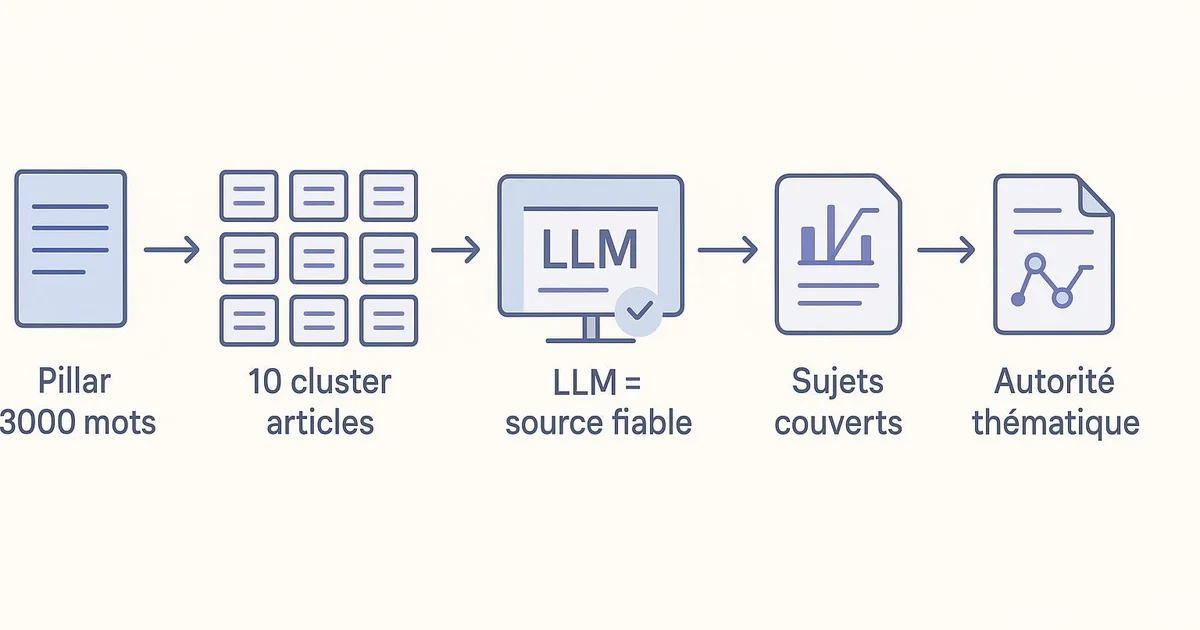
The pillar + cluster structure is currently one of the most discussed approaches to materialize topical depth. The principle is simple: a pillar page addresses a broad subject synthetically, while several cluster articles each develop a precise sub-topic, all interconnected via internal links. This organization, detailed in our topical map SEO guide, creates a linking structure that engines, both classic and generative, may interpret as a signal of comprehensive coverage. For LLMs, this architecture presents several likely advantages. Each cluster article becomes a potential source of citable passages on a precise question, while the pillar serves as a contextual entry point. When a user asks a specific question in Perplexity, for example, a dedicated cluster offers a dense, targeted answer, more likely to be extracted than a paragraph buried in a generalist article. The quality of internal linking also plays a role. Relevant contextual links between pillar and clusters reinforce the readability of the structure. Google Search Console lets you track the evolution of impressions and clicks on this content, while tracking citations in AI answers remains, to date, more artisanal. It would be excessive, however, to claim this structure ensures citations. It constitutes a favorable condition, not a certainty. Depending on the topic, competition, and domain maturity, results vary. A well-built cluster on an otherwise poorly covered topic will, in some cases, have more impact than an exhaustive cluster on a saturated topic. The challenge is therefore as strategic as it is structural: choosing the topics where depth can genuinely make a difference.
- Pillar: synthesis of the broad subject, contextual entry point
- Clusters: dense development of each sub-topic
- Contextual internal linking between pillar and clusters
- Tracking impressions in Search Console
Informational density: what LLMs actually extract
Beyond architecture, the way each piece of content is written influences its ability to be cited. Generative engines extract passages, not entire articles. Text structured into autonomous blocks, with clear definitions, direct answers, and data presented as estimates, offers more usable anchor points. Several format elements are frequently associated with better citability in empirical observations. Explicitly formulated definitions ("X is...") are directly reusable by a model. Short answers at the top of a section function as ready-to-cite excerpts. Structured lists and comparison tables facilitate the extraction of comparisons. Finally, mentioning entities by their exact name — Google, Yoast, Semrush, RankMath — anchors the content in an identifiable context. The nuance is important: informational density does not mean stacking keywords. It means maximizing informational value per unit of text, avoiding filler. A paragraph that states a verifiable fact, nuances it according to the topic, and ties it to a measurable source is more likely to be considered reliable than a generality. This requirement aligns with the principles of Generative Engine Optimization that we develop in our dedicated GEO guide. The consistency between depth (architecture) and density (writing) forms the foundation of a citation strategy. A site can have a perfect pillar + cluster architecture but content too vague to be extracted; conversely, isolated dense content lacks the overall coverage signal. The two dimensions reinforce each other, and it is their combination that, in some cases, appears to maximize the probability of being cited by ChatGPT, Gemini, or Perplexity.
- Explicit definitions reusable as-is
- Direct answers at the top of a section
- Lists and tables facilitating comparison extraction
- Precisely named entities (Google, Yoast, Semrush...)
How do you measure the impact of topical depth?
Measuring the effect of topical depth on LLM citations remains a delicate exercise, since no official dashboard records citations generated by ChatGPT or Perplexity. Measurement therefore combines several partial sources, to be interpreted with caution. The first approach consists of manually testing prompts representative of your topic across different generative engines, at regular intervals, and noting the presence or absence of citations of your domain. This method is artisanal but provides a direct signal. It's useful to standardize questions and keep a dated history to observe a trend, rather than drawing conclusions from an isolated test. In parallel, Google Search Console lets you track impressions and clicks, including for content likely to appear in AI Overviews. A rise in impressions on a recently published cluster may constitute an indirect clue. Tools like Semrush also offer visibility tracking that, in some cases, incorporates signals linked to AI answers. It's essential to reason in terms of trends rather than absolute proof. A correlation between enriching a cluster and the appearance of citations does not establish strict causality, but it guides decisions. Results vary depending on the topic, language, and domain maturity. Finally, it's worth distinguishing two complementary indicators: citation frequency (how often the domain is cited) and the contextual quality of the citation (does the cited passage faithfully reflect the content). Content that is cited but misinterpreted sometimes signals a lack of clarity that needs correcting. This tracking, cross-referenced with Search Console data, gradually helps refine a GEO-oriented topical depth strategy.
- Standardized, dated prompt tests across several engines
- Tracking impressions and clicks in Search Console
- Analyzing the contextual quality of obtained citations
- Reasoning in trends rather than absolute proof
With Selfhook, an agency can cover a topic in depth without producing everything manually. The platform relies on AI content generation structured as pillar + cluster, with each article optimized for Yoast and connected through coherent internal linking, then published automatically to WordPress. Concretely, you define a topical map, and Selfhook generates the dense clusters that feed it, with explicit definitions and citable blocks. This setup builds the topical depth signal that LLMs appear to favor, while keeping performance tracking measurable in Search Console. Depth thus becomes operational rather than theoretical.
Selfhook centralizes content generation, SEO/GEO optimization, WordPress publishing and tracking in a single workflow.
See all features →Topical depth vs isolated content for LLM citations
| Criterion | Pillar + cluster approach | Isolated articles |
|---|---|---|
| Available citable passages | High, spread across content | Limited to a few articles |
| Topical coverage signal | Strong, legible structure | Weak or fragmented |
| Production effort | Higher upfront | Occasional but scattered |
| Tracking in Search Console | Consistent per cluster | Difficult to consolidate |
| Observed citation probability | Generally higher depending on topic | Variable and often lower |
FAQ
Does topical depth ensure being cited by ChatGPT?
No, no method ensures a citation. Topical depth can contribute to increasing the likelihood of being cited, as it multiplies relevant passages and reinforces the coverage signal. Results vary depending on the topic, language, and domain maturity.
How many articles are needed to cover a topic in depth?
There is no fixed number. The goal is to cover the main sub-topics of a subject via a pillar page and several clusters. Depending on the topic, this can range from a few articles to several dozen, with perceived completeness mattering more than raw volume.
How do I know if my content is cited by LLMs?
To date, tracking combines manual prompt tests in ChatGPT, Perplexity, or Gemini, and impression analysis in Google Search Console. No official dashboard centralizes these citations, so you must reason in terms of trends across dated, repeated tests.
Does topical depth replace classic SEO?
No, it extends it. Topical depth is close to topical authority in traditional SEO. It serves both ranking in Google and citability by generative engines, in a complementary rather than substitutive logic.
Key takeaways
Topical depth can contribute to increasing the likelihood of being cited by LLMs, without ever guaranteeing it.
The pillar + cluster structure materializes this coverage signal for classic and generative engines.
The informational density of each piece of content determines what LLMs can actually extract and cite.
Tracking combines dated prompt tests and Search Console data, to be interpreted as trends.
Depth (architecture) and density (writing) reinforce each other.
Operational checklist
Related cluster articles
Automate with Selfhook
Conclusion
Topical depth is emerging as one of the most discussed signals for improving citability by LLMs. It ensures nothing, but it creates favorable conditions by multiplying usable passages and reinforcing a domain's coherence. The combination of a pillar + cluster architecture and dense writing remains, in many cases, the most robust strategy. To operationalize this approach at scale, Selfhook lets you generate structured clusters, optimize them for WordPress, and track their performance in Search Console. Depth then becomes a measurable lever rather than an intention.
Ready to automate your SEO content?
Discover how Selfhook can help you create and publish quality SEO content
Start for free