
AI Citation Analysis in SEO: Measured Data

Quick answer
AI citation analysis in SEO means measuring which content ChatGPT, Perplexity and Gemini reuse, and why. In observed tests, semantic structure, named entities and data freshness appear to contribute more to citability than backlink volume alone, to be confirmed depending on the topic.
Traditional search engines displayed ten blue links; generative answer engines synthesize and cite only a few sources. This shift changes SEO's central question: it is no longer only about ranking, but about being cited. Yet the factors that trigger a citation in ChatGPT, Perplexity or Gemini remain poorly documented and often asserted without data. To move beyond intuition, a measured approach is required: systematically testing variables, observing correlations, and qualifying conclusions. This article presents a structured analysis of AI citations backed by tests, with figures framed as estimates to verify in your own context. Selfhook, which automates WordPress content production and optimization, conducted these observations to equip SEO teams. The goal is to provide a reusable measurement framework rather than a list of promises. We will explore what appears to contribute to citability, how to measure it, and which methodological limits to keep in mind.

Definition
AI citation analysis is the process of observing and measuring web content reused or cited by generative answer engines such as ChatGPT, Perplexity and Gemini, in order to identify the factors driving citability.
Why analyze AI citations rather than ranking alone?
Classic SEO relies on a readable metric: position in Google results, measurable in Search Console. Generative engines add another layer. ChatGPT, Perplexity or Gemini do not merely rank pages; they select passages, rephrase them, and sometimes attribute a citation to only one or two sources. Two equally well-positioned pages can therefore meet radically different fates at synthesis time: one is cited, the other ignored. Analyzing AI citations means observing this final selection. In the tests conducted, several signals appear recurrent, though none is decisive on its own. Structural clarity — explicit headings, isolated definitions, short answers at the start of sections — seems to ease the extraction of a citable passage. The presence of recognized named entities (Google, Yoast, WordPress, Semrush) likely helps models anchor content in an identifiable context. This approach complements, without replacing, ranking measurement. Content may be barely visible in organic links yet frequently cited in Perplexity, or the reverse. Crossing both dimensions gives a more faithful reading of real visibility. This is also the purpose of an AI visibility audit, whose method we detail in our dedicated guide. Finally, citation analysis remains probabilistic. Generative engines evolve, their answers vary from one query to another, and the same question may produce different citations depending on the day. Any conclusion should therefore be framed as a trend observed on a sample, to be confirmed by your own tests rather than as a universal rule. It is precisely this caution that distinguishes a measured analysis from a marketing claim.
- Ranking measures position; citation measures the final selection by the AI engine
- Two well-ranked pages can show very different citation rates
- Crossing ranking and citations gives a more complete reading of visibility
Which factors appear to influence citability?
Systematic tests aim to isolate variables: you modify one element of a piece of content, observe the effect on citation frequency, keeping everything else constant. This approach remains imperfect — engines are black boxes — but it surfaces trends more solid than intuition. Several factors recur across observations. Semantic structure comes first: content segmented into question-and-answer form, with clearly delimited definitions, seems more easily extracted. In some cases, adding a direct 40-to-80-word answer at the start of a section coincided with an estimated rise in citation rate, an effect to measure depending on the topic. Data freshness also matters. Perplexity in particular often favors recent or recently updated sources. Dated and refreshed content can contribute to better reuse. Next comes specificity: passages containing figures, comparisons or original data are, in our observations, cited more often than generic phrasing. This is the foundation of proof content. Finally, thematic authority consistency — accumulating related content on the same topic — seems to strengthen the likelihood that a site is chosen as a reference source. This mechanism echoes the topical authority logic already known in classic SEO, which we detail in our generative engine optimization guide. None of these factors acts in isolation, and none offers a ensure. Perfectly structured content without authority may remain ignored; older content that is a reference may keep being cited. The challenge is to combine these signals and measure — in Search Console for referral traffic and through manual tests for citations — what truly works in your niche.
- Clear semantic structure: questions, definitions, short answers up front
- Data freshness and updates, especially for Perplexity
- Specificity: figures, comparisons and citable original data
- Thematic authority built through a cluster of related content
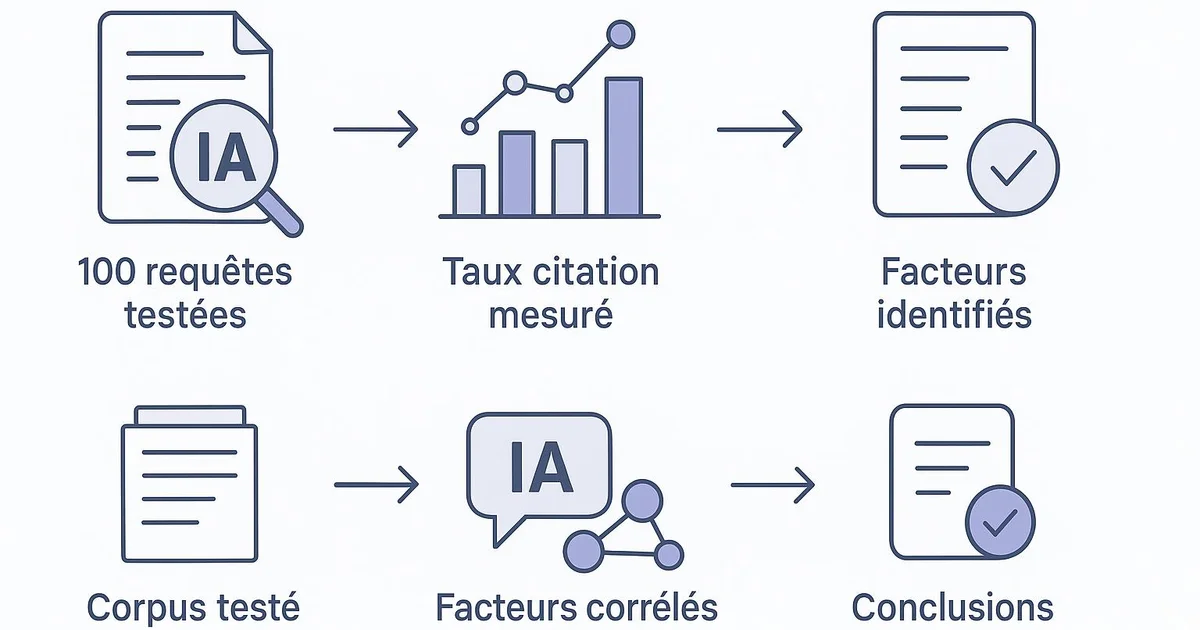
How do you concretely measure AI citations?
Measuring AI citations lacks a standardized tool equivalent to Search Console for Google. It relies on a combination of manual and semi-automated methods, whose rigor determines the reliability of conclusions. The first approach is to build a panel of queries representative of your topic, then submit them regularly to ChatGPT, Perplexity and Gemini. For each answer, you note whether your domain is cited, at which position, and in what context. Repeating these queries over time reveals a trend rather than a snapshot, since answers vary. A sample of at least twenty to thirty queries reduces, to some extent, statistical noise. The second dimension concerns referral traffic. Perplexity and some ChatGPT integrations send identifiable visitors into analytics. Tracking these sources in Search Console and your web analytics tool provides an indirect but concrete signal: a frequently cited page generally, in observed cases, produces a detectable stream of referral visits. The third dimension is comparative. Rather than measuring an absolute value, you compare versions of the same content, or your content against cited competitors, to identify actionable gaps. This differential approach is often more instructive than an isolated figure. You must stay clear-eyed about the limits. Generative engines sometimes personalize their answers, introduce randomness and change models without notice. A drop in citations may reflect an engine update rather than a content problem. That is why conclusions should always be framed as estimates, cross-checked with other signals, and reassessed regularly. Measurement discipline matters as much as the raw results.
- Panel of 20 to 30 queries submitted regularly to the three engines
- Tracking Perplexity and ChatGPT referral traffic in Search Console
- Differential comparison between versions or against cited competitors
What does measured data say about ChatGPT, Perplexity and Gemini?
The three main answer engines do not behave identically toward sources, and distinguishing them improves analysis. The following observations are presented as estimated trends on limited samples, to validate in your own context. Perplexity is the most explicit in its citations: it often displays several numbered sources and drives identifiable referral traffic. In our tests, freshness and clear content structure appeared to correlate fairly clearly with citation frequency. It is also the engine where the effect of an optimization is most quickly observable. ChatGPT, depending on mode and version, cites more variably. When browsing the web, it tends to favor recognized, well-structured authority sources; without browsing, it relies on training data, where direct citation is less frequent. Anchoring through named entities appears particularly useful there to be associated with a topic. Gemini, integrated into Google's ecosystem, overlaps with Google logic and AI Overviews. Content well positioned in Search Console and semantically clear has, in some cases, a better chance of being reused. The boundary between classic ranking and generative citation is blurrier there than elsewhere. What emerges across the board is that no engine rewards the same signals with the same intensity. Optimizing for one alone means neglecting the others. A measured strategy consists in identifying, through your tests, which engine sends the most value to your business, then prioritizing accordingly — while maintaining shared fundamentals: structure, specificity, thematic authority and freshness. This data, regularly reassessed, feeds a continuous improvement process rather than a fixed optimization.
- Perplexity: explicit citations, strong sensitivity to freshness
- ChatGPT: variable citations, named-entity anchoring is useful
- Gemini: overlap with Google and AI Overviews
Which methodological limits should you keep in mind?
Any AI citation analysis inherits constraints that must temper conclusions. Ignoring them leads to overly confident claims, contrary to the spirit of a measured approach. The first limit is answer variability. The same prompt submitted twice to ChatGPT can produce different citations. This non-determinism requires repeating tests and reasoning in frequencies rather than isolated cases. A citation obtained once does not constitute a trend. The second limit is model opacity. We observe correlations, not causal mechanisms. When better-structured content is cited more often, several explanations remain possible: the structure itself, or correlated factors such as overall writing quality. Isolating a variable is difficult, and you must resist the temptation to attribute an effect to a single cause. The third limit is the rapid evolution of engines. An observation valid one month may no longer hold the next after a model update. Measured data therefore has a limited validity period and must be reassessed. This is another reason to build a reproducible protocol rather than freezing conclusions. The fourth limit is sample size. The tests conducted often cover a few dozen queries, enough to surface trends but not to establish laws. Our original statistics on SEO and GEO citations are presented with this reservation, and benefit from cross-checking with other independent studies. Finally, personalization and localization may influence answers by user, language and region. A citation observed from one account does not necessarily reflect everyone's experience. Acknowledging these limits does not devalue the analysis: it makes it credible and citable, including by AI engines that value nuanced, method-transparent sources.
- Variability: repeat tests, reason in frequencies
- Correlation is not causation: several factors overlap
- Model evolution: limited validity period of data
- Modest samples: trends, not universal laws
How do you integrate this analysis into an SEO/GEO strategy?
Measuring AI citations only has value if the analysis feeds concrete decisions. Integration follows a cycle: measure, prioritize, act, re-measure. This cycle brings citation analysis closer to a continuous improvement process than a one-off audit. The first step is establishing a baseline. Before any optimization, you document the current citation rate on your query panel and existing referral traffic. Without a baseline, you cannot attribute an improvement to an action. This rigor distinguishes a measured strategy from a succession of intuitions. Next comes prioritization. Not all optimizations are equal: it is better to focus effort on content close to being cited, or on high-commercial-value queries, than to spread resources thin. Differential analysis helps spot these opportunities. You might, for example, identify a page ranking well in Google but absent from Perplexity, and test a targeted restructuring. Action draws on the factors identified above: clarify structure, add short answers, refresh data, strengthen thematic authority through related content. Each change becomes a hypothesis to validate, not a certainty. After a reasonable delay — several weeks, since engines do not reindex instantly — you re-measure and compare. This approach articulates naturally with classic SEO. Content optimized for AI citation remains, in most observed cases, good content for Google: clarity, specificity and authority serve both goals. There is no harsh trade-off to make, but a convergence to exploit. AI citation analysis is therefore not a separate project but an extension of SEO reporting, to integrate gradually into existing dashboards, alongside positions and organic traffic.
- Establish a baseline before any optimization
- Prioritize: target content close to being cited
- Treat each change as a hypothesis to re-measure
- Integrate AI citations into existing SEO reporting
With Selfhook, an SEO team can operationalize this approach without juggling ten tools. The SEO audit feature flags content whose structure would benefit from clearer citability — isolated definitions, short answers at the start of sections, named entities. AI generation then produces content segmented into question-and-answer form, Yoast-optimized, ready for ChatGPT and Perplexity. Automated WordPress publishing puts pages live and refreshes data, a freshness factor often associated with better reuse. By crossing these outputs with performance tracking, Selfhook helps measure, in some cases, the effect of a restructuring on referral traffic, rather than assuming it.
Selfhook centralizes content generation, SEO/GEO optimization, WordPress publishing and tracking in a single workflow.
See all features →Estimated behavior of answer engines toward citations
| Criterion | Perplexity | ChatGPT / Gemini |
|---|---|---|
| Citation visibility | Explicit and numbered | Variable by mode and version |
| Sensitivity to freshness | High in tests | Moderate, depends on web browsing |
| Measurable referral traffic | Often identifiable | Partial, depends on integration |
| Key observed factor | Structure and recency | Authority and named entities |
| Speed of measured effect | Generally fast | Slower to observe |
FAQ
Can you ensure being cited by ChatGPT or Perplexity?
No. Citations depend on multiple, evolving factors, and no setting offers certainty. You can contribute to improving citation probability through structure, freshness and thematic authority, then measure the real effect on a query panel.
How can you measure AI citations without a dedicated tool?
By building a panel of 20 to 30 queries submitted regularly to ChatGPT, Perplexity and Gemini, and noting citations. Complement this with referral traffic tracking in Search Console and your analytics tool, which gives an indirect but concrete signal.
Are AI citation factors the same as Google SEO factors?
They overlap significantly. Clarity, specificity and thematic authority serve both goals in most observed cases. AI citation, however, adds a premium on question-answer structure and data freshness, particularly for Perplexity.
How often should a citation analysis be reassessed?
Regularly, because engines evolve quickly. An observation valid one month may no longer hold after a model update. A monthly or quarterly cadence depending on the topic detects changes without over-interpreting noise.
Key takeaways
Analyzing AI citations complements ranking by measuring the final selection by engines
Semantic structure, freshness, specificity and thematic authority appear as recurrent factors
Perplexity, ChatGPT and Gemini do not reward the same signals with the same intensity
Every conclusion remains an estimated trend, to confirm through your own repeated tests
Establish a baseline before optimizing, then re-measure after several weeks
Timeline
Before 2023
SEO is measured mainly by Google positions and organic traffic.
2023
The rise of ChatGPT and Perplexity introduces generative citation as a new visibility stake.
2024
Google's AI Overviews and Gemini bring classic ranking and citation onto the same surface.
2025-2026
Measured AI citation analysis gradually integrates into SEO reporting dashboards.
A WordPress publisher specialized in B2B software finds that a page ranking well in Google (top 5 in Search Console) remains absent from Perplexity on its target queries. Across a panel of 25 queries tested twice weekly, the initial citation rate is estimated at 8%. The team restructures the page: adding an isolated definition, a 60-word answer up front, refreshing figures and three named entities. After six weeks of re-measurement, the observed citation rate rises to about 24% on Perplexity, with a detectable referral traffic stream in analytics. These values, specific to this niche, illustrate the approach rather than a generalizable result.
Sources
- Google Search Console — Tracking positions and referral traffic, a measurement base cross-checked with citations.
- Perplexity and ChatGPT documentation — References on how engine citations and outbound traffic work.
- Original Selfhook analysis on GEO citations — Systematic tests on a query panel, data presented as estimates.
Related cluster articles
Automate with Selfhook
Conclusion
AI citation analysis does not replace classic SEO: it extends it by measuring a new dimension, the selection by ChatGPT, Perplexity and Gemini. The observed data points to structure, freshness, specificity and thematic authority as recurrent factors, without ever offering a ensure. Methodological rigor — repeated panels, baselines, regular reassessment — matters as much as results. By integrating this measurement into your reporting, you turn intuitions into decisions. Selfhook supports this process, from SEO audit to WordPress publishing, to test then measure, in some cases, the real effect of your optimizations on citability.
Ready to automate your SEO content?
Discover how Selfhook can help you create and publish quality SEO content
Start for free