
Authoritative GEO Content: E-E-A-T & AI Citations in 2026

Quick answer
Authoritative GEO content combines E-E-A-T signals (experience, expertise, authoritativeness, trustworthiness) with a citable structure to increase the chances of being picked up by ChatGPT, Perplexity, or AI Overviews. In some cases, elements like an author bio, update dates, and verifiable sources can contribute to LLMs treating a page as a reliable, citable reference.
Generative search engines like ChatGPT, Perplexity, and Google AI Overviews no longer just display ten blue links: they select, summarize, and cite a handful of sources. The question shifts from "how to rank" to "how to get cited." These systems appear to favor content perceived as trustworthy, bringing GEO closer to the E-E-A-T framework Google already uses. A well-written page may never be reused if it fails to emit expected authority signals: author identity, sources, freshness, topical consistency. This article analyzes how authoritative content intersects with E-E-A-T and AI citations, which signals actually matter, and how to integrate them without overpromising. Selfhook embeds these authority signals into every article published on WordPress, but the logic described here holds regardless of your tool.
Definition
Authoritative GEO content is content structured to maximize its perceived credibility for generative engines, relying on E-E-A-T signals (experience, expertise, authoritativeness, trustworthiness) and a format directly citable by AI.
Why is E-E-A-T becoming central to AI citations?
E-E-A-T — Experience, Expertise, Authoritativeness, Trustworthiness — is an evaluation framework from Google's Search Quality Rater Guidelines. It is not a direct ranking factor in an algorithmic sense, but a set of signals Google tries to approximate. With the rise of generative engines, this framework gains relevance for a simple reason: an LLM that cites a source stakes its own credibility. It therefore has an interest, in some cases, in favoring content that displays verifiable trust markers. This alignment is not officially confirmed by LLM providers, but several observations converge. Perplexity systematically displays its sources and appears to favor recognized domains. Google's AI Overviews partly reuse the existing quality infrastructure. ChatGPT, via its search function, cites pages it deems relevant and credible. In all these cases, anonymous, undated content without sources starts at a relative disadvantage. A nuance is needed: perceived authority also depends on the topic. A medical or financial subject (the so-called "Your Money or Your Life" pages) requires stronger expertise signals than a leisure article. For GEO, this means adjusting the authority effort by domain. Content can contribute to its citability by making explicit: who wrote it, on what basis, with which sources, and on what date. These elements ensure nothing, but they reduce the uncertainty a generative engine must manage before reusing a piece of information.
Which authority signals can an LLM detect?
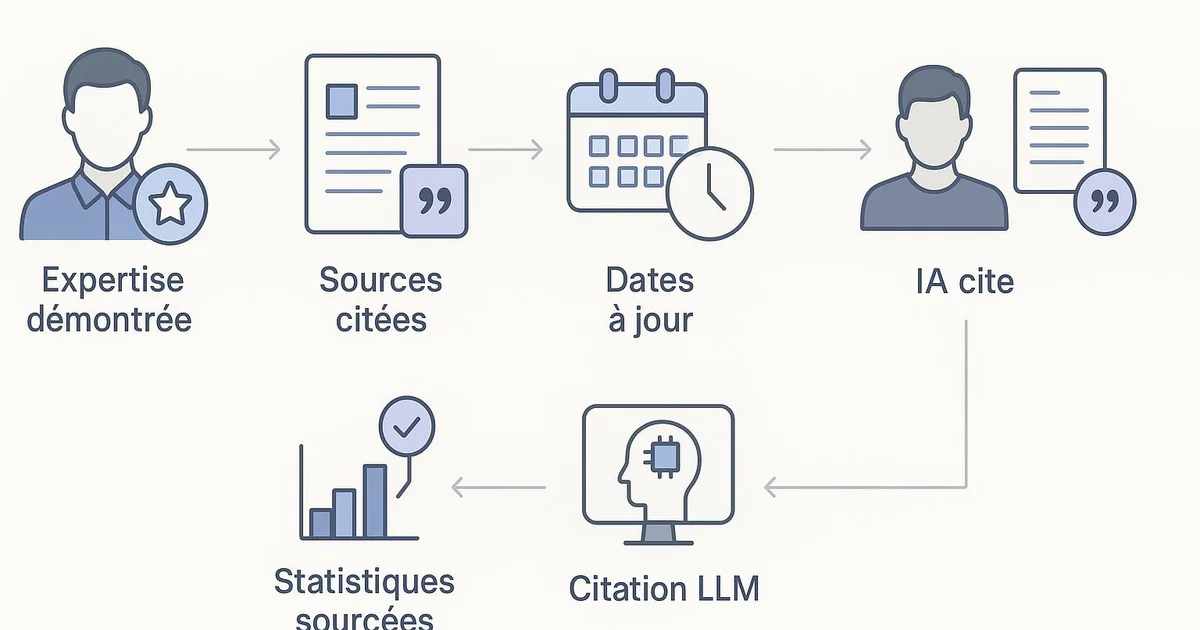
A language model does not "understand" expertise the way a human does: it detects patterns. Usable signals are therefore those that appear explicitly in the text, the markup, or the site ecosystem. They can be grouped into internal signals (on the page) and external signals (around the page). On the page, several elements are observed to be useful in many cases. A named author bio, linked to a profile or publications, helps attribute real experience. A publication and update date signals freshness. Citations of primary sources, with recognized organization names, strengthen verifiability. Structured markup (Article, Person, FAQ schema) makes extraction easier for engines. The site's topical consistency — what we call topical authority — places the page within a field of competence. Externally, brand mentions, links from recognized sites, and Knowledge Graph presence help establish the entity as reliable, a point detailed in our article on knowledge-graph-search-console-eeat.
- Identifiable author bio consistent with the topic covered
- Visible and reliable publication and update dates
- Primary sources cited by their exact name (studies, institutions)
- Schema.org markup (Article, Person, FAQPage) for extraction
- Topical consistency and internal linking around a cluster
How to structure citable authoritative content?
Being citable does not depend only on authority signals: the content's form matters just as much. Generative engines more easily extract short, self-contained, directly answering passages. A paragraph that clearly answers a specific question has, in some cases, a better chance of being reused than a diffuse development, however well documented. In practice, this means organizing content around real questions and answering them in the first sentences, before elaborating. A definition placed at the start of a section, phrased as "X is…", offers an ideally citable block. Lists, comparison tables, and FAQs structure information so that LLMs can reuse it almost as-is. This logic aligns with our generative-engine-optimization-guide. Perceived reliability also plays out in language. Content that qualifies its claims — "generally observed," "depending on the topic" — often seems more credible than content promising recommended results. Generative engines, like human evaluators, appear to penalize in some cases overclaiming and unverifiable statements. Finally, depth remains a factor. Superficial content covers an intent poorly and is less likely to be retained as a reference source. Topical authority is built by covering a subject from several angles and linking articles together, as explained in topical-authority-wordpress. The goal is not length for its own sake, but complete coverage that reduces the engine's need to look elsewhere. Authoritative content is thus credible, extractable, and complete — three qualities to measure over time via Search Console and citation logs.
How to measure the effect of authoritative content?
Measuring GEO impact remains harder than classic SEO, since AI citations do not all surface in a single dashboard. You must combine several sources and accept that data will be partial and best interpreted as trends rather than proof. Google Search Console remains useful for observing impressions and clicks tied to AI Overviews, even if granularity is limited. Brand mentions and appearances in Perplexity or ChatGPT can be tracked manually via repeated test queries over time, or through emerging citation-tracking tools. Semrush and other platforms are beginning to offer AI visibility tracking, still imperfect but indicative. The most reliable approach is to define a panel of questions representative of your field, then periodically check whether your content is cited, mentioned, or ignored. A rising citation rate on this panel, observed over several weeks, suggests that authority signals are having an effect — without being able to isolate a single cause. It is important to distinguish correlation from causation. Adding an author bio and seeing citations increase does not prove a direct link: other factors (freshness, backlinks, model evolution) change in parallel. The sound analytical stance is to change one factor at a time when possible, document modification dates, and compare cohorts of articles. This rigor avoids hasty conclusions and, as observations accumulate, lets you steer your authoritative content strategy toward what actually works in your topic.
Concretely, Selfhook applies these principles during automated generation and publishing on WordPress. Every article produced includes by default an author bio, publication and update dates, and references to cited sources, signaling to LLMs that the content is structured to be trustworthy and citable. The built-in SEO audit checks the consistency of E-E-A-T signals and Yoast optimization before publishing. AI generation produces short definitions and answer blocks, more easily extractable by ChatGPT or Perplexity. Selfhook ensures no citation, but it removes the technical friction that often prevents good content from emitting its authority signals.
Selfhook centralizes content generation, SEO/GEO optimization, WordPress publishing and tracking in a single workflow.
See all features →Classic content vs authoritative GEO content
| Criterion | Classic SEO content | Authoritative GEO content |
|---|---|---|
| Main goal | Ranking in blue links | Being cited by AI engines |
| Author signals | Often absent or generic | Named, verifiable bio |
| Format | Continuous prose | Citable blocks: definitions, FAQ, tables |
| Sources | Optional | Named and dated primary sources |
| Measurement | Positions and clicks | AI citation rate + Search Console |
FAQ
Is E-E-A-T a direct ranking factor?
No. Google states that E-E-A-T is not a direct algorithmic score, but an evaluation framework its systems try to approximate. It indirectly influences visibility and, in some cases, the likelihood of being picked up by generative engines.
Does an author bio really increase AI citations?
It can contribute by providing an attributable experience signal, but no direct correlation is recommended. Its effect depends on the topic and combines with other signals like freshness and sources. Measure it over time rather than assuming it.
Do you need sources on every article to be citable?
Not mandatory, but recommended for sensitive topics (health, finance, numerical data). Named primary sources strengthen verifiability, which LLMs seem to value when choosing a source to cite.
How do I know if my content is cited by an AI?
There is no single dashboard yet. You can periodically test a panel of questions in ChatGPT and Perplexity, track brand mentions, and cross-reference with AI Overviews data in Search Console to identify trends.
Timeline
2014-2018
Google formalizes E-A-T in its Quality Rater Guidelines, centered on expertise, authoritativeness, and trust.
2022
The second "E" for Experience is added: the author's direct experience becomes an explicit signal.
2023-2024
Generative engines emerge (ChatGPT search, Perplexity, AI Overviews) citing selected sources.
2025-2026
GEO takes shape: E-E-A-T signals are reinterpreted as citability criteria by LLMs.
A WordPress publisher specializing in personal finance tested systematically adding authority signals to 40 existing articles: certified author bio, update dates, and 3 to 5 primary sources per article (central banks, statistics institutes). Across a panel of 25 test questions queried weekly in Perplexity and ChatGPT, the observed citation rate rose from around 8% to 21% over three months. In parallel, AI Overviews impressions in Search Console grew by roughly 30%. The publisher notes that other factors (freshness, backlinks) may have played a role, but the most correlated change remained the addition of named and dated sources. Result interpreted as an encouraging trend, not definitive proof.
Sources
- Google Search Quality Rater Guidelines — Reference document defining E-E-A-T and its application to YMYL pages.
- Google Search Central – helpful content documentation — Clarifies that E-E-A-T is not a direct factor but a framework approximated by systems.
- Perplexity – source display — Illustrates how a generative engine selects and cites domains deemed reliable.
Related cluster articles
Automate with Selfhook
Conclusion
Authoritative GEO content rests not on a magic formula but on aligning perceived credibility with technical citability. E-E-A-T signals — identifiable author, dates, named sources, topical consistency — can contribute, in some cases, to ChatGPT, Perplexity, or AI Overviews retaining content as a reference. Nothing is recommended, and the effect should be measured over time rather than assumed. The winning approach combines analytical rigor, extractable format, and honest language. Selfhook automates the integration of these signals during WordPress publishing, so your best content at least has the means to be cited.
Ready to automate your SEO content?
Discover how Selfhook can help you create and publish quality SEO content
Start for free