
GEO vs SEO: Differences, Synergy and Strategy for 2026

Quick answer
GEO (Generative Engine Optimization) optimizes content to be cited by AI engines like ChatGPT, Perplexity and AI Overviews, while SEO targets rankings in classic Google results. Both approaches are complementary: SEO works visibility in blue links, GEO works presence in generative answers. In 2026, combining them is generally recommended.
Since the rise of ChatGPT, Perplexity and AI Overviews in Google, one question keeps coming up among freelancers and agencies: should you abandon SEO for GEO? The reality is more nuanced. SEO (Search Engine Optimization) remains the foundation of organic visibility, but GEO (Generative Engine Optimization) addresses a new behavior: users now ask questions directly to AI engines and receive synthesized answers. These two disciplines do not compete, they reinforce each other. Content well structured for Google often has a better chance of being cited by an AI, and vice versa. The challenge is not to choose, but to integrate both logics into a single editorial workflow. This is exactly what Selfhook enables, optimizing every article published on WordPress for both classic search and generative engines. This article compares GEO vs SEO in detail to help you build a coherent strategy.
SEO vs GEO: two goals, two mechanics
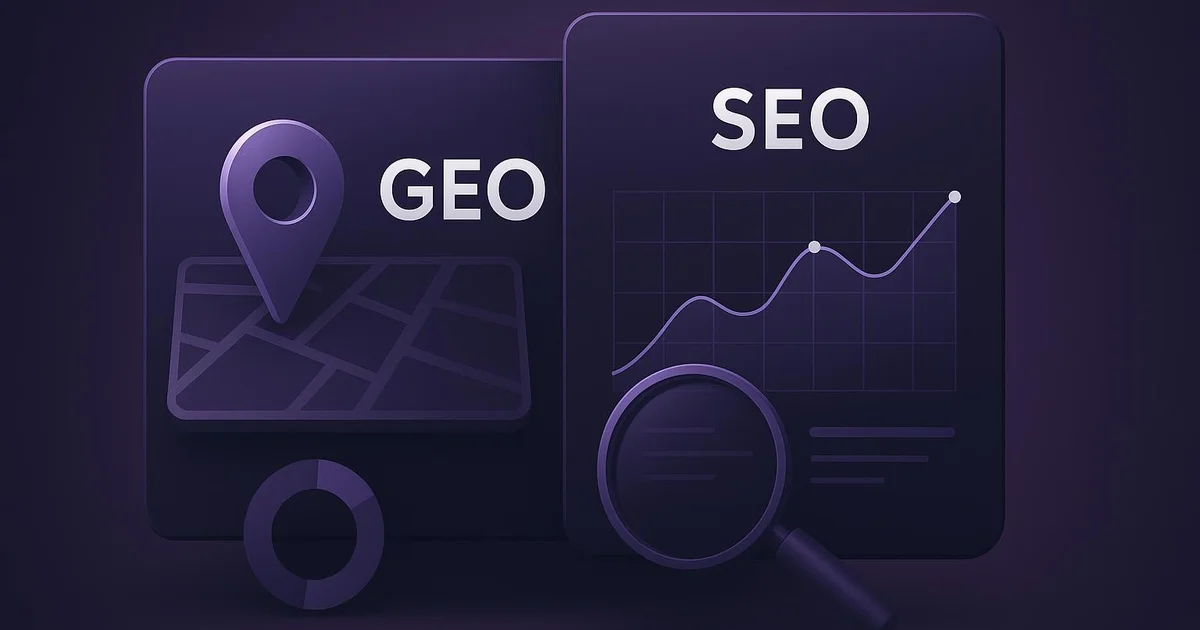
SEO aims to position a page as high as possible in organic search results. It relies on well-known signals: keyword relevance, content quality, technical structure, backlinks and user experience. The end goal is the click to your site. GEO, on the other hand, aims for your content to be selected and cited by AI engines when they generate an answer. Here, the click is no longer systematic: the AI can summarize your information directly. The observed signals partly differ: factual clarity, question-answer structure, source citations, and topical authority appear to play a role. In some cases, a page with low SEO visibility can be cited by an AI, and vice versa.
- SEO: ranking and click goal in Google
- GEO: citation goal in AI answers
- SEO: backlink signals and domain authority
- GEO: factual clarity and citable structure
GEO vs SEO: what truly overlaps
Despite their differences, GEO and SEO share a common foundation that many underestimate. Quality content, structured and reliable, generally performs well in both cases. AI engines rely largely on the existing web index: well-ranked content therefore often has a better chance of being spotted and cited. Classic best practices still apply: hierarchical headings, semantic markup, structured data, speed and readability. Topical authority, already essential in SEO, becomes a central asset in GEO because AIs favor sources that cover a topic in depth. Rather than a break, GEO extends SEO by adding a layer of optimization designed for answer generation.
- Editorial quality and factual reliability
- Clear heading structure and semantic markup
- Structured data (FAQ, Article, HowTo)
- Topical authority over a content cluster

Do you have to choose between GEO and SEO in 2026?
The question of an exclusive choice between GEO and SEO is poorly framed. Classic Google searches still generate a major share of traffic for most sites, to be measured in Search Console depending on your topic. But the share of queries handled by AI answers is growing, and neglecting GEO can mean disappearing from these new visibility surfaces. The strategy observed as the most solid is to design each piece of content for both uses. An article that clearly answers an intent, offers concise citable answers, and fits within a topical authority, can contribute to both Google ranking and citation by AIs. The marginal cost of optimizing for both is low when the approach is integrated from production.
- Measure the share of AI traffic vs classic organic
- Prioritize content with dual potential
- Integrate GEO and SEO into a single workflow
- Track evolution in Search Console and AI tools
How to combine GEO and SEO concretely
Combining both approaches starts with the editorial brief. Identify the search intent, then structure the content to answer it directly: a quick-answer paragraph at the start of the article helps AIs extract the essentials while improving user experience. Then optimize classic SEO elements with a tool like Yoast (title, meta, internal linking, keywords). Add a structured FAQ, clear lists and data presented as estimates to strengthen GEO citability. Finally, build topical authority by covering a complete cluster: see our geo-wordpress and topical-authority-wordpress guides. This integrated approach avoids producing twice and maximizes the chances of visibility across all channels.
- Write a citable quick answer at the start of the article
- Optimize title, meta and internal linking with Yoast
- Add FAQ and structured data
- Cover a cluster for topical authority
Imagine a freelance SEO publishing an article on 'How to choose a CRM'. In a SEO-only version, they target the keyword, structure their headings and work on internal linking: in Search Console, after a few weeks they observe growing impressions on long-tail queries. By adding a GEO layer — a 60-word quick answer in the intro, a structured FAQ, a factual comparison table — they notice their article starting to appear as a cited source in Perplexity and in some AI Overviews. Organic traffic grows, but above all the brand gains presence on AI surfaces. This dual effect, hard to achieve with a single approach, illustrates the value of thinking GEO and SEO together from the writing stage.
With Selfhook, you don't have to choose between GEO and SEO. Every generated article is structured to directly answer the search intent (quick answer, FAQ, structured data) while respecting classic Yoast optimizations: title, meta description, keywords and internal linking. Selfhook then publishes directly to WordPress and organizes your content into clusters to strengthen topical authority, a signal valued by both Google and AI engines. Concretely, a single workflow produces content designed for blue links and for AI citations, whose performance you track in Search Console to adjust your strategy depending on your topic.
Key takeaways
SEO targets ranking and clicks, GEO targets citation by AIs
Both approaches share a common base: quality content and clear structure
Topical authority strengthens both SEO and GEO simultaneously
Combining GEO and SEO from production has a low marginal cost
Measure the share of AI vs organic traffic in Search Console and AI tools
Selfhook centralizes content generation, SEO/GEO optimization, WordPress publishing and tracking in a single workflow.
Discover Selfhook →FAQ
Will GEO replace SEO?
Nothing indicates a replacement in the short term. Classic search still generates a significant share of traffic for most sites. GEO adds a layer of visibility on AI engines. In most cases, both approaches coexist and reinforce each other.
What is the main difference between GEO and SEO?
SEO optimizes for ranking in search results and the click to your site. GEO optimizes for your content to be cited in answers generated by AIs like ChatGPT or Perplexity, where a click is not always necessary.
Is SEO-optimized content already good for GEO?
Partially. Quality SEO content provides a good base, as AIs rely on the web index. But GEO requires additional adjustments: concise citable answers, structured FAQs and reinforced factual clarity.
How do you measure GEO results?
GEO tracking is less direct than SEO. You can observe citations in Perplexity, test your queries on AI tools, and monitor traffic and impression evolution in Search Console. Measurement methods are still evolving.
Do you need two distinct content strategies?
No, in most cases an integrated strategy is more effective. Designing each piece of content for both uses avoids duplicating work and maximizes visibility chances on both Google and AI engines.
Operational checklist
Related articles in this cluster
Conclusion
Pitting GEO against SEO is a false trail: these two disciplines address different search behaviors but rest on common foundations. In 2026, the most solid strategy is to integrate both from the content production stage, rather than choosing. Clear, structured content with authority on its topic can contribute to both Google ranking and AI citation. This is exactly Selfhook's logic: generating and publishing on WordPress articles optimized simultaneously for classic search and generative engines, with performance tracking to adjust depending on your topic.
Ready to automate your SEO content?
Discover how Selfhook can help you create and publish quality SEO content
Start for free