
LLM Crawlability and robots.txt: SEO for the AI Era
Quick answer
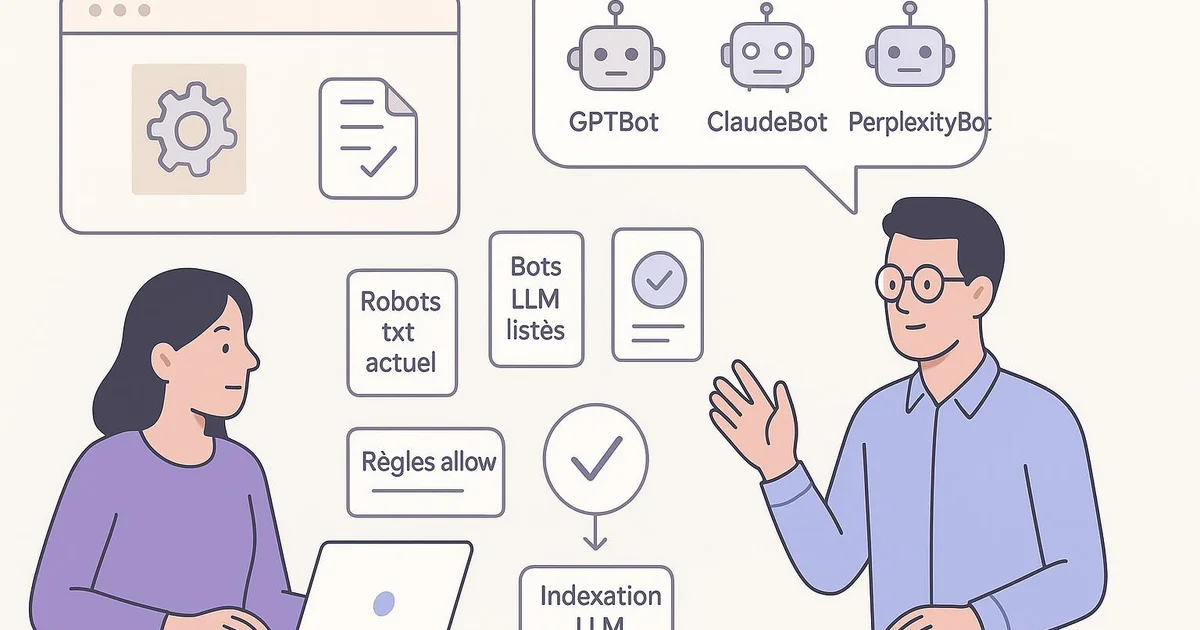
LLM crawlability refers to the ability of AI bots (GPTBot, ClaudeBot, PerplexityBot) to access your pages through the robots.txt file. Allowing these agents can contribute to having your content indexed by language models and cited in generative answers, whereas blocking them limits that visibility in certain cases.
The robots.txt file long served to guide traditional search crawlers like Googlebot. Since the rise of generative engines, a new category of agents has appeared: OpenAI's GPTBot, Anthropic's ClaudeBot and PerplexityBot. Their presence raises a strategic question for any WordPress publisher: should you allow or block them? The answer depends on the topic, the business model and visibility goals. Blocking these bots protects content from training use, but it also reduces, in certain cases, the chances of being cited in ChatGPT, Perplexity or Gemini. Conversely, an open configuration can contribute to strengthening presence in generative answers. This article analyzes how these agents work, the trade-offs involved and how a tool like Selfhook verifies that your robots.txt does not unintentionally hinder indexing by LLMs.
Definition
LLM crawlability is the ability of language-model crawlers to access, read and index a website's pages, an accessibility largely determined by the directives in the robots.txt file.
How do LLM bots interpret robots.txt?
Language-model crawlers, in theory, follow the robots exclusion protocol just like traditional crawlers. Each agent identifies itself with a specific user-agent: GPTBot for OpenAI, ClaudeBot and anthropic-ai for Anthropic, PerplexityBot for Perplexity, and Google-Extended for Google's generative use of Gemini. The robots.txt file, placed at the domain root, tells each one what it may crawl through Allow and Disallow directives. However, two often-confused uses must be distinguished. Some bots crawl for model training, others retrieve content in real time during a user query — as Perplexity does when it cites a source. Blocking a user-agent can therefore have different effects depending on its function. One point deserves attention: compliance with robots.txt relies on the declared goodwill of LLM providers, and its observed enforcement varies across actors. Finally, a poorly written directive — a global Disallow accidentally applied to all user-agents — can close access without explicit intent. It is precisely this kind of configuration error that, in certain cases, deprives a site of citations in generative engines without the publisher being aware. Regular verification, cross-checked with server logs, remains the most reliable method to understand who actually accesses the content.
- GPTBot — OpenAI's crawler for training and retrieval
- ClaudeBot / anthropic-ai — Anthropic's agents
- PerplexityBot — crawling tied to Perplexity's cited answers
- Google-Extended — control over generative use on Google's side
Should you allow or block AI crawlers?
The trade-off between openness and blocking has no universal answer: it depends on the site's topic and visibility strategy. For a publisher aiming at topical authority and seeking to be cited in generative answers, allowing GPTBot, ClaudeBot and PerplexityBot can contribute to strengthening the brand's presence in ChatGPT or Perplexity. This logic fits a generative engine optimization approach, where content citability becomes a goal in itself, complementary to classic SEO measured in Search Console. Conversely, a site whose content is its core asset — proprietary databases, paid content, original works — may legitimately wish to block training use to preserve its value. The essential nuance: blocking a training bot does not necessarily mean disappearing from real-time answers, since some agents separate the two uses. In practice, many publishers adopt an intermediate stance, allowing citation-related retrieval while monitoring how providers' policies evolve. It is also prudent to document each choice and review it periodically, because the landscape of user-agents changes quickly — new crawlers appear, and existing actors modify their declared behavior. A configuration frozen today may, within a few months, no longer match the observed realities of bot traffic. The decision is therefore best treated as a living parameter rather than a permanent setting.
How to optimize LLM crawlability beyond robots.txt?
Allowing the bots is not enough: the content must also be technically accessible and structured to be usable. LLM crawlability relies on several levers that extend familiar SEO best practices. First, an up-to-date XML sitemap helps agents discover all relevant URLs, something an automatic sitemap generation facilitates far better than manual maintenance. Next, HTML clarity matters: server-rendered content with semantic tags and structured data is generally easier to interpret than content injected by JavaScript after loading. Language models also value editorial structure — explicit headings, concise definitions, direct answers at the start of a section — because these elements make it easier to extract citable passages. This is the very principle of optimizing content for LLMs: making each paragraph self-contained and understandable out of context. Loading speed and the absence of 4xx or 5xx errors also matter, just as for Googlebot, since a bot that repeatedly encounters errors reduces its crawl frequency in certain cases. Finally, consistency between robots.txt, page-level meta robots tags and X-Robots-Tag HTTP headers prevents contradictory signals. A page allowed in robots.txt but marked noindex sends an ambiguous message. Effective optimization therefore consists of aligning all these signals to give AI crawlers a clear access path and directly usable content.
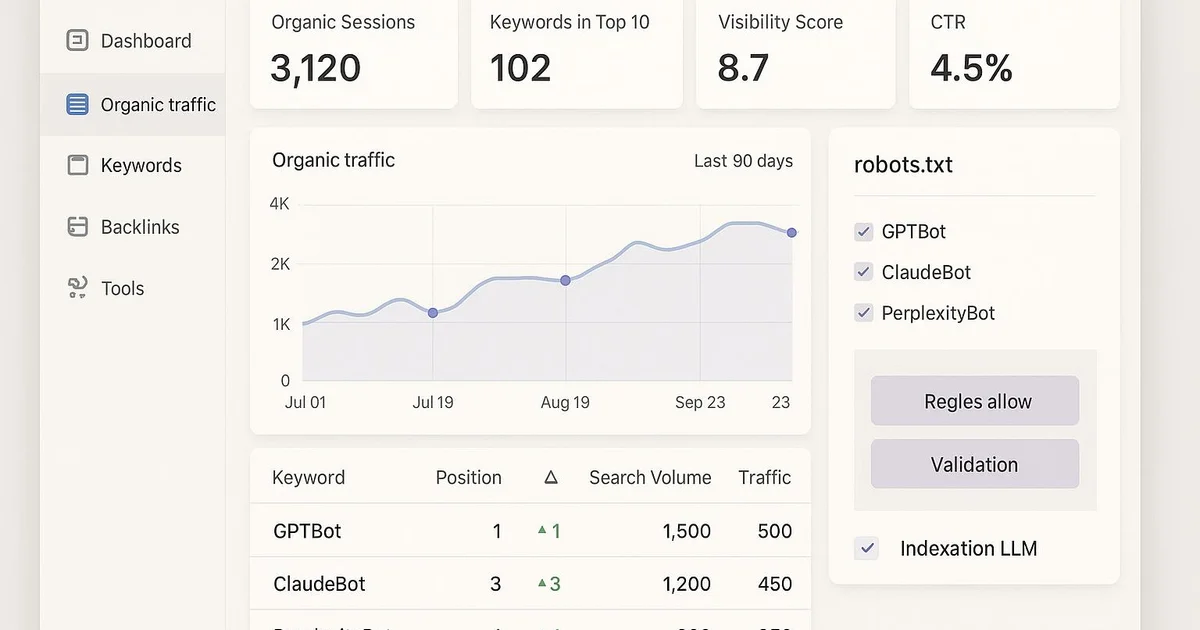
Selfhook includes an automatic robots.txt check as part of its technical SEO audit. With every automated WordPress publication, the tool verifies that the main LLM user-agents — GPTBot, ClaudeBot and PerplexityBot — are not blocked unintentionally, and flags Disallow directives likely to limit generative indexing. Combined with AI content generation optimized for citability and the production of an up-to-date XML sitemap, Selfhook thus helps align technical accessibility with editorial quality. The goal is not to ensure a citation, but to remove the configuration obstacles that, in certain cases, prevent relevant content from being discovered by generative engines.
Selfhook centralizes content generation, SEO/GEO optimization, WordPress publishing and tracking in a single workflow.
See all features →Timeline
Before 2023
robots.txt mainly serves to guide Googlebot and Bingbot in a classic search-engine logic.
Mid-2023
OpenAI documents GPTBot and publishes its user-agent, enabling explicit control over access to training content.
Late 2023
Google introduces Google-Extended to separate generative use from classic search indexing.
2024-2025
Anthropic and Perplexity clarify their agents, and the distinction between training crawl and real-time retrieval becomes a strategic issue.
2026
LLM crawlability becomes part of routine SEO audits, treated as a living parameter to monitor regularly.
An agency managing a WordPress media site observed an almost complete absence of citations in Perplexity despite strong rankings in Search Console. The audit revealed a Disallow accidentally applied to all user-agents in robots.txt, inherited from an old staging environment. After correction — explicitly allowing GPTBot, ClaudeBot and PerplexityBot, and regenerating the XML sitemap — server logs showed these agents resuming crawling within about ten days. Over the following six weeks, the team observed an estimated increase in the domain appearing as a cited source in Perplexity, to be confirmed over a longer period. The example illustrates how a simple configuration flaw can neutralize an entire GEO strategy.
FAQ
Does blocking GPTBot prevent appearing in ChatGPT?
Blocking GPTBot can limit OpenAI's exploration of your content, which reduces in certain cases the chances of being used or cited. The effect, however, depends on the bot's function, between training and retrieval, and on the agent's actual compliance with robots.txt.
Is robots.txt really respected by LLM bots?
Compliance with robots.txt relies on the declared goodwill of LLM providers. Major actors like OpenAI and Anthropic claim to follow it, but observed enforcement varies. Cross-checking the directives with server logs remains the most reliable verification method.
What is the difference between Google-Extended and Googlebot?
Googlebot handles indexing for classic search, while Google-Extended controls the use of content for generative features like Gemini and AI Overviews. Blocking one does not necessarily affect the other.
Should all LLM bots be allowed by default?
It depends on the topic and business model. A site seeking generative visibility generally benefits from allowing them, while a site with proprietary content may prefer to restrict training use. The decision is best reviewed regularly.
Related cluster articles
Reference guides
Automate with Selfhook
Conclusion
LLM crawlability extends classic technical SEO into the era of generative engines. robots.txt remains a central control point: poorly configured, it can deprive relevant content of any visibility in ChatGPT, Perplexity or Gemini, often without the publisher realizing it. The recommended approach is to treat bot permissions as a living parameter, align all technical signals and measure effects over time rather than freezing a configuration. By automating robots.txt verification, sitemap generation and editorial optimization, Selfhook helps remove the obstacles that limit, in certain cases, the discovery of your content by language models.
Ready to automate your SEO content?
Discover how Selfhook can help you create and publish quality SEO content
Start for free