
Semantic Search Optimization: SEO and AI in the Semantic Era
Quick answer
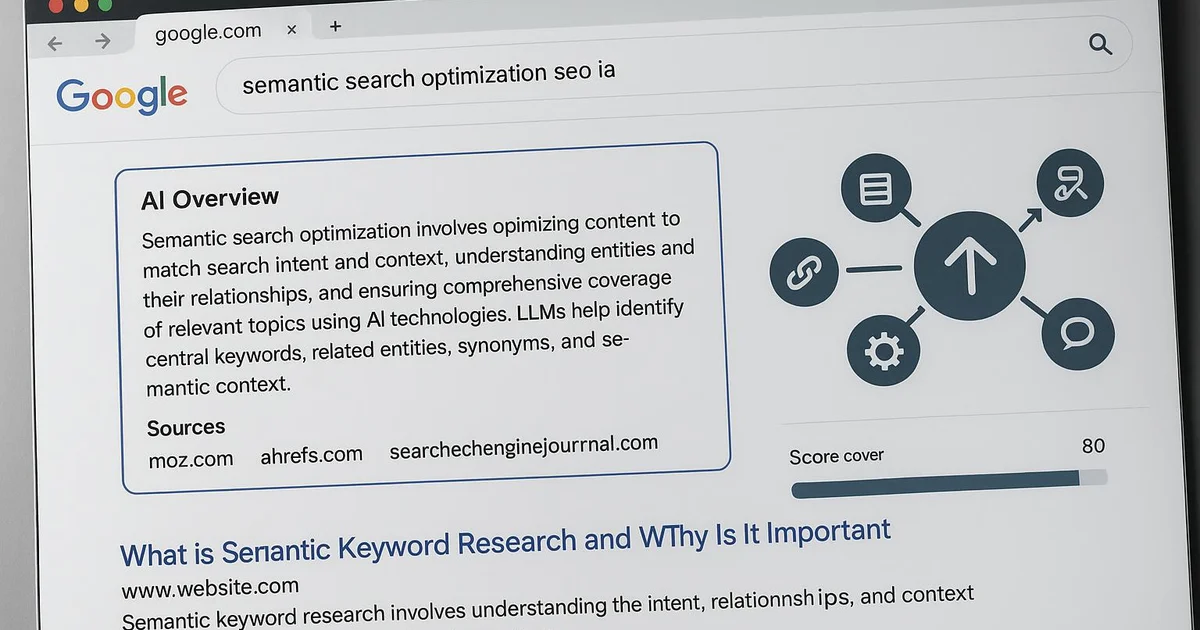
Semantic search optimization means optimizing content for meaning rather than exact keyword matching. It relies on entities, full topical coverage, and context—signals that Google and AI engines like ChatGPT or Perplexity process through embeddings. In some cases, it can contribute to improved visibility.
In just a few years, search has fundamentally changed. Google gradually moved away from purely lexical indexing toward models like BERT and MUM, while ChatGPT, Gemini, and Perplexity rely entirely on vector representations of language. The result: ranking well for an exact phrase is no longer enough. What matters now is a text's ability to demonstrate deep, comprehensive coverage of a topic. Semantic search optimization addresses exactly this need. It structures content around entities, vocabulary, and associated intents so it can be understood—and potentially cited—by both traditional and generative engines. For SEO teams, agencies, and WordPress publishers, this is a paradigm shift. Tools like Selfhook, which use embeddings to verify the semantic coverage of an article, fit squarely into this logic. This guide details the principles, signals, and concrete methods to apply.
Definition
Semantic search optimization is the set of practices aimed at aligning content with how search engines and AI models interpret meaning, context, and relationships between entities, rather than simple keyword density.
What is semantic search and why does it redefine SEO?
Semantic search refers to an engine's ability to understand the real intent behind a query rather than merely matching character strings. The classic example is a search like "best spot to watch the sunset near me": no exact keyword ensures relevance—what matters is understanding the geographic, temporal, and thematic context. Google began this shift in 2013 with Hummingbird, then accelerated it with RankBrain, BERT, and MUM. These models turn text into mathematical representations—embeddings—that capture meaning. Two phrases expressing the same idea with different words end up close together in this vector space. This is exactly the mechanism ChatGPT, Gemini, and Perplexity also use to select and synthesize their answers. For SEO, this evolution has several generally observed consequences. It reduces the value of keyword stuffing, which can even be harmful. Instead, it rewards comprehensive coverage of a topic, including the peripheral notions a reader expects. It strengthens the role of named entities—people, places, concepts, brands—that engines link together in a knowledge graph. An article about semantic search should naturally mention embeddings, the knowledge graph, search intent, or natural language processing. The link to topical authority is direct: a site that covers a domain thoroughly and coherently sends a strong relevance signal, to be measured in Search Console over time. This approach aligns with our guide on generative engine optimization, since AI engines apply the same semantic logic.
- Understand intent rather than exact words
- Turn text into embeddings to capture meaning
- Link entities within a knowledge graph
- Reward comprehensive topic coverage
How do you optimize content for semantic search?
Optimizing for semantic search doesn't mean abandoning SEO fundamentals, but shifting the center of gravity from the keyword to the topic. The first step is mapping the full vocabulary of a theme. Before writing, you need to identify the concepts, sub-questions, entities, and related terms that a reader—and an engine—expect to find. Tools like Semrush, along with analyzing Google's "People Also Ask," help build this map. Next comes structure. Semantically rich content is organized into clear sections, each answering a facet of the intent. H2 headings phrased as questions, explicit definitions, and well-built lists make extraction easier for engines. Yoast and RankMath, on WordPress, help refine structure and readability, even though their analysis remains partly lexical. Mentioning named entities is a central lever. Citing Google, ChatGPT, Perplexity, or precise concepts by their exact name strengthens your content's connection to the knowledge graph—a point we expand on in our article about named entities and GEO visibility. The goal isn't to sprinkle them artificially, but to integrate them where they make sense. Finally, cross-content consistency matters. Thematic internal linking, connecting articles within the same cluster, reinforces the perception of expertise. In some cases, this approach can contribute to a stronger presence in AI Overviews and Perplexity responses. A few concrete practices to apply:
- Map the vocabulary field before writing
- Structure in sections answering each facet of intent
- Cite named entities by their exact name
- Build consistent thematic internal linking
- Measure impact in Search Console over time

Embeddings and semantic coverage: the signals that matter
At the heart of semantic search are embeddings, the vector representations that place each word, phrase, or document in a space of meaning. Understanding this mechanism helps grasp what engines actually value. When a model like Google's or ChatGPT's analyzes content, it doesn't count keyword occurrences: it evaluates the semantic proximity between your text and the query's intent. Concretely, this means an article that covers a topic in its full breadth—addressing expected concepts, nuances, and associated terms—generally earns a stronger relevance signal than a text mechanically repeating a phrase. This is called semantic coverage, or semantic completeness. It's one of the most interesting indicators to monitor in the era of generative engines. Several signals contribute to this coverage: the presence of interconnected entities, controlled vocabulary variety, handling of sub-intents, and overall document coherence. Conversely, content that is too short or too superficial may seem incomplete to a model, even if it contains the main keyword. For generative engines, citability becomes a distinct objective. Perplexity and Google's AI Overviews select specific passages to quote. A self-contained, factual, well-delimited paragraph has a better chance of being reused. This logic aligns with our guide on optimizing content for LLMs. It's important to stay measured: no method ensures systematic citation. Algorithms evolve, and results vary by theme and competition. The semantic approach increases the likelihood of being understood and retained, without ever being a certainty. It's a statistical improvement, to be validated by observing your own data.
Semantic search optimization and AI engines: what are the differences?
Google's traditional semantic search and generative engines like ChatGPT, Gemini, or Perplexity share the same technological foundation—embeddings—but differ in their end use. Google still displays a list of links, now complemented by AI Overviews that synthesize multiple sources. ChatGPT and Perplexity, by contrast, produce a written answer directly, sometimes citing the sources used. This difference has practical implications. For Google, semantic optimization targets both classic ranking and selection in AI Overviews. For generative engines, the goal is to be identified as a reliable, citable source at the moment the model builds its answer. This is called generative engine optimization (GEO), a neighboring but distinct field we detail in a dedicated guide. In both cases, the same core principles apply, with different emphases. Factual clarity becomes paramount for LLMs, which favor verifiable statements and direct phrasing. Question-and-answer structuring facilitates extraction. The presence of recognized entities strengthens perceived credibility. And information freshness plays a growing role, with Perplexity, for instance, paying particular attention to recent content. One point deserves attention: AI engines don't always reveal why they cite one source over another. The signals remain partly opaque, which calls for an experimental approach. Test, measure the share of referral traffic from these engines, and adjust gradually. For SEO teams and agencies, this means designing content that works on both fronts simultaneously. A semantically complete, well-structured, entity-rich article has, in many cases, a better chance of being both ranked by Google and cited by a generative engine—without that ever being recommended.
- Google: classic ranking + AI Overviews
- ChatGPT and Perplexity: written answers with citations
- LLMs: priority on factual clarity and entities
- Experimental approach essential given opaque signals
With Selfhook, semantic coverage isn't left to chance. During content generation, the tool uses embeddings to compare the produced article against the full expected vocabulary for the topic, and flags missing notions or entities. Concretely, a WordPress publisher can generate an article, verify through the SEO audit that key concepts—intent, entities, sub-questions—are well covered, optimize the Yoast-compatible structure, then publish automatically to WordPress. This approach aims to strengthen the semantic signal sent to Google and AI engines. Results should still be measured in Search Console depending on the theme, but the method reduces the risk of incomplete content.
Selfhook centralizes content generation, SEO/GEO optimization, WordPress publishing and tracking in a single workflow.
See all features →Timeline
2013 — Hummingbird
Google introduces an engine able to interpret the overall meaning of a query, beyond individual words.
2015-2019 — RankBrain & BERT
Machine learning and language models strengthen contextual understanding of queries.
2021 — MUM
Google unifies text, languages, and modalities to answer complex intents with greater semantic finesse.
2023-2024 — Generative engines
ChatGPT, Gemini, and Perplexity establish conversational search based on embeddings and source citation.
2025-2026 — GEO & unified semantics
Semantic optimization converges toward a practice shared by classic SEO and AI engines.
Sources
- Google Search Central — Official documentation on BERT, MUM, and content quality principles.
- Search Console — Real performance data to measure the impact of semantic optimizations over time.
- Perplexity documentation — Insights on how a generative engine selects and cites sources.
In the era of embeddings, content is no longer judged by its keyword density but by its ability to demonstrate deep, comprehensive coverage of a topic. It's completeness, not repetition, that sends the strongest signal.
FAQ
What is semantic search optimization?
It's optimizing content for meaning rather than exact keyword matching. It relies on entities, full topical coverage, and context—signals processed by Google and AI engines through embeddings.
Are keywords now useless?
No. Keywords remain a useful starting point for understanding intent, but they're no longer enough. Semantic search now rewards comprehensive coverage of a topic, including synonyms, entities, and peripheral notions.
How do you measure the effectiveness of semantic optimization?
Mainly through Search Console, by observing changes in impressions, average positions, and covered queries. You need to think long-term, as effects are gradual and vary by theme.
Does semantic search optimization improve visibility in ChatGPT or Perplexity?
It can contribute to it. Complete, factual, entity-rich content has, in some cases, a better chance of being cited, but no result is recommended because these engines' signals remain partly opaque.
Key takeaways
Optimize for meaning and intent, not just an exact keyword.
Map the full vocabulary field before writing each piece of content.
Cite named entities by their exact name to strengthen the link to the knowledge graph.
Structure in scannable sections with question-style headings.
Measure impact in Search Console over time rather than expecting an immediate result.
Design content that works for both Google and generative engines.
Related cluster articles
Reference guides
Automate with Selfhook
Conclusion
Semantic search optimization is not a passing trend: it reflects how Google and AI engines now understand language. Rather than targeting an exact phrase, the goal is to cover a topic in its full depth, linking entities, intents, and associated notions. This approach can contribute to improved visibility, provided you measure it patiently in Search Console and adapt it to the theme. For teams producing large volumes of content, relying on a tool like Selfhook, which verifies semantic coverage through embeddings, lets you industrialize this rigor without sacrificing quality. Meaning has become the new unit of relevance.
Ready to automate your SEO content?
Book a 30-minute video demo: we show you Selfhook on your WordPress site, from SEO audit to publishing.
Request a demo