
Named Entities SEO: Visibility in AI Search Engines
Quick answer
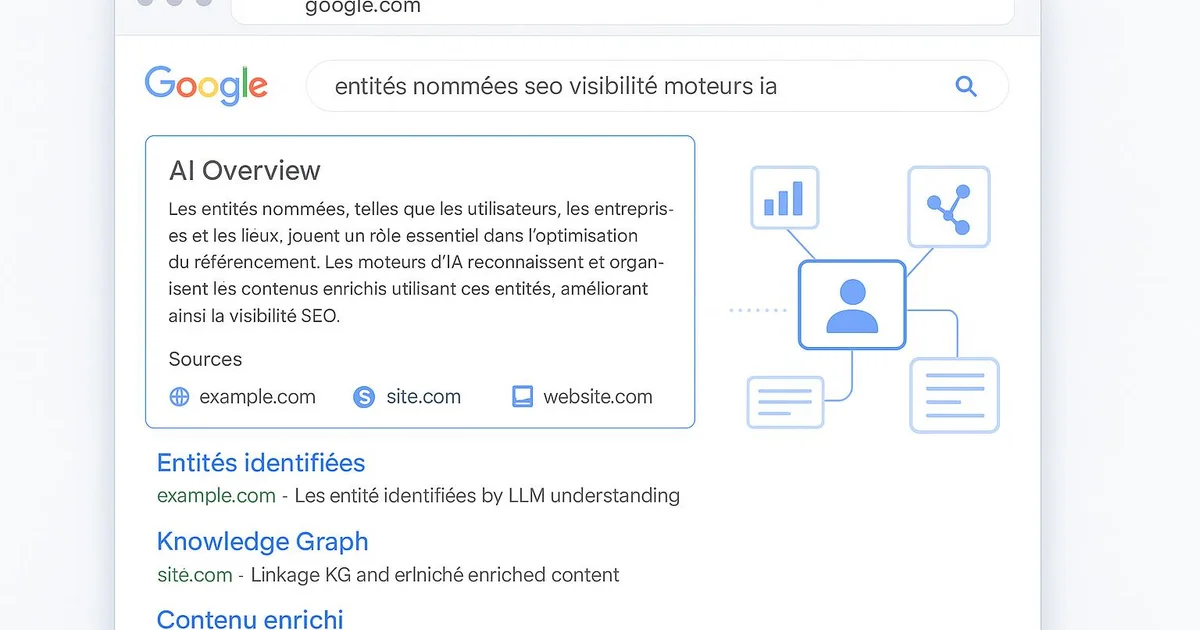
Named entities in SEO are identifiable concepts, people, or organizations that a search engine links to a stable meaning. By citing them explicitly and consistently, content can, in some cases, improve its understanding by LLMs and its likelihood of being cited by ChatGPT, Perplexity, or Google's AI Overviews.
Search engines no longer simply match keywords: they aim to understand entities and the relationships between them. This shift, initiated by Google's Knowledge Graph, is accelerating with generative engines like ChatGPT, Gemini, and Perplexity, which reason about concepts rather than character strings. For a content publisher, the question is no longer only "which keywords to target" but "which entities should my content cover and connect credibly." An article that names the right entities, defines them clearly, and connects them to recognized sources sends semantic signals that LLMs can exploit. This is exactly the work Selfhook automates by enriching each article with relevant entities. This article analyzes the role of named entities in visibility across AI search engines, without promising recommended results, but drawing on observed mechanisms.
Definition
A named entity is a real-world element — person, organization, place, product, or concept — that a search engine or language model can identify, disambiguate, and connect to other entities within a knowledge graph.
What is a named entity and why do AI engines care?
A named entity differs from a simple keyword by its nature: it designates an identifiable, disambiguated thing. The word "apple" is ambiguous, but the entity "Apple Inc." has a adapté identifier, attributes (founders, sector, products), and relationships with other entities. Google has embodied this logic since 2012 with its Knowledge Graph, capable of linking millions of entities together. Generative engines push this approach even further: an LLM like the one powering ChatGPT or Gemini represents language as vectors where entities and their contexts occupy stable relative positions. For these systems, content that explicitly names recognized entities — rather than skirting around them with pronouns or vague phrasing — becomes easier to interpret. When an article discusses "SEO" without ever citing Google, Yoast, Search Console, or Semrush, it provides few anchor points. Conversely, a text that mentions these entities by their exact name and clarifies their roles connects to a semantic network already known to the model. This interest is explained by how AI engines build their answers. Faced with a question, they look for passages where the expected entities coexist coherently. Content structured around well-identified entities increases, in some cases, its likelihood of being selected as a source. This is not a ensure of citation, but one signal among others — to be measured notably via Search Console for the classic organic share, and through mention tracking for the generative share.
- Entity = identifiable, disambiguated element (person, organization, concept)
- Keyword = character string without stable identity
- Google's Knowledge Graph links entities together
- LLMs represent entities through vector semantic proximity
How do named entities influence visibility in AI engines?
The influence of named entities operates on several levels, which must be distinguished to avoid shortcuts. First, at the level of understanding: an AI engine that clearly identifies the entities in a text better grasps its real subject and depth. An article on "WordPress topical authority" that cites RankMath, Yoast, the Knowledge Graph, and adjacent concepts sketches a richer thematic coverage than a generic text. Next, at the level of credibility. Generative models tend, depending on the topic, to favor sources that connect entities accurately and consistently with what they already "know." Correctly naming Perplexity, precisely describing how Google's AI Overviews work, or associating a method with its recognized author strengthens the perceived reliability of the content. An entity error — attributing a feature to the wrong tool, for instance — produces the opposite effect. Finally, at the level of citability. Engines like ChatGPT or Perplexity assemble their answers from self-contained passages. A paragraph that names the relevant entity, defines it, and articulates it with other entities is more easily extractable than a passage dependent on distant context. This is a principle found in our guide on optimizing content for LLMs. A nuance is nonetheless needed: entity density is not a slider to push to the maximum. Artificial accumulation hurts readability and can be perceived as filler. The goal remains relevant, coherent coverage aligned with search intent, whose real impact is verified over time through tracking of impressions and mentions.

Which entities to prioritize by topic?
Not all entities are equal for a given subject. Prioritization depends on three factors: the entity's centrality to search intent, its recognition by engines, and the credibility it brings to the content. In the field of SEO and GEO, certain entities recur naturally because they structure the domain. "Tool" entities — Google, ChatGPT, Gemini, Perplexity, Yoast, RankMath, Semrush, Search Console — serve as concrete landmarks. Mentioning them by their exact name, without loose variations, helps engines confirm the domain covered. "Concept" entities — topical authority, generative engine optimization, Knowledge Graph, disambiguation — situate content within a recognized theoretical framework. Finally, reference "person" or "organization" entities provide backing, provided they are accurate and verifiable. The analytical method consists of mapping the expected entities for a subject before writing. One can draw on existing AI engine answers to related questions: which entities consistently appear in their responses? These often form a base to cover. It is generally observed that content covering the central entities of a subject, while establishing explicit links between them, maintains better thematic coherence. This logic aligns with topical authority on WordPress: the more a site coherently covers a domain's entities, the more it becomes a recognizable reference, both to Google and to generative engines. Internal linking between articles dealing with related entities reinforces this signal by materializing the relationships engines are already trying to reconstruct.
- Tool entities: Google, ChatGPT, Yoast, Semrush, Search Console
- Concept entities: topical authority, GEO, Knowledge Graph
- Reference entities: verifiable people and organizations
- Prioritize by centrality, recognition, and credibility
How to structure content around named entities?
Structuring begins with clarity of definitions. Introducing an important entity with a sentence like "[Entity] is…" provides an anchor point usable by AI engines and readers alike. This practice, central to generative engine optimization, turns a passage into a citable unit. An engine like Perplexity may reuse this definition as-is if it is clear and correct. Next comes consistency of mentions. An entity should always be designated the same way: "Search Console" rather than alternating between "GSC," "the Google console," and "Google's tool." This stability aids disambiguation. Structured data — schema.org, notably the Organization, Person, or Product types — further reinforces this identification by providing engines with explicit markup, complementary to the text. Linking also plays a role. Connecting an article to other content dealing with related entities reproduces, at the site scale, the graph structure engines favor. An article on named entities benefits from pointing to a guide on optimizing for LLMs or on topical authority, because these links materialize real semantic relationships. Finally, factual verification is decisive. A misattributed entity degrades the trust an engine grants to content. It is better to cite fewer entities but correctly than to accumulate them at the risk of errors. This rigor, hard to maintain manually across dozens of articles, benefits from tooling. Any potential visibility gains remain to be measured in Search Console and through generative citation tracking, since none of these levers produce a recommended or immediate effect.
With Selfhook, named-entity enrichment integrates directly into the content generation flow. When drafting an article, Selfhook identifies the entities relevant to the topic — tools like Yoast or Search Console, concepts like topical authority — and integrates them coherently and verifiably into the text. The SEO audit flags central entities missing compared to already well-ranking content. Once approved, the article moves to automated WordPress publishing, structured data included. The goal: strengthen semantic understanding by LLMs, whose real impact is then measured in Search Console and through generative mention tracking.
Selfhook centralizes content generation, SEO/GEO optimization, WordPress publishing and tracking in a single workflow.
See all features →Keyword approach vs named-entity approach
| Criterion | Keywords alone | Named entities |
|---|---|---|
| Base unit | Character string | Identifiable, disambiguated concept |
| LLM understanding | Limited to immediate context | Tied to a knowledge graph |
| Main risk | Over-optimization, stuffing | Entity attribution error |
| AI engine citability | Varies by phrasing | Strengthened by clear definitions |
| Measuring the effect | Positions, clicks | Impressions + generative mentions |
FAQ
Do named entities replace keywords?
No. Named entities complement keyword logic without canceling it. Engines still use textual queries, but they increasingly interpret them through the entities those queries evoke. An effective strategy combines both approaches.
Should I cite as many entities as possible to be visible in ChatGPT?
No, density is not an end in itself. Artificial accumulation hurts readability and can be perceived as filler. It is better to accurately cover a subject's central entities and establish coherent links between them.
Does structured data improve entity recognition?
It can contribute to it. Schema.org markup such as Organization, Person, or Product provides engines with explicit identification, complementary to the text. The effect varies by topic and remains to be observed in Search Console.
How to measure the impact of entities on AI visibility?
There is no single metric. One generally combines tracking of impressions and positions in Search Console for classic search, and manual or tooled tracking of mentions in ChatGPT, Perplexity, or Google's AI Overviews for the generative share.
Key takeaways
A named entity is an identifiable, disambiguated concept, distinct from a mere keyword
Naming entities by their exact name and consistently helps AI engines understand content
Prioritize entities by centrality, recognition, and the credibility they bring
Introduce each key entity with a clear definition to make it citable
Verify each entity attribution: an error degrades engine trust
Measure the real effect in Search Console and via generative mention tracking
An often-overlooked point: disambiguation relies as much on context as on the name. Citing "Gemini" without context may refer, for a model, to several entities (Google's model, the constellation, a cryptocurrency). Surrounding the entity with discriminating attributes — "Gemini, Google's language model" — secures interpretation. This contextual co-occurrence carries more weight, in some cases, than mere repetition of the name, because it guides the model's vector representation toward the correct entity in the graph.

Related cluster articles
Reference guides
Automate with Selfhook
Conclusion
Named entities are not a magic recipe, but a structuring lever as generative engines increasingly reason about concepts rather than words. Accurately covering a subject's central entities, defining them clearly, and connecting them can, in some cases, strengthen LLM understanding of content and its likelihood of citation — an effect to confirm in Search Console and through mention tracking. Maintaining this rigor across a large volume of articles remains demanding: this is where Selfhook, through automatic entity enrichment and WordPress publishing, helps industrialize otherwise time-consuming semantic work.
Ready to automate your SEO content?
Book a 30-minute video demo: we show you Selfhook on your WordPress site, from SEO audit to publishing.
Request a demo