
Answer Engine Optimization (AEO): The Complete 2026 Guide
Quick answer
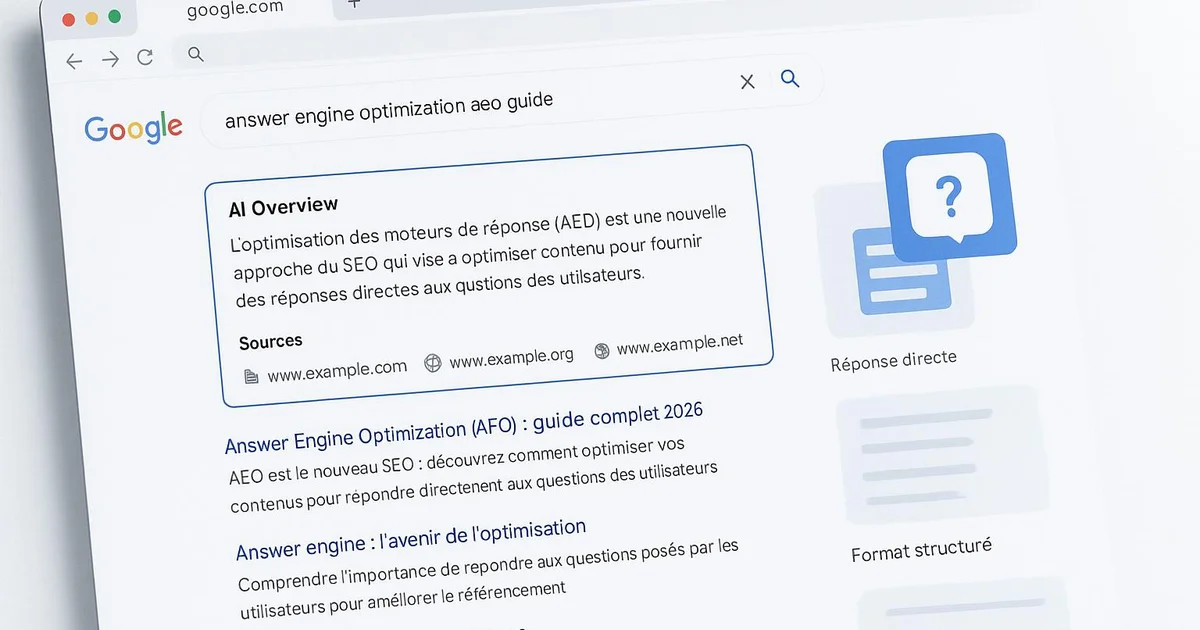
Answer engine optimization (AEO) means structuring content so it is selected as a direct answer by engines like Google (AI Overviews), ChatGPT or Perplexity. It relies on concise answers, question/answer formatting and verifiable factual data. Unlike classic SEO, the observed goal is to be cited, not merely ranked.
For two decades, search optimization meant winning positions in a list of ten blue links. That model is shifting. Google now integrates AI Overviews, while ChatGPT, Perplexity and Gemini answer queries directly, often citing only a handful of sources. In this context, ranking well is no longer always enough: you need to be the answer. This is precisely what answer engine optimization (AEO) addresses. It does not replace SEO; it extends its logic by prioritizing clarity, structure and factuality. Content designed to be cited by an answer engine responds directly, relies on verifiable data and adopts a format models can extract. This article analyzes AEO principles, its differences from traditional SEO, the structuring methods observed and their limits. Tools like Selfhook can help industrialize this approach by generating content already oriented toward the direct answer.
Definition
Answer engine optimization (AEO) is the set of practices aimed at optimizing content so it is extracted and presented as an answer by answer engines and AI assistants, rather than simply ranked in a list of links.
What is answer engine optimization and why is it emerging?
Answer engine optimization responds to a documented shift in behavior: a growing share of searches end without a click, as users get their answer directly in the interface. This phenomenon, often called zero-click search, is amplified by Google's AI Overviews and conversational assistants like ChatGPT or Perplexity. In this model, value no longer lies solely in traffic to a page, but in the engine citing the source. An answer engine differs from a classic search engine in its purpose. Where legacy Google returned a list of links to explore, an answer engine synthesizes a response from several sources, which it may or may not cite. Perplexity explicitly displays its references; ChatGPT does so via its search mode; AI Overviews highlight attributed excerpts. AEO therefore aims to maximize the probability that content is selected as a building block of an answer. This probability depends, according to available observations, on several factors: the presence of a concise, self-contained answer, a question/answer structure readable by models, factual density and the perceived credibility of the source. It is not a foolproof method: engines remain opaque and their criteria evolve. It is nonetheless observed that content formatted for extraction — clean definitions, lists, tables, short paragraphs at the top of sections — is reused more frequently. AEO thus sits at the intersection of technical SEO, structured writing and an understanding of how large language models work.
AEO, GEO and SEO: what are the concrete differences?
Three acronyms now coexist and often cause confusion: SEO, GEO and AEO. SEO (search engine optimization) aims to improve a page's ranking in search results pages. GEO (generative engine optimization) seeks to optimize visibility within overall generative answers, working on topical authority and global citability. AEO focuses more narrowly on being selected as a direct answer to a specific question. These approaches do not conflict: they overlap significantly. Content that ranks well in SEO terms is more likely to be crawled and therefore cited. Conversely, content designed for AEO — clear, structured, factual — tends to perform better on the user-experience criteria Google values. Our article on GEO vs SEO differences details this articulation, as does the dedicated generative engine optimization guide. The main nuance lies in the measurable objective. In SEO, the central metric remains position and organic traffic, to be tracked in Search Console. In AEO, the goal is to appear in a direct answer, a metric far harder to measure since no tool yet perfectly consolidates citations in ChatGPT, Perplexity or AI Overviews. This measurement difficulty is a real limit to keep in mind. In practice, a coherent strategy combines all three. You first build a solid SEO base, develop topical authority in a GEO logic, then optimize each page for the direct answer following AEO principles. Depending on the topic, one lever or another will weigh more heavily, but none is mutually exclusive.
How do you structure content for answer engine optimization?
Structuring content for AEO means anticipating how a language model extracts information. Several practices recur in analyses of content that is actually cited. The first is to phrase H2 headings as questions and answer them immediately, from the first or second sentence of the paragraph. This direct, self-contained and concise answer matches what an engine can extract without additional context. The second practice concerns factual density: dates, figures presented as estimates, comparisons and clean definitions increase perceived informational value. Semantic markup also plays a role. FAQPage schema, in particular, helps engines identify usable question/answer pairs — a topic we explore further in our article on FAQ schema and LLM citations. Extensions like Yoast or RankMath make implementing these structured data easier on WordPress.
- Place a 40-80 word direct answer at the top of the section
- Use H2 headings phrased as real user questions
- Integrate verifiable factual data presented as estimates
- Structure with lists and tables to ease extraction
- Mark up FAQs with clean FAQPage schema
- Cite recognized entities (Google, Semrush, Perplexity) by their exact name
What are the limits and risks of AEO?
Answer engine optimization is not a recommended method, and several limits must be honestly acknowledged. The first is engine opacity. Neither Google, OpenAI nor Perplexity publish precise criteria for selecting cited sources. The best practices described rest on observations and correlations, not official rules. What works in one topic may not transfer to another. The second limit is measurement. Unlike SEO, where Search Console provides impressions and positions, there is not yet a reliable, universal instrument to track how often content is cited by an answer engine. Some platforms are beginning to offer LLM mention tracking, but this data remains partial and should be interpreted with caution. A third risk concerns traffic cannibalization. If an engine answers directly from your content without a click, the citation strengthens your visibility but does not necessarily generate a visit. In some cases, this can reduce organic traffic while increasing brand visibility — a trade-off to evaluate against your objectives. Finally, the temptation to over-optimize can backfire. Excessively fragmented content, reduced to shallow micro-answers, risks losing value for the human reader as well as for engines that also value expertise and completeness. The observed balance consists of alternating extractable direct answers with substantial analytical development. AEO remains a reasoned bet, to be adjusted continuously as engines evolve.
With Selfhook, an agency can generate articles already structured for AEO without rethinking each brief manually. AI content generation produces H2 headings phrased as questions, a direct answer at the top of each section, and condensed factual blocks that answer engines can extract. The built-in SEO audit then checks readability and Yoast optimization, while automated WordPress publishing puts content online with its structured data. In some observed cases, this approach can help increase the probability of citation in AI Overviews or Perplexity — an effect to measure in Search Console and via mention tracking.
Selfhook centralizes content generation, SEO/GEO optimization, WordPress publishing and tracking in a single workflow.
See all features →SEO, GEO and AEO: comparing approaches
| Criterion | Classic SEO | AEO |
|---|---|---|
| Main objective | Rank a page in results | Be selected as a direct answer |
| Key metric | Position and traffic (Search Console) | Citation frequency (partial measure) |
| Preferred format | Long keyword-optimized content | Concise answers and structured data |
| Target engines | Google, Bing | AI Overviews, ChatGPT, Perplexity |
| Measurement maturity | High and well-tooled | Emerging and incomplete |
FAQ
Does AEO replace SEO?
No. AEO extends SEO rather than replacing it. Well-ranked content is more likely to be crawled and cited by an answer engine. The two approaches generally combine within a coherent strategy.
How do you measure the results of an AEO strategy?
Measurement remains a real limit. No tool perfectly consolidates citations in ChatGPT, Perplexity or AI Overviews. You can track impressions in Search Console and use LLM mention tracking platforms, interpreting this data with caution.
Does FAQPage schema help answer engine optimization?
In some cases, yes. FAQPage schema helps engines identify usable question/answer pairs. It does not ensure citation, but it makes content extraction easier for language models.
Which content format is most effective for AEO?
It is generally observed that 40-80 word direct answers placed at the top of sections, lists, tables and clean definitions are reused more frequently. The ideal is to alternate concise excerpts with substantial development.
An often-overlooked point: answer engines do not cite based solely on formatting, but also on the consistency between a source and the consensus detected across multiple pages. An isolated claim, even well-structured, will be reused less than data corroborated elsewhere. This means AEO is not played out at the level of a single page, but at the level of the domain's overall topical authority — a logic close to GEO. Optimizing a page without building this broader consistency strongly limits observed results.
Key takeaways
AEO aims to be selected as a direct answer, not merely ranked
Phrase H2 headings as questions and answer in 40-80 words upfront
Strengthen factual density with figures presented as estimates
Mark up FAQs with clean FAQPage schema via Yoast or RankMath
Accept measurement limits and interpret data with caution
Combine SEO, GEO and AEO rather than opposing them
Timeline
Until 2019
SEO dominates: the goal is to rank among the blue links in Google.
2020-2022
Featured snippets and zero-click search spread, foreshadowing the direct answer.
2023
The rise of ChatGPT and Perplexity introduces mainstream conversational answer engines.
2024-2025
Google rolls out AI Overviews at scale and AEO takes shape as a discipline.
2026 and beyond
Citation measurement improves and AEO integrates into automated content workflows.
Sources
- Google Search Central — Official documentation on AI Overviews and structured data.
- Search Console — Reference tool for tracking organic impressions and positions.
- Yoast and RankMath documentation — Guides for implementing FAQPage schema on WordPress.

Related cluster articles
Reference guides
Automate with Selfhook
Conclusion
Answer engine optimization extends SEO logic into the era of answer engines. It prioritizes the direct answer, question/answer structure and factual density, without ever guaranteeing citation in ChatGPT, Perplexity or AI Overviews. Its limits — criteria opacity, partial measurement, zero-click risk — call for a reasoned approach rather than promises. Combined with SEO and GEO, AEO can help strengthen your visibility in AI answers. Tools like Selfhook, through AI generation of content oriented toward the direct answer and automated WordPress publishing, can industrialize this process, to be adjusted continuously based on your observations.
Ready to automate your SEO content?
Discover how Selfhook can help you create and publish quality SEO content
Start for free