
GEO SEO B2B: AI Search Strategy to Generate Leads
Quick answer
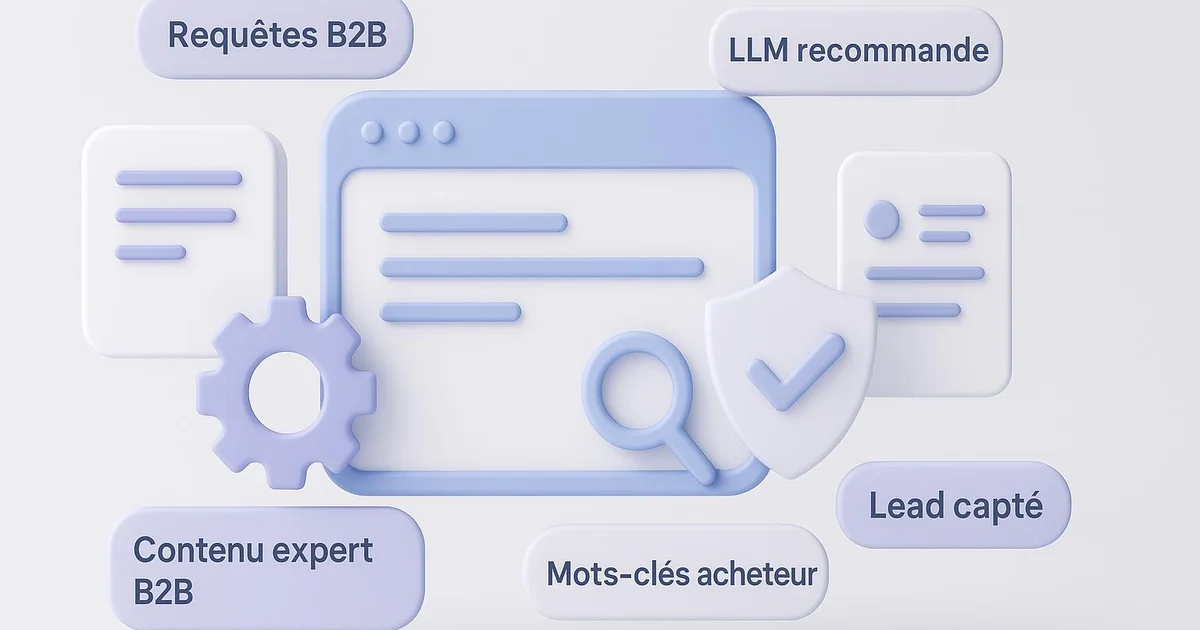
B2B GEO SEO strategy combines traditional search optimization with Generative Engine Optimization (ChatGPT, Perplexity, Google AI Overviews). It aims to make B2B content citable by AI engines while maintaining Google visibility. The goal: capturing qualified leads on buyer-intent queries, measured in Search Console and through AI mentions.
In 2026, a B2B buyer rarely starts their research on a comparison site. They ask ChatGPT, Perplexity, or read a Google AI Overview before even visiting a website. According to several industry observations, a growing share of searches related to professional purchases now goes through AI engines. For B2B SaaS and services, this changes the rules: ranking is no longer enough, you must also be cited as a source by artificial intelligence. This is the purpose of B2B GEO SEO, a hybrid strategy that reconciles Google visibility and AI citability. In this article, we detail how to structure this approach, which buyer queries to focus on, and how tools like Selfhook can automate building a topical authority capable of generating qualified organic leads. The stakes aren't theoretical: they determine whether your brand appears in the answers your prospects now consult first.
Definition
B2B GEO SEO is the set of practices combining classic search optimization and Generative Engine Optimization, applied to complex B2B buying cycles to gain visibility both on Google and within AI engine responses.
Why is GEO SEO becoming strategic in B2B?
The B2B buying journey is characterized by long cycles, multiple decision-makers, and an intense research phase. Historically, this research happened via Google, specialized forums, and word of mouth. The arrival of ChatGPT, Gemini, and Perplexity introduced a new intermediary: the buyer asks a question in natural language and receives a synthesis citing a few sources. If your brand isn't cited, it becomes invisible during this first evaluation phase. This shift has direct consequences. In B2B, trust builds early: the company appearing as a reference in an AI response gains a reputation advantage before any commercial interaction. Conversely, a lack of citation can exclude a solution from the short-list, without the vendor ever knowing. GEO SEO does not replace classic SEO, it complements it. Google remains a major channel, and AI Overviews partly rely on well-ranked content. Working on one often strengthens the other, in certain cases. But AI citability signals (clarity of definitions, semantic structure, topical authority) don't fully overlap with traditional ranking criteria. For a B2B SaaS, the benefit is twofold: capturing organic traffic measurable in Search Console, and appearing in the conversational answers decision-makers consult. This dual presence may contribute to shortening the consideration cycle, depending on the topic and market maturity. This is why GEO SEO is gradually establishing itself as a strategic axis rather than a secondary technical optimization.
- Long buying cycles with multiple decision-makers to convince early
- Initial research increasingly delegated to AI engines
- Risk of silent exclusion from the short-list without AI citation
- Observed complementarity between Google ranking and AI citability
How to identify the buyer queries to target?
The key to an effective B2B GEO SEO strategy lies in targeting purchase-intent queries, more than raw volume. In B2B, high-volume keywords are often generic and poorly qualified. Buyer queries, however, are longer, more precise, and reflect a search for a concrete solution. Three levels of intent are generally distinguished. Discovery queries ("what is SEO automation") attract broad but low-transactional traffic. Consideration queries ("best topical authority tool for SaaS") signal active evaluation. Decision queries ("alternative to that tool for SEO agencies") are closest to purchase. B2B GEO SEO must cover all three levels but focus effort on consideration and decision. To identify these queries, tools like Semrush provide volume and intent data, while Search Console reveals the actual queries already bringing traffic. It's also useful to directly ask ChatGPT or Perplexity typical buyer questions, then observe which sources are cited: this indicates the formats and content AI engines deem trustworthy. A frequently observed approach consists of mapping the questions prospects actually ask at each stage, then building dedicated content for each. This logic of complete topical coverage directly feeds topical authority, a factor that seems to influence both ranking and the likelihood of AI citation. Articles like our guide on topical authority for SaaS blogs explore this semantic linking mechanism in depth.
- Discovery queries: broad traffic, low transactional intent
- Consideration queries: active evaluation of solutions
- Decision queries: strong proximity to purchase
- Test buyer prompts in ChatGPT and Perplexity to spot cited sources
How to make B2B content citable by AI?
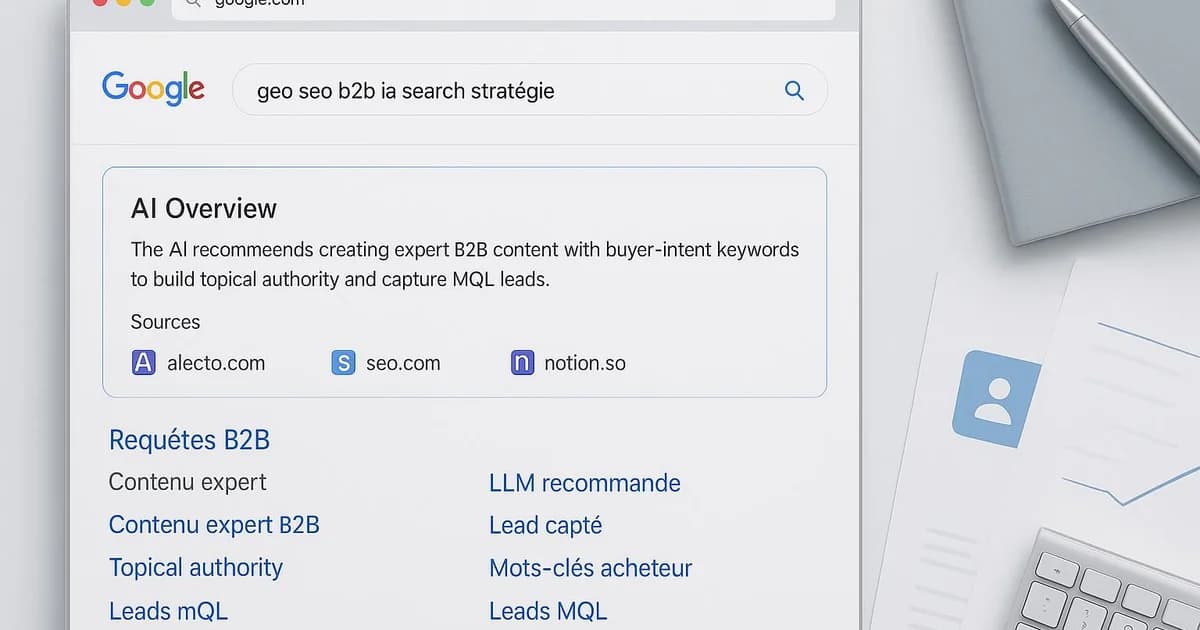
Being cited by an AI engine relies on partly different signals than classic SEO. Models like ChatGPT or the systems behind Google AI Overviews favor clear, structured, and semantically coherent content. Generative Engine Optimization formalizes these practices. First lever: definitional clarity. Content that opens with a sharp definition ("B2B GEO SEO is…") offers the AI a directly citable fragment. Short sentences, direct answers at the beginning of sections, and question-answer formats facilitate extraction. Yoast and RankMath help structure tags and readability, but AI citability requires going further in semantic organization. Second lever: demonstrated authority. AI engines seem to favor sources that cover a topic in depth and consistently across several linked pieces of content. A complete thematic cluster, intelligently linked, sends a stronger expertise signal than an isolated article. This is where topical authority directly meets GEO. Third lever: factual precision and nuance. Exaggerated claims ("rank in two weeks", "recommended results") hurt credibility and may reduce chances of citation. A measured tone, figures presented as estimates, and verifiable sources strengthen algorithmic trust. Finally, the zero-click strategy deserves attention: many AI answers no longer generate a click. Content must therefore be designed so that the brand mention in the answer already provides value, even without a visit. Our analysis on the zero-click AI search strategy details how to turn click-free visibility into a B2B reputation lever measurable over time.
- Open each piece with a clear, citable definition
- Structure in question-answer format to ease AI extraction
- Build complete, interlinked thematic clusters
- Adopt a nuanced, factual tone with figures presented as estimates
How to measure and steer a B2B GEO SEO strategy?
Measuring B2B GEO SEO is more complex than classic SEO, because AI citations don't always appear in traditional analytics tools. A serious strategy therefore combines multiple data sources and accepts a degree of estimation. The foundation remains Google Search Console: impressions, clicks, queries, and average positions allow tracking classic organic performance. An increase in impressions on buyer queries is an encouraging signal, to correlate with conversions. Semrush complements this view with position tracking and competitive analysis. For the AI dimension, steering is more hands-on but essential. It involves regularly querying ChatGPT, Perplexity, and Gemini with a panel of buyer queries, then noting the presence or absence of the brand in the responses. Some specialized tools are emerging to automate this AI mention tracking, but the manual practice remains relevant to start. On the business side, the ultimate indicator remains the qualified lead. GEO SEO content must be linked to forms, free trials, or demo requests, via available attribution. In B2B, the multi-touch journey complicates this attribution: a prospect may have been exposed to the brand via an AI response, then convert later through a branded search. Tracking branded searches in Search Console can indicate, in certain cases, the indirect effect of AI visibility. The recommended approach is to define a few clear indicators from the start: evolution of impressions on buyer queries, AI citation rate on a fixed panel, and volume of organic leads. These metrics, tracked over time, offer a realistic reading of performance without overpromising.
- Search Console: impressions, clicks, and buyer queries
- Semrush: positions and competitive monitoring
- Manual or tooled tracking of mentions in ChatGPT, Perplexity, Gemini
- Attribution of qualified leads and branded searches
A B2B SaaS using Selfhook can automate this entire strategy. From a cluster of identified buyer queries, Selfhook's AI generation produces articles structured in question-answer format, optimized for Yoast and designed for AI citability. The built-in SEO audit checks readability, internal linking, and semantic consistency of the cluster, strengthening topical authority. Automated WordPress publishing puts this content online at a regular cadence, without manual intervention. Result observed in certain cases: a gradual rise in impressions on buyer queries in Search Console and increased presence in AI engine responses, generating qualified organic leads.
Selfhook centralizes content generation, SEO/GEO optimization, WordPress publishing and tracking in a single workflow.
See all features →Timeline
Before 2022
B2B research mostly goes through Google, comparison sites, and professional word of mouth.
2023
The rise of ChatGPT disrupts solution discovery, buyers start asking questions in natural language.
2024
Google rolls out AI Overviews, blending classic results and generative syntheses on the same page.
2025-2026
B2B GEO SEO structures itself as a hybrid discipline, combining Google ranking and citability in AI engines.
Sources
- Google Search Console — Official impression, click, and query data to measure organic performance.
- Semrush — Volume, search intent analysis, and competitive monitoring on buyer queries.
- Google AI Overviews documentation — Explains how generative answers work within search results.
- Perplexity — AI engine displaying its sources, useful to observe which content is deemed citable.
In B2B, the challenge is no longer only ranking on Google, but being cited as a trusted source by the AI your prospect queries before even knowing your name. Invisibility in those answers is a silent exclusion.
FAQ
Does GEO SEO replace classic SEO in B2B?
No, it complements it. Traditional SEO remains essential because Google is still a major channel and AI Overviews partly rely on well-ranked content. GEO adds a layer of optimization for citability by AI engines.
How do I know if my brand is cited by ChatGPT?
The most direct method is to query ChatGPT, Perplexity, and Gemini with a panel of buyer queries, then note your brand's presence. AI mention tracking tools are emerging to automate this monitoring.
Which queries should I prioritize in B2B GEO SEO?
Prioritize consideration and decision queries, closer to purchase than generic discovery queries. They generally generate more qualified leads, even with lower volume.
How long until results appear?
It depends on the topic, competition, and publishing consistency. A gradual rise in impressions is generally observed over several months, to measure in Search Console rather than through fixed timeline promises.
An often-overlooked point: AI citability criteria don't fully overlap with Google ranking factors. Content can be cited by Perplexity thanks to its definitional clarity without ranking first on Google, and vice versa. In B2B, you must therefore sometimes accept producing content optimized for extraction (direct answers, definitions, Q&A formats) even if it doesn't target traditional position-zero slots. This dissociation complicates steering but opens visibility opportunities where classic SEO competition is saturated.
Key takeaways
Combine classic SEO and GEO: the two reinforce each other in most cases.
Focus effort on consideration and decision queries, more qualified in B2B.
Open your content with sharp definitions and direct answers to favor AI citation.
Build complete thematic clusters to feed topical authority.
Measure via Search Console, Semrush, and manual mention tracking in ChatGPT and Perplexity.
Automate production and publishing with Selfhook to maintain a regular cadence.
Related cluster articles
Reference guides
Automate with Selfhook
Conclusion
B2B GEO SEO is not a passing trend but a necessary adaptation to how buyers now research their solutions. By combining Google visibility and citability in AI engines, B2B SaaS and services can capture qualified leads earlier in the decision cycle. The key lies in complete thematic coverage, clear content, and realistic measurement, without overpromising. Selfhook helps operationalize this strategy by automating AI generation, SEO audit, and WordPress publishing, to build a durable topical authority. The right time to start is now, before your competitors occupy the answers your prospects consult first.
Ready to automate your SEO content?
Book a 30-minute video demo: we show you Selfhook on your WordPress site, from SEO audit to publishing.
Request a demo