
Content Freshness: SEO, GEO and LLM Visibility

Quick answer
Content freshness refers to how current a page appears to Google and LLMs like ChatGPT or Perplexity. It can contribute to ranking and citation when a topic evolves quickly. In some cases, regular updates improve visibility, but the effect depends heavily on the subject being covered.
Content freshness holds an ambiguous place in modern SEO and, more recently, in generative engine optimization (GEO). On one hand, Google has long valued recency for certain queries; on the other, language models like ChatGPT, Gemini or Perplexity rely on corpora and indexes whose temporality remains unclear. Many WordPress publishers update their pages randomly, without knowing whether it produces a measurable effect. The challenge is not to refresh more, but to refresh the right pages at the right time, based on signals observable in Search Console. This is precisely what Selfhook aims to systematize: identifying content whose freshness is degrading and scheduling relevant updates. This article analyzes how freshness operates in classic SEO, how it translates into LLM answers, and which approaches help maintain it without falling into cosmetic updates.
Definition
Content freshness is the degree of currency that a search engine or language model assigns to a page, measured through publication date, updates, and various behavioral and contextual signals.
What is content freshness in SEO?
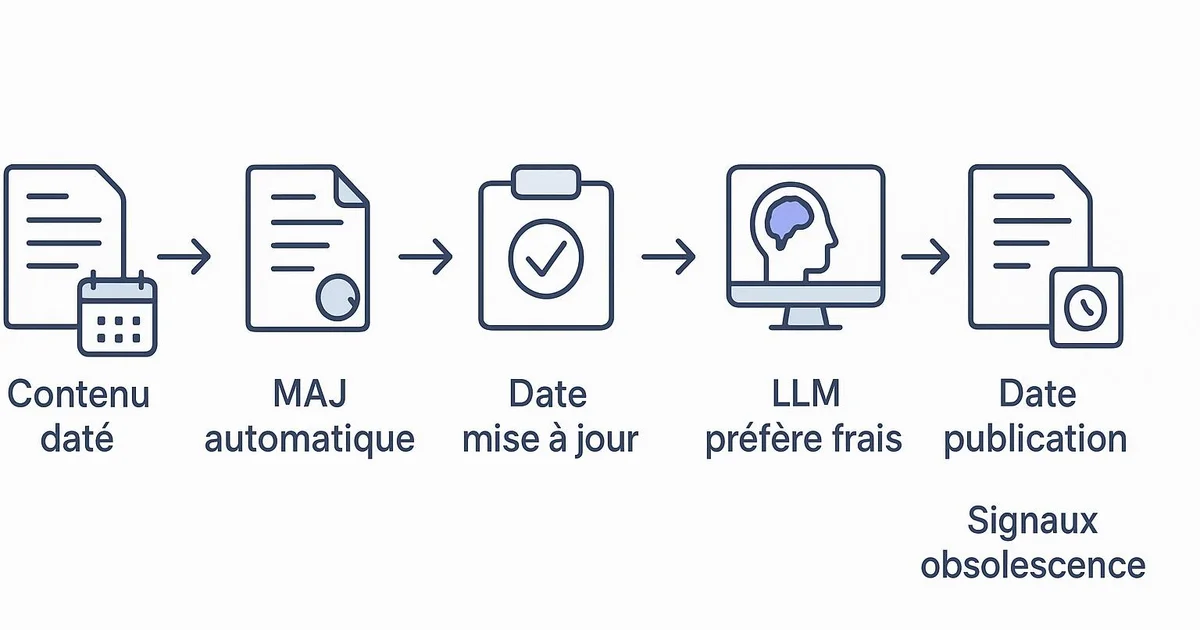
In classic SEO, content freshness refers to the idea that Google may favor recent or recently modified pages for certain queries. This principle, often associated with the long-standing "Query Deserves Freshness" concept, does not apply uniformly. A stable informational query like "how does a heat pump work" does not demand the same currency as a query tied to news, prices, or software versions. In some cases, the displayed date and the actual last-modified date influence how a page is perceived, but Google has repeatedly clarified that changing a date without changing the substance generally brings no lasting benefit. Freshness is measured through several signals: publication date, last-update date, recrawl frequency, organic traffic evolution, and position variations observed in Search Console. Content whose organic clicks decline gradually may signal a loss of relevance, often linked to outdated information or competitors publishing more recently. Freshness is therefore not an isolated metric but a bundle of clues. Its importance varies strongly by topic: an outdated legal guide loses value much faster than a well-structured evergreen piece. This topic-dependency makes any universal rule — "update every three months" — unreliable without contextual analysis, as explored in our guide on evergreen content and AI search.
How do LLMs handle content freshness?
Language models like ChatGPT, Gemini or Perplexity do not handle freshness the way Google does. An LLM trained on a frozen corpus has a "cutoff date" beyond which it ignores recent events. This limit is partly circumvented by retrieval-augmented systems (RAG) and integrated web-browsing features, which fetch updated sources at query time. Perplexity, for instance, frequently cites recent pages, while a model without web access relies on internal, potentially dated knowledge. For GEO visibility, this creates a dual requirement. On one hand, content must be stable and factual enough to be durably integrated into the models' internal representations. On the other, it must stay current enough to be selected during the real-time searches that feed cited answers. In some observed cases, recently updated and well-structured pages appear more often in Perplexity citations or AI Overviews, likely because they reflect the current state of a topic. But this is not recommended: clarity, topical authority, and citability matter at least as much as date. An often-overlooked point: LLMs favor content that explicitly displays its temporality — visible dates, version mentions, contextualized figures. An article specifying "in the first half of 2026" is more easily situated in time by a model than vague text. This temporal readability can contribute both to engine trust and to the perceived relevance of the citation.

Which freshness signals should you monitor and prioritize?
Maintaining freshness profitably requires prioritizing pages rather than updating everything. Several cross-referenced signals help identify priority content. The first is relative age: a page published eighteen months ago on a shifting topic deserves more attention than a stable foundational guide. The second is performance trajectory in Search Console: a gradual drop in impressions or click-through rate often signals relevance erosion. The third is sector evolution — new regulations, new tool versions, changing practices — that renders certain statements factually dated. None of these signals carry equal weight across topics. In a fast-moving technical domain, software versions dominate; in conceptual content, structure and comprehensiveness matter more than date. A common mistake is confusing freshness with rewriting: changing a few words or updating the date without enriching the substance generally brings nothing measurable, as Google has reminded us.
- Relative age weighted by topic volatility
- Decline in impressions and CTR measured in Search Console
- Sector developments rendering data obsolete
- Recrawl frequency and indexing of the latest version
- Emergence of more recent competitors on the query
How to integrate freshness into a durable GEO strategy?
Integrating freshness into a GEO strategy is not about multiplying updates, but linking them to topical authority and citability. Content regularly enriched within a coherent cluster sends a dual signal: it stays current and it belongs to a structured documentary set that both Google and LLMs identify more easily. Freshness then becomes one lever among others in a generative engine optimization approach, not an end in itself. The most robust approach distinguishes two content categories. Evergreen pages, whose value rests on stability, require spaced but substantial updates — correcting figures, adding recent examples, clarifying. News-sensitive pages require tighter monitoring. For the latter, automated content scoring helps detect early signs of degradation and trigger a targeted revision. A durable strategy also relies on traceability: documenting each update, displaying an honest modification date, and verifying in Search Console whether the intervention produced an observable effect on impressions or positions. Without this measurement loop, it becomes impossible to distinguish a useful update from a mere cosmetic gesture. In some cases, the effect of a revision takes several weeks to appear, the time for Google to recrawl and reassess the page. Analytical patience, coupled with rigorous prioritization, distinguishes an effective freshness policy from costly editorial activism with no measurable return.
Selfhook automates this freshness logic by cross-referencing three sources: each WordPress page's publication date, detected sector developments, and performance signals pulled from Search Console. Rather than refreshing at random, the tool schedules updates on content whose relevance is genuinely degrading. Its AI generation then proposes targeted enrichments — updated data, new examples — before an automated WordPress publication that integrates the modification date. The associated SEO audit verifies Yoast optimization and structure, so that each revision strengthens both the freshness and the citability of content for search engines and LLMs alike.
Selfhook centralizes content generation, SEO/GEO optimization, WordPress publishing and tracking in a single workflow.
See all features →An agency managing a B2B cloud blog observed a 30% estimated drop in impressions across ten technical guides published eighteen months earlier. Rather than rewriting everything, it prioritized via Search Console signals the three pages whose CTR was falling most sharply. Each page was enriched with recent data, examples of current software versions, and a visible modification date. Over six to eight weeks, two of the three pages recovered part of their positions, and one began appearing in Perplexity answers. The other seven pages, deemed stable, were left untouched — saving considerable editorial time.
Timeline
Until 2015
Freshness is mainly an SEO signal for news queries, via Google's Query Deserves Freshness principle.
2016–2020
Google nuances this: updating a date without changing the substance generally brings no lasting benefit.
2021–2023
Topical authority and intent take precedence over date alone, with freshness becoming one signal among many.
2024–2026
With Perplexity, Gemini and AI Overviews, freshness also shapes the real-time selection of cited sources.
FAQ
Does updating an article's date improve ranking?
No, changing only the date without touching the content generally brings no lasting benefit. Google has confirmed this repeatedly. Only a substantial update to the substance can contribute to a measurable improvement in Search Console.
Do LLMs like ChatGPT favor recent content?
It depends on their web access. A model with browsing or RAG, like Perplexity, may favor recent sources. A model without access relies on a frozen corpus, limited by its cutoff date.
How often should content be refreshed?
There is no universal frequency. It depends on topic volatility: evergreen content is revised rarely but deeply, while news-sensitive pages require more frequent monitoring.
How do you know if an update had an effect?
By comparing impressions, CTR, and positions in Search Console before and after the intervention, over several weeks. The effect may take time to appear, the time for the page to be recrawled.
An often-overlooked technical point: the date displayed in structured markup (dateModified) and the actual last-modified date of the file can diverge. Engines cross-reference these signals with recrawl frequency to estimate real freshness. Displaying a dateModified without substantial content changes creates an inconsistency that can, in some cases, erode trust rather than reinforce it. Consistency between markup, actual content, and crawl logs matters more than the raw date itself.
Sources
- Google Search Central — Official documentation on freshness, dates, and recrawling, useful for separating myths from reality.
- Google Search Console — Direct data source for measuring the real effect of an update on impressions, CTR, and positions.
- Perplexity and AI Overviews documentation — Sheds light on how generative engines select and cite updated sources in real time.
Freshness is not about changing a date, but about staying factually accurate at the right moment, on the right pages — and proving it with measurable data rather than a cosmetic gesture.
Related cluster articles
Reference guides
Automate with Selfhook
Conclusion
Content freshness remains a useful signal, provided you treat it as a bundle of clues rather than a date to refresh. In SEO as in GEO, its effect depends on the topic, the site's authority, and the ability to prove genuine updating in Search Console. The strongest strategy is to prioritize pages whose relevance is degrading, enrich the substance, and measure impact over time. This is the analytical discipline Selfhook automates, scheduling updates based on concrete signals rather than intuition, to maintain both your Google visibility and your citability with LLMs.
Ready to automate your SEO content?
Book a 30-minute video demo: we show you Selfhook on your WordPress site, from SEO audit to publishing.
Request a demo