
Zero-click AI search: the content strategy to adopt
Quick answer
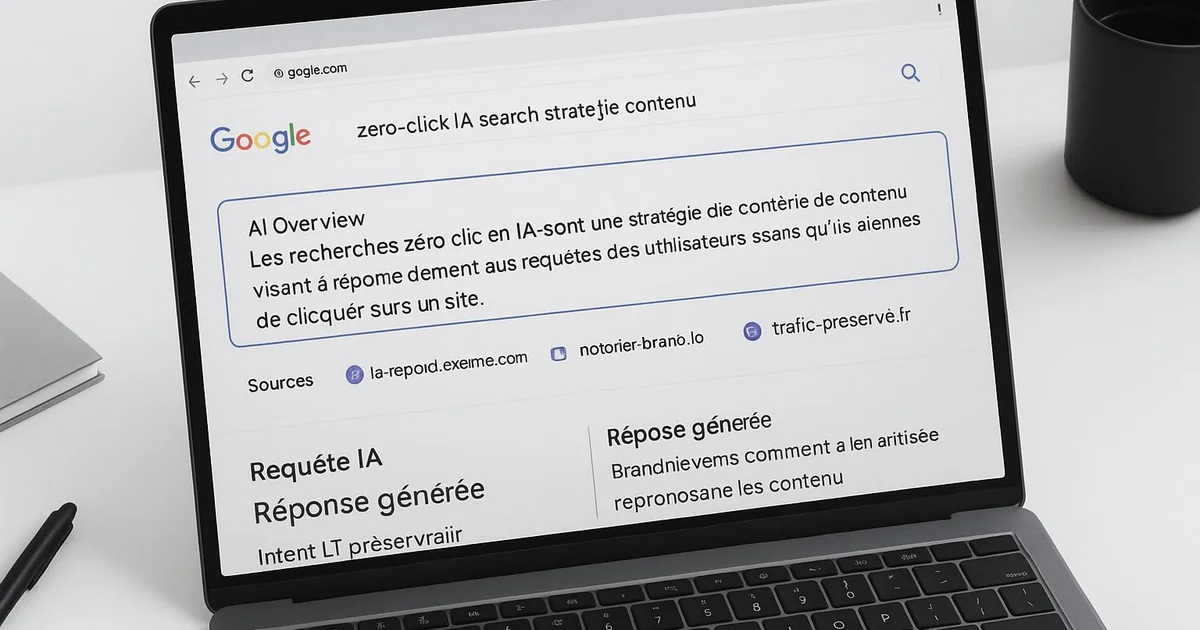
Zero-click AI search refers to searches where users get their answer directly within an AI interface (AI Overviews, ChatGPT, Perplexity) without clicking through to a website. The recommended strategy combines content that is citable by generative engines for brand awareness and long-tail transactional content to capture the remaining traffic.
In 2025, Google rolled out AI Overviews broadly and ChatGPT crossed hundreds of millions of weekly users. As several analytics firms observed, a growing share of queries now resolves without a click to any website. For WordPress publishers, freelancers and SEO agencies, this shift raises a major strategic question: how do you stay visible when the answer appears somewhere other than your page? The answer lies neither in denial nor in abandoning classic SEO. It lies in a hybrid content strategy, capable of both feeding AI engine citations (for brand awareness) and preserving traffic on long-tail transactional queries, which are still widely clicked. This is exactly the dual logic Selfhook helps structure, by automating the production of content optimized for these two complementary goals.
Definition
Zero-click AI search is the phenomenon whereby a query receives a complete answer within an artificial intelligence interface, without the user visiting the cited source website.
What is zero-click AI search and why should you care?
Zero-click search is not new: featured snippets, Knowledge Panels and Google's rich results had already been reducing clicks for years. What changes with generative AI is the scale and the nature of the phenomenon. With Google's AI Overviews, ChatGPT, Gemini or Perplexity, users receive a written synthesis—sometimes complete—that satisfies their intent without requiring a visit. According to several industry studies, this evolution may reduce organic click-through rates on certain informational queries, although the magnitude varies greatly by topic and remains to be measured in your own Search Console. Yet it would be reductive to see this only as a threat. Being cited by an AI engine generates a new form of awareness: your brand appears as a reference source within the answer, which may contribute to trust and to later branded searches. Zero-click thus becomes a branding channel as much as a loss of direct traffic. For a WordPress publisher, the challenge breaks down into two distinct query populations. On one side, broad informational queries ("what is GEO", "how does X work") are the most exposed to zero-click. On the other, long-tail transactional queries ("best WordPress SEO plugin for agencies", "AI content generation tool price") generally retain strong click potential, because the user is looking to compare, buy or sign up. Understanding this segmentation is the first step of a content strategy suited to the AI search era.
How to build a hybrid content strategy?
A hybrid strategy rests on a simple principle: don't pit AI citation against traffic, but treat them as two distinct goals served by different content types. The first pillar targets citability by generative engines—what we call GEO (Generative Engine Optimization). The second pillar protects transactional traffic, where the click retains all its commercial value. To make content citable by ChatGPT, Perplexity or AI Overviews, some practices are observed as favorable: - Formulate clear, standalone definitions that can be extracted out of context - Structure with direct answers at the start of each section - Back claims with data, sources and recognized entities - Use clean semantic markup (headings, lists, structured data) To preserve traffic, the logic partly reverses: you must target intents the AI cannot satisfy alone. In-depth comparisons, pricing, demos, customer reviews, configurators and product-oriented step-by-step tutorials push users to click in order to act. This long-tail content, often lower in search volume but more qualified, remains a conversion magnet. The articulation between these two pillars runs through a cluster content architecture, where citable informational pages reinforce topical authority and redirect, via internal linking, toward transactional pages. This approach echoes the principles detailed in our guides on Generative Engine Optimization and on the differences between GEO and SEO. The goal is never to choose between awareness and traffic, but to orchestrate both within a single coherent editorial strategy.

Which content formats should you favor to be cited by AI?
Generative engines don't cite at random. Although their exact mechanisms aren't public, several empirical observations converge on the formats that appear most frequently in responses from ChatGPT, Perplexity or Google's AI Overviews. Understanding these formats helps guide production without falling into over-optimization. The first winning format is the standalone definition. A sentence like "Zero-click AI search is…" has a better chance of being extracted than a descriptive paragraph buried in context. AI engines look for compact meaning units, reusable as-is. Next come direct answers at the start of sections, ordered lists (steps, criteria, benefits), comparison tables and FAQs. These structures ease extraction and often match how the AI reformulates an answer. That's why a well-written FAQ, with natural questions and two-to-four-sentence answers, is an excellent citation vector. Perceived reliability also plays a decisive role. Citing recognized entities—Google, Yoast, Semrush, WordPress, Search Console—and backing claims with identifiable sources strengthens credibility in the eyes of engines, which favor content demonstrating verifiable expertise. Conversely, absolute or unqualified claims ("recommended", "always") should be avoided: they undermine citability and trust. Finally, freshness matters. AI engines generally value recent or regularly updated content, especially on fast-moving topics like GEO. A dated, updated page sends a relevance signal. These principles echo our recommendations on optimizing for AI Overviews.
How to measure the impact of zero-click on your traffic?
Measuring zero-click AI search remains one of the trickiest challenges of this transition, because AI interfaces offer limited analytics visibility. Unlike classic SEO, where Search Console details impressions and clicks, citations in ChatGPT or Perplexity don't yet feed into standardized dashboards. You must therefore combine several indirect signals. The starting point remains Google Search Console. By comparing the evolution of impressions and clicks on your informational queries, you can observe whether the click-through rate (CTR) drops on otherwise stable positions—a possible sign of AI Overviews appearing. This reading should stay cautious: many factors influence CTR, and correlation is not proof. For citations in generative engines, a few approaches are observed as useful: - Manually query ChatGPT, Gemini and Perplexity on your target queries to check whether your domain is cited - Monitor brand mentions and direct branded searches, which may rise with AI-driven awareness - Track referral traffic from Perplexity or other interfaces that sometimes leave a referrer - Measure the share of long-tail transactional traffic, less exposed to zero-click, as a resilience barometer The key is to define indicators suited to each pillar: awareness and citation on one side, traffic and conversion on the other. Content can "lose" informational clicks while strengthening the domain's overall authority, which may contribute, over the medium term, to better performance on transactional queries. This holistic view avoids hasty conclusions based on a single declining metric.
With Selfhook, an SEO agency can operationalize this hybrid strategy without multiplying tools. AI content generation produces both informational pages structured for citation (standalone definitions, FAQs, direct answers) and long-tail transactional pages oriented toward conversion. The built-in SEO audit checks semantic structure and Yoast optimization, while automated WordPress publishing deploys everything while respecting the cluster architecture. Concretely, Selfhook helps pace an editorial calendar where each citable piece reinforces topical authority and redirects, via internal linking, toward the pages capable of capturing the traffic that still clicks.
Selfhook centralizes content generation, SEO/GEO optimization, WordPress publishing and tracking in a single workflow.
See all features →Timeline
Before 2020
Zero-click already exists through Google's featured snippets and Knowledge Panels, but stays limited to simple factual queries.
2023
The rise of ChatGPT popularizes direct conversational answers and gives birth to the notion of Generative Engine Optimization.
2024
Google rolls out AI Overviews at scale, generalizing synthesized answers at the top of search results.
2025-2026
Zero-click AI becomes a structuring awareness channel: content strategies shift toward hybridizing citation and traffic.
Sources
- Google Search Console — Tracking impressions, clicks and CTR to detect drops linked to AI Overviews.
- Google Search Central documentation — Official references on how AI Overviews and structured data work.
- Industry SEO studies (Semrush, CTR analyses) — Estimates on how organic click-through rate evolves in an AI context.
Zero-click is not the end of traffic, but the end of free traffic on informational queries. The winning strategy turns AI citation into awareness while concentrating conversion effort on the transactional long tail.
FAQ
Does zero-click AI search really cause traffic loss?
In some cases, yes, mainly on broad informational queries where AI answers directly. The magnitude varies greatly by topic and remains to be measured in your own Search Console. Long-tail transactional queries generally retain their click potential.
How do I know if my brand is cited by ChatGPT or Perplexity?
There is no standardized analytics tool yet. The most reliable observed method is to manually query ChatGPT, Gemini and Perplexity on your target queries and check whether your domain appears as a cited source.
Should I abandon classic SEO because of zero-click?
No. SEO remains the foundation: without good ranking, content has little chance of being cited by AI engines. GEO and SEO are complementary, as detailed in our GEO vs SEO differences guide.
Which content resists zero-click best?
Long-tail transactional content: comparisons, pricing, demos, configurators. They answer action intents that AI cannot satisfy alone, which pushes users to click.
An often-overlooked point: being cited by an AI engine ensures neither a clickable link nor measurable traffic. Perplexity shows clickable sources, but AI Overviews and ChatGPT do so more variably. Focusing your entire strategy on AI citation without securing a transactional base thus exposes you to awareness without conversion. The technical balance is to treat citation as a long-term branding signal, never confuse it with a direct acquisition channel, and keep internal linking pointed toward the pages that convert.
A WordPress publisher specialized in no-code publishes an article "What is no-code automation." After AI Overviews roll out, they observe in Search Console an estimated CTR drop from 42% to 28% on that query, at a stable position. Rather than unpublishing, they transform their strategy: the article becomes citable content (standalone definition, FAQ) and integrates reinforced internal linking toward its "No-code tools comparison 2026" page. Result observed over three months: informational traffic keeps declining, but the comparison page's traffic rises by roughly 18%, and direct branded searches grow, a sign of increased awareness through AI citations.

Related cluster articles
Automate with Selfhook
Conclusion
Zero-click AI search redefines the value of content: visibility is no longer limited to the click but extends to citation within generative answers. Rather than seeing a threat, savvy publishers adopt a hybrid strategy, combining citable content for awareness and long-tail transactional content for qualified traffic. This dual logic demands method, cautious measurement and editorial coherence. Selfhook supports this transition by automating the generation, audit and WordPress publishing of both content types, within a cluster architecture. In the AI search era, the question is no longer "how do I keep the click" but "how do I remain a reference source".
Ready to automate your SEO content?
Discover how Selfhook can help you create and publish quality SEO content
Start for free