
Optimizing Content for Google Gemini on WordPress
Quick answer
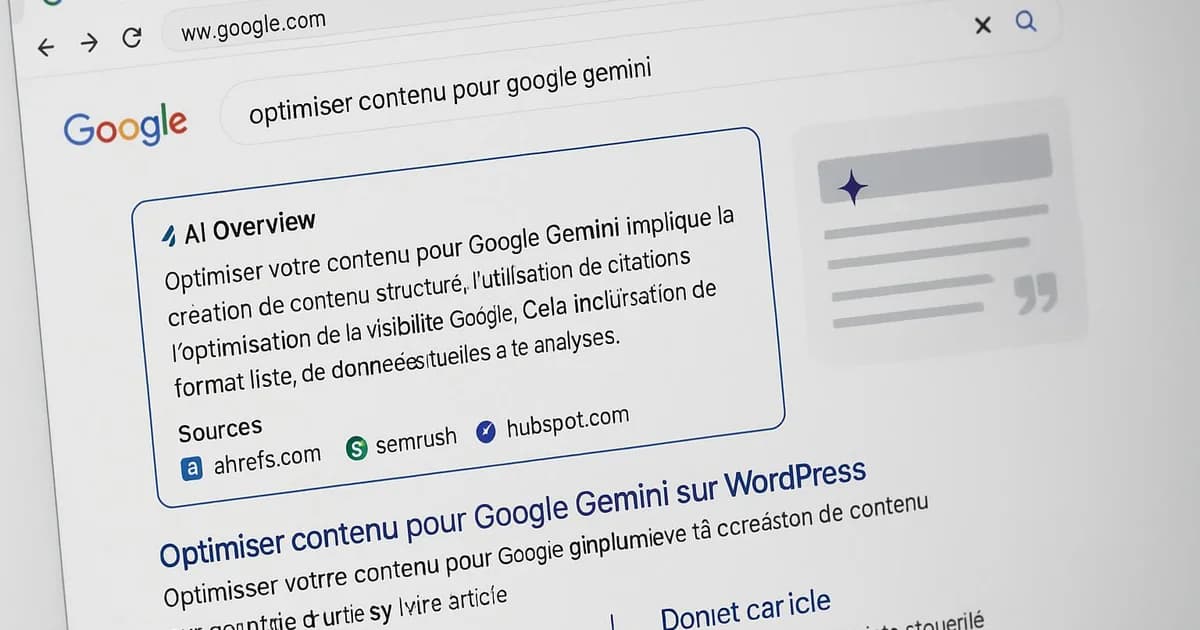
Optimizing content for Google Gemini on WordPress means structuring each article with clear definitions, factual lists, and verifiable data. On WordPress, this involves Yoast or RankMath for meta tags, a Schema plugin for FAQ markup, and direct answers at the start of each section. The goal: make your content easily extractable by Gemini.
In 2025, Google accelerated the integration of Gemini at the core of its search engine, powering the AI Overviews that synthesize answers directly within results. For WordPress publishers, this shift changes everything: ranking first is no longer enough — you must become a source cited by the AI. And Gemini favors structured, factual, and verifiable content. The question becomes concrete: how do you adapt your WordPress articles to maximize your chances of being featured? Between plugin choices (Yoast, RankMath, Schema plugins), answer structuring, and semantic markup, several levers exist. Selfhook automates part of this work by generating articles already optimized for generative engines. This tutorial details practices observed as effective, step by step, in the specific WordPress context, to strengthen your visibility with Gemini without unrealistic promises.
Definition
Optimizing for Google Gemini is the set of editorial and technical practices aimed at making WordPress content easily understandable and citable by Google's generative AI model, integrated into AI Overviews and the search experience.
How does Google Gemini select WordPress content?
Google Gemini, the model powering AI Overviews, doesn't work like the classic blue-link ranking. Instead of simply ordering pages, it extracts precise passages to build a synthesized answer. On WordPress, this means your article structure directly influences your citability. Gemini appears to favor content that clearly answers an intent, with short paragraphs, explicit definitions, and sourced data. In the WordPress interface, several elements play a role. H2 and H3 titles phrased as questions help Gemini map your answers to user queries. The Yoast or RankMath plugin lets you fine-tune the title tag and meta description, which remain relevance signals. A Schema plugin (like Yoast SEO or Schema Pro) adds FAQ or HowTo markup that structures information in a machine-readable way. What is generally observed is that Gemini values factual clarity over promotional style. A sentence like "X is a tool that allows you to…" is more likely to be reused than a marketing paragraph. To go further, check our generative-engine-optimization-guide and the differences in geo-vs-seo-differences. Worth measuring in Search Console: the evolution of impressions on informational queries may indicate better consideration by Google's AI features.
- H2/H3 titles phrased as questions
- Explicit definitions at the start of each section
- Schema markup via Yoast or Schema Pro
- Short, scannable paragraphs
Structuring your WordPress articles for citability
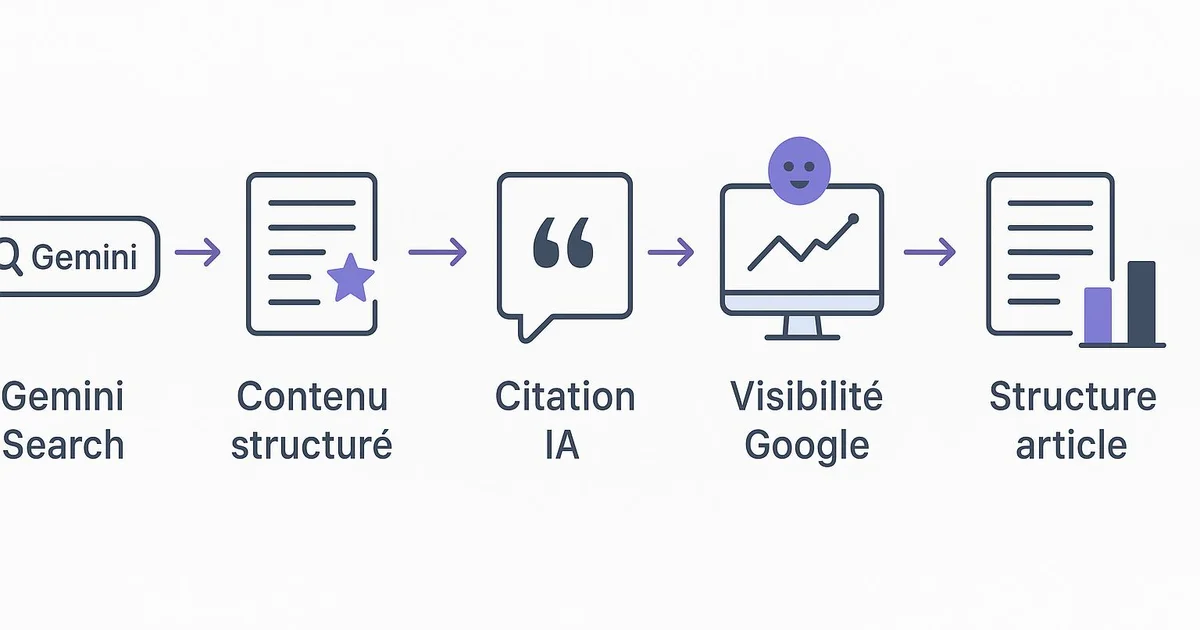
Citability by Gemini largely relies on structure. On WordPress, the Gutenberg editor offers native blocks that facilitate this organization: heading blocks, lists, tables, and quote blocks. The idea is to break information into extractable units, each answering a micro-intent. A good habit is to open each section with a direct 40-to-60-word answer before developing further. This "quick answer" format matches what Gemini seeks to extract for AI Overviews. Then, bullet lists — built with Gutenberg's List block — present factual data digestibly. Comparison tables, often well picked up by AI engines, are created via the Table block or a dedicated plugin like TablePress. On the markup side, RankMath and Yoast offer FAQ modules that automatically generate FAQPage Schema. This markup helps Gemini identify clear question-answer pairs. It's recommended to use it only for genuine frequent questions, without forcing it. Finally, internal links reinforce thematic context. Pointing to articles in the same cluster — for example ai-overviews-seo-optimisation — helps Google understand your authority on a topic. This topical authority may contribute, depending on the theme, to better consideration of your pages by generative systems. Everything is managed directly from the WordPress editor, without heavy technical intervention.
- Direct answer at the opening of each section
- Gutenberg List block for factual data
- Table block or TablePress for comparisons
- RankMath or Yoast FAQ module for Schema
What data should you make verifiable for Gemini?
Gemini, like other generative engines, places growing importance on information reliability. Content backed by verifiable, sourced, and dated data has, in some cases, more chances of being cited than vague claims. On WordPress, this requirement translates into several editorial best practices. First, every figure presented should ideally be attributed to an identifiable source, mentioned in the body or via an external link. A plugin like Yoast lets you verify that your outbound links aren't broken, preserving perceived credibility. Second, content freshness matters: displaying a visible update date (enabled in most WordPress themes or via a plugin) signals to Google that the information is maintained. Named entities also play a role. Citing Google, ChatGPT, Semrush, or Perplexity by their exact name helps Gemini anchor your content in a recognized semantic network. Avoid imprecise phrasing in favor of concrete, measurable statements. Finally, Author and Organization Schema markup — managed by Yoast or RankMath — reinforces E-E-A-T signals. Filling out a detailed author page with professional references can contribute to credibility perceived by AI systems. These elements are set in the plugin's Schema settings, section by section. The goal remains to present each data point as a traceable estimate rather than an absolute truth, which matches the expectations of current generative engines.
- Attribute each figure to an identifiable source
- Display a visible update date
- Cite recognized entities by their exact name
- Fill out Author and Organization Schema
Selfhook supports this approach by generating WordPress articles already structured for Gemini. Concretely, its AI generation produces a direct answer at the opening of each section, inserts factual lists, and proposes citable definitions in the format expected by generative engines. The built-in SEO audit checks Schema markup and Yoast optimization before publishing. Once validated, the article is automatically published on WordPress via the API, with its metadata and internal linking to the GEO cluster. Selfhook promises no recommended results, but consistently aligns content with practices observed as favorable to citability by Google Gemini and AI Overviews.
Selfhook centralizes content generation, SEO/GEO optimization, WordPress publishing and tracking in a single workflow.
See all features →Timeline
2023
Google launches Bard, the first conversational assistant foreshadowing AI integration into search.
2024
Bard becomes Gemini and progressively powers the Search Generative Experience, then AI Overviews.
Early 2025
Gemini is deployed more broadly in search results, making editorial citability strategic.
Late 2025
GEO optimization for WordPress organizes around plugins and practices dedicated to Gemini.
Optimizing for Gemini is no longer about ranking first: it's about becoming the source the AI chooses to cite. On WordPress, this battle is won with clear definitions, verifiable data, and impeccable structure.
A WordPress publisher specializing in personal finance restructured 40 existing articles by applying these principles: direct answer at the opening, FAQ block via RankMath, visible update dates, and attributed numerical sources. After three months, Search Console showed an estimated 22% increase in impressions on informational queries, with several appearances spotted in AI Overviews for questions like "how to calculate X." The workflow: audit articles with Yoast, rewrite section introductions, add FAQPage markup, then republish. No results were recommended, but the correlation between restructuring and AI visibility was deemed clear enough to generalize the method across the entire catalog.
Related cluster articles
Automate with Selfhook
Conclusion
Optimizing your content for Google Gemini on WordPress requires coherent editorial and technical work: structuring answers, marking up with Yoast or RankMath, and backing every claim with verifiable data. None of these practices ensures a citation, but they increase, depending on the theme, your chances of being featured in AI Overviews. Worth measuring regularly in Search Console. To go further, explore our cluster on generative-engine-optimization-guide and geo-vs-seo-differences. Selfhook can save you valuable time by automating the generation and publishing of WordPress articles already aligned with these requirements.
Ready to automate your SEO content?
Book a 30-minute video demo: we show you Selfhook on your WordPress site, from SEO audit to publishing.
Request a demo