
GEO WordPress: The Complete Guide to Being Cited by AI
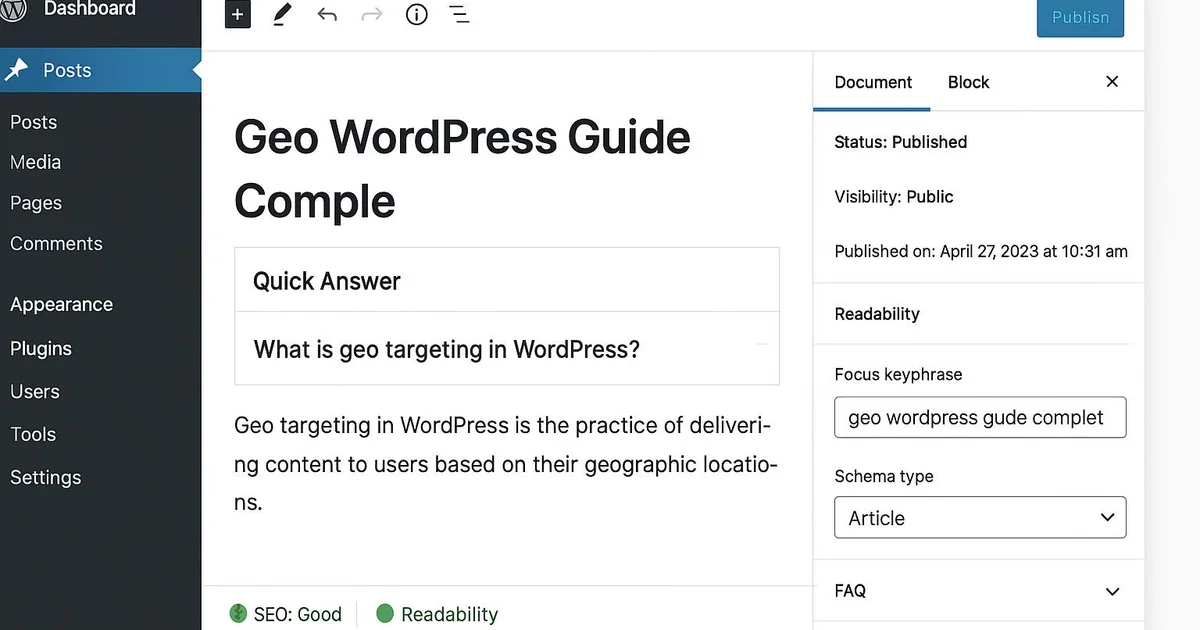
Quick answer
GEO WordPress involves optimizing a WordPress site to be cited by generative engines like ChatGPT, Google AI Overviews and Perplexity. This relies on structured content, JSON-LD via Yoast or RankMath, marked-up FAQs and citable direct answers. The goal: becoming a reference source for AI-generated responses.
Users now ask their questions to ChatGPT, Perplexity or Google's AI Overviews rather than a classic search engine. For a WordPress publisher, the question is no longer just "how to rank" but "how to be cited" by these engines. The problem: most WordPress sites aren't structured to be extracted by an AI. Missing JSON-LD markup, non-citable content, unstructured FAQs. This complete GEO WordPress guide details every concrete lever, plugin by plugin, to maximize your citations: from Yoast configuration to Schema markup, including writing direct answers. We'll also see how Selfhook automates this entire workflow, from generating structured content to WordPress publishing, to turn your site into a reference source for AI.
What is GEO on WordPress concretely?
GEO WordPress adapts your content so a generative engine like ChatGPT or Perplexity can extract and cite it. Unlike classic SEO which targets clicks, GEO targets the citation within a generated answer. On WordPress, this translates into concrete actions: structuring your articles with H2s framed as questions, adding JSON-LD markup via Yoast or RankMath, and providing direct answers at the start of each section. Google, with its AI Overviews, relies heavily on structured data. To dig into the theory, check our generative-engine-optimization-guide.
- Structure articles with clear Gutenberg blocks (headings, lists, tables)
- Enable automatic Schema markup via Yoast or RankMath
- Write citable direct answers in 40-80 words per section
How to structure your WordPress content for AI?
Structure is the first GEO lever generally observed as decisive. On WordPress, the Gutenberg editor makes semantic blocks easy: H2/H3 headings, bullet lists, tables and FAQ blocks. Yoast SEO offers a dedicated FAQ block that automatically generates FAQPage Schema, often picked up by generative engines. RankMath offers an equivalent feature. The idea is to provide ChatGPT or AI Overviews with autonomous, extractable content units. Each section should answer a specific question on its own, without depending on the rest of the article.
- Use Yoast's FAQ block to automatically generate FAQPage Schema
- Place a direct answer (quick answer) under each H2
- Add comparison tables via Gutenberg's Table block
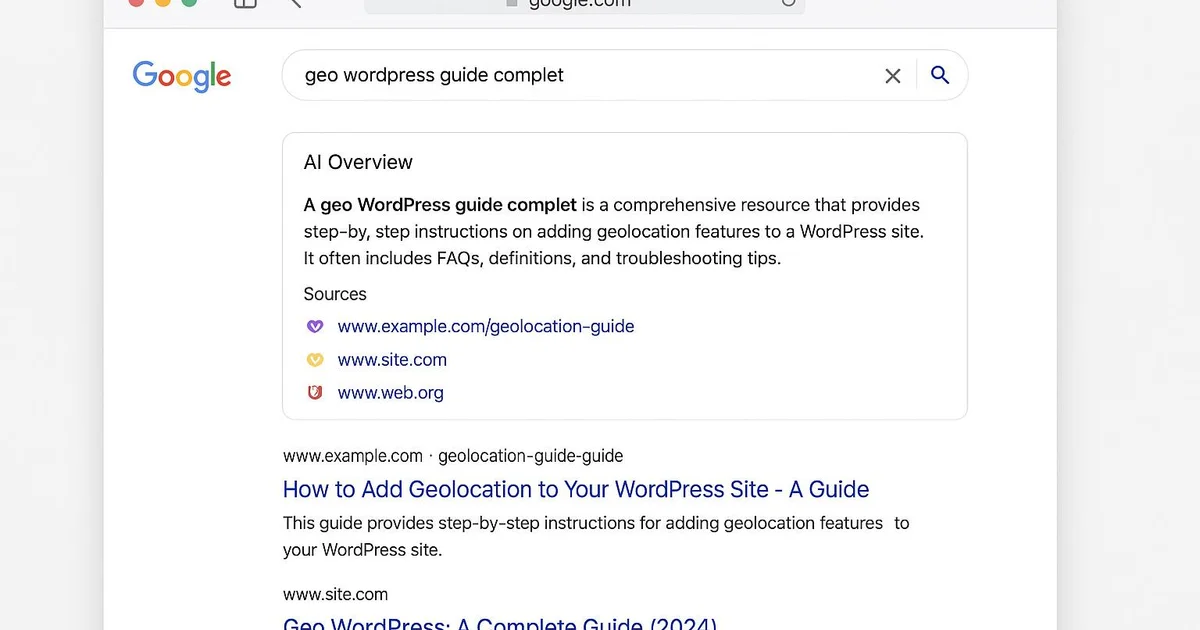
Why is JSON-LD essential in GEO WordPress?
JSON-LD is the structured data format recommended by Google. On WordPress, it tells engines the content type (Article, FAQPage, HowTo, Organization). Yoast SEO automatically generates a complete JSON-LD graph connecting your entities, which can contribute to better understanding by AIs. RankMath also offers an advanced Schema generator with over 20 types. Without this markup, a generative engine must guess your content structure, reducing your citation chances. Always verify your markup with Google's Rich Results Test tool.
- Check the JSON-LD graph generated by Yoast in the source code
- Add an Organization Schema with logo and social profiles
- Test each page with Google's Rich Results tool
GEO and SEO: do you have to choose on WordPress?
GEO doesn't replace SEO, it complements it. A WordPress site well optimized for Google remains the foundation: without indexing or authority, no AI will cite you. GEO adds a layer of optimization for extraction and citation. In practice, both reinforce each other: content structured for AI is also more readable for Google's crawlers. Semrush and Search Console remain your measurement tools. To understand the nuances, read our geo-vs-seo-differences article which details each approach on WordPress.
- Maintain SEO fundamentals: internal linking, speed, indexing
- Layer GEO on top: structure, JSON-LD, direct answers
- Measure both in Search Console depending on the topic
Take a WordPress article "How to configure Yoast SEO". In a non-GEO-optimized version, the content is a wall of unstructured text. After optimization: each step becomes an H2 framed as a question, with a 50-word direct answer right below, a Yoast FAQ block at the bottom, and a HowTo Schema via RankMath. Result generally observed on this type of rework: an increase in impressions in Search Console and the page appearing in certain AI Overviews for long-tail queries. The workflow takes around 30 minutes per article manually — a time publishers often seek to reduce through automation.
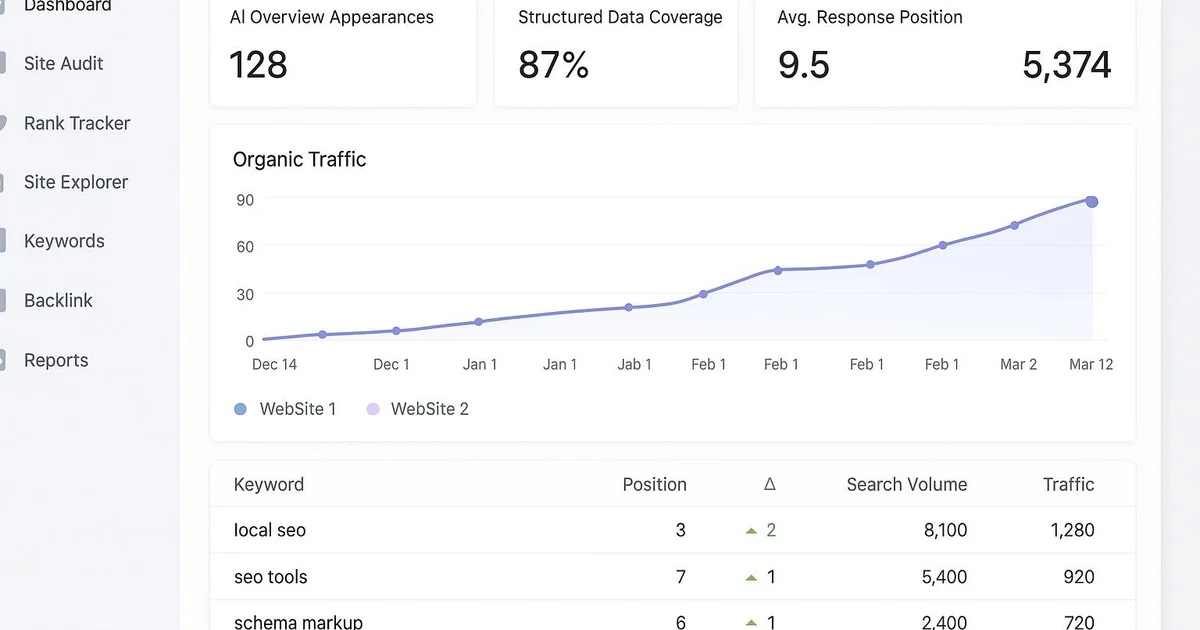
With Selfhook, this entire GEO WordPress workflow is automated. The structured AI generation produces articles with H2s as questions, direct answers and GEO-ready FAQs right from creation. JSON-LD (Article, FAQPage) is injected automatically, without manual Yoast configuration. The integrated SEO audit checks the structure and flags non-citable sections. Finally, automated WordPress publishing sends the optimized article directly into your back-office, ready to be indexed. A publisher can thus go from an idea to an article citable by ChatGPT and Perplexity in minutes, instead of hours of manual formatting.
Key takeaways
GEO WordPress targets citation by generative engines, not just clicks
Structure each article with H2s as questions and citable direct answers
Enable JSON-LD via Yoast or RankMath and test it with Google's tool
Use Yoast's FAQ block to automatically generate FAQPage Schema
GEO complements SEO: maintain indexing and authority fundamentals
Selfhook automates structure, JSON-LD and publishing to save time
Selfhook centralizes content generation, SEO/GEO optimization, WordPress publishing and tracking in a single workflow.
See all features →FAQ
Does GEO WordPress replace SEO?
No, GEO complements SEO. A WordPress site must first be indexed and hold authority for Google before being cited by an AI. GEO adds a layer of optimization for extraction and citation in ChatGPT or Perplexity.
Which plugin should I use for JSON-LD in GEO WordPress?
Yoast SEO automatically generates a complete JSON-LD graph connecting your entities. RankMath also offers an advanced Schema generator with over 20 types. Both work; the choice depends on your existing setup.
How do I know if my site is cited by ChatGPT or Perplexity?
There's no single official report. You can manually test your target queries in ChatGPT and Perplexity, and monitor impression increases on conversational queries in Search Console. Measurement remains indirect depending on the topic.
Is Yoast's FAQ block useful for GEO?
Yes, Yoast's FAQ block automatically generates FAQPage Schema markup, often picked up by generative engines and AI Overviews. It's a simple, effective GEO lever to integrate at the bottom of your WordPress articles.
How long does it take to optimize a WordPress article for GEO?
Manually, expect around 30 to 60 minutes per article to structure H2s, write direct answers and configure markup. Tools like Selfhook automate this process and cut the time to a few minutes.
Operational checklist
Related cluster articles
Automate with Selfhook
Conclusion
GEO WordPress is no longer optional for publishers who want to stay visible in the age of generative engines. By structuring your content, enabling JSON-LD via Yoast or RankMath, and writing citable direct answers, you increase your chances of being cited by ChatGPT, AI Overviews and Perplexity — while strengthening your classic SEO. This work requires method and time. That's exactly what Selfhook automates: structured content generation, automatic JSON-LD, GEO-ready FAQs and WordPress publishing in minutes. Start today to turn your WordPress site into a reference source for artificial intelligence.
Ready to automate your SEO content?
Book a 30-minute video demo: we show you Selfhook on your WordPress site, from SEO audit to publishing.
Request a demo