
SEO Automation Framework: The Complete 5-Step Method
Quick answer
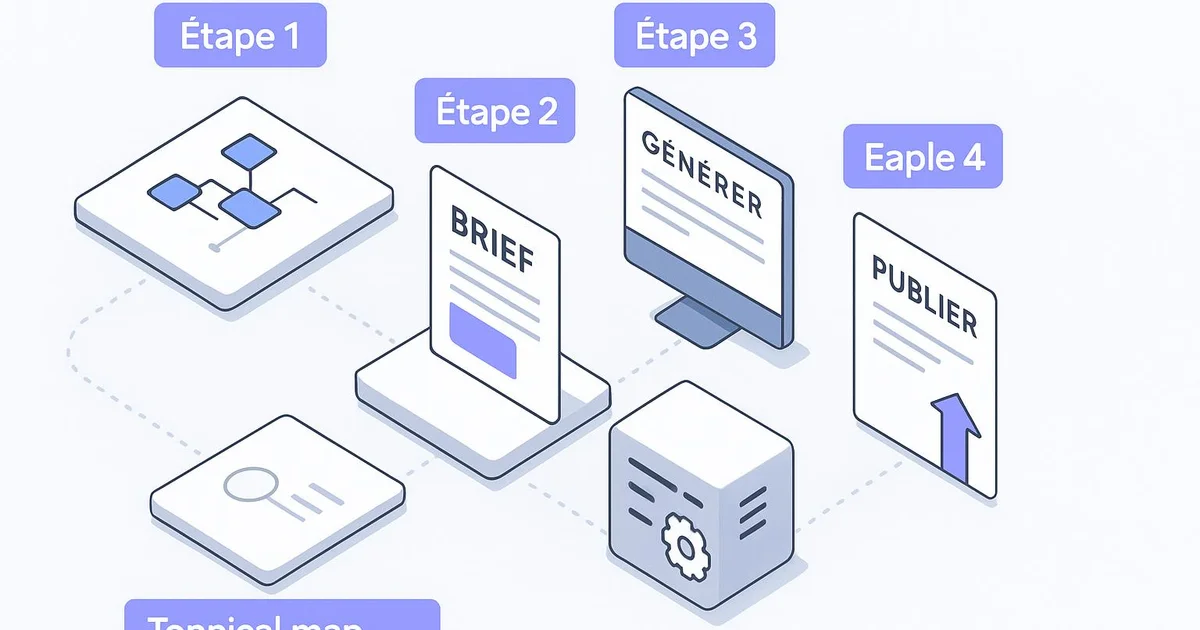
An SEO automation framework is a structured method in 5 reproducible steps: topical map, editorial brief, content generation, on-page optimization, then publishing. Each step is documented and measurable, allowing you to industrialize production without sacrificing semantic relevance or reading experience. The goal: produce at scale while keeping quality control.
Most SEO teams fail not for lack of tools, but for lack of a reproducible method. They stack content generators, plugins and spreadsheets with no overall logic, which produces uneven results that are hard to measure. An SEO automation framework solves this by imposing a clear sequence: each step has a goal, a deliverable and a validation criterion. This framework lets you move from artisanal production to a controlled industrial chain without losing semantic control. In this article, we detail a complete method in 5 steps — topical map, brief, generation, optimization, publishing — as implemented in Selfhook. Each phase is documented so it can be audited and reproduced. The idea is not to automate everything blindly, but to automate what is repeatable and keep humans where judgment matters. This framework fits within a broader logic covered in our complete SEO automation guide.
Definition
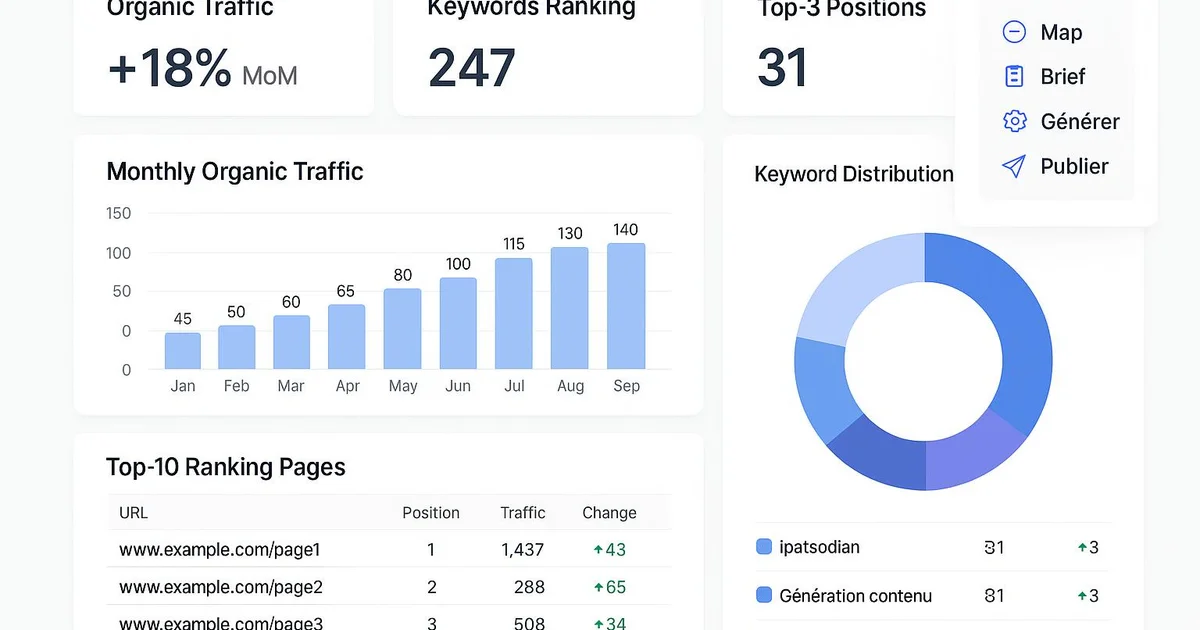
An SEO automation framework is a documented, reproducible sequence of steps — from topical mapping to publishing — that structures and partially automates SEO content production while retaining human control points.
What is an SEO automation framework and why have one?
An SEO automation framework is a structured system that organizes all content production operations, from topic selection through publishing. Unlike a mere accumulation of tools, it defines a logical order, dependencies between steps and validation criteria at each transition. Without a framework, SEO automation tends to produce incoherent volume: redundant articles, weak semantic coherence, absence of thoughtful internal linking. The framework corrects this by imposing discipline. The main benefit is reproducibility. A team following a documented framework can delegate part of the process to a new collaborator or an automated system without degrading quality, because the rules are explicit. This reduces dependence on individuals and makes results measurable: you can isolate which step is failing when a page underperforms in Search Console. A second benefit is scalability. Producing ten coherent articles requires little method; producing two hundred covering a complete thematic domain requires a lot. The framework handles this load without quality collapsing. Finally, a well-designed framework natively integrates GEO requirements — being citable by ChatGPT, Perplexity or Google's AI Overviews. This requires clear definitions, direct answers and a scannable structure, all of which can be standardized within a framework. A framework is therefore not bureaucratic constraint: it is a productivity multiplier that, in some cases, also improves the consistency of observed results.
Step 1: build the topical map
The topical map is the foundation of the framework. A topical map is the exhaustive mapping of the topics and subtopics that make up a thematic domain, organized into clusters linked by logical internal linking. Without this map, automation produces isolated articles that build no thematic authority. Construction begins by identifying the central entity — the pillar of your domain — then breaking it down into subtopics. Each subtopic becomes a cluster, and each cluster contains several search intents to cover. The goal is coverage: Google and AI engines generally value sites that address a topic in depth rather than superficially. Several signals feed this map: Google suggestions, related questions, volume data from Semrush, and analysis of existing SERPs. At this stage, you write nothing; you structure. You also define the content type expected for each node: guide, comparison, definition, tutorial. A well-built topical map also specifies the target internal linking. Each page knows which pages to point to, which reinforces the semantic coherence perceived by crawlers.
- Define the pillar entity and main clusters
- Break each cluster into search intents
- Assign a content type to each node
- Map the target internal linking
- Prioritize by volume, difficulty and business relevance
Step 2: write a structured, reproducible brief
The brief is the bridge between strategy and production. It is the document that transforms a topical map node into concrete, actionable instructions, whether for a human writer or an AI generation system. A weak brief produces weak content, regardless of downstream automation quality. A reproducible brief contains standardized elements: the primary keyword and its variants, the dominant search intent, the editorial angle, the expected H2/H3 heading structure, entities and concepts to mention mandatorily, and internal pages to link to. It also specifies tone and target level of detail. For GEO, the brief must impose certain citable formats: a direct answer at the top, an explicit definition, autonomous sections. These formal constraints are not cosmetic; they increase, in some cases, the likelihood that a passage will be picked up by ChatGPT or an AI Overview. The strength of a standardized brief is that it becomes a template. Once validated for a content type, it replicates across dozens of topics by changing only the semantic variables. This level of standardization is precisely what makes generation at scale reliable. The brief should also anticipate Yoast or RankMath optimization criteria: target length, reasoned keyword density, presence in titles and meta description. By integrating these constraints from the brief stage, you avoid costly back-and-forth at the end of the chain. A good brief reduces uncertainty and makes each subsequent step more predictable.
How to automate content generation without sacrificing quality?
Generation is the most visible step of the framework, but also the most misunderstood. Automating generation does not mean clicking a button and publishing. It means feeding a system with a rich brief, then applying systematic quality controls to the output. A modern AI generator — based on language models — produces coherent text only if it receives precise context. That is why the quality of step 2 conditions everything. A detailed brief reduces hallucinations, frames tone and imposes structure. Generation then becomes disciplined execution rather than improvisation. Quality is preserved through several complementary mechanisms. First, fact-checking: numerical claims must be presented as estimates and be verifiable. Second, semantic control: does the text cover the entities planned in the brief? Finally, readability control: clear sentences, no filler, genuinely autonomous sections. You must also avoid the trap of excessive standardization. If all articles follow exactly the same template, they become detectable as mass content and lose perceived value. The framework must therefore introduce controlled variability: different angles, specific examples, data adapté to each topic.
- Feed generation with a complete brief, not just a keyword
- Check coverage of expected entities
- Present numerical data as estimates
- Introduce controlled variability between articles
- Proofread for readability and remove filler
Step 4: on-page optimization and Yoast compatibility
Once content is generated, on-page optimization adjusts the page to maximize its readability by engines. This step is often neglected in improvised workflows, even though it has a measurable impact in Search Console. Optimization covers several dimensions. The first concerns tags: title optimized with the keyword at the start, compelling meta description of 145 to 160 characters, coherent heading structure. Yoast and RankMath provide useful indicators, but they must be interpreted, not followed blindly — a Yoast green light does not ensure good ranking. The second dimension is semantic. You verify the natural presence of the primary keyword and its variants, the richness of the lexical field, and coverage of related questions. Well-optimized content answers search intent completely, which may contribute to improving time on page and reducing bounce rate. The third dimension is internal linking, defined from the topical map. Each article should point to relevant cluster pages and receive links in return. This linking reinforces the thematic structure perceived by Google. Finally, optimization integrates GEO signals: appropriate structured data, direct answers at the start of sections, explicit definitions. These elements increase, depending on the topic, the likelihood of being cited by AI engines like Perplexity or AI Overviews. Optimization is not a final touch-up: it is a full step, with its own checklist and validation criteria. Automating part of these controls — tag verification, missing link detection — frees time for the editorial judgment that remains irreplaceable.
Step 5: WordPress publishing and performance measurement
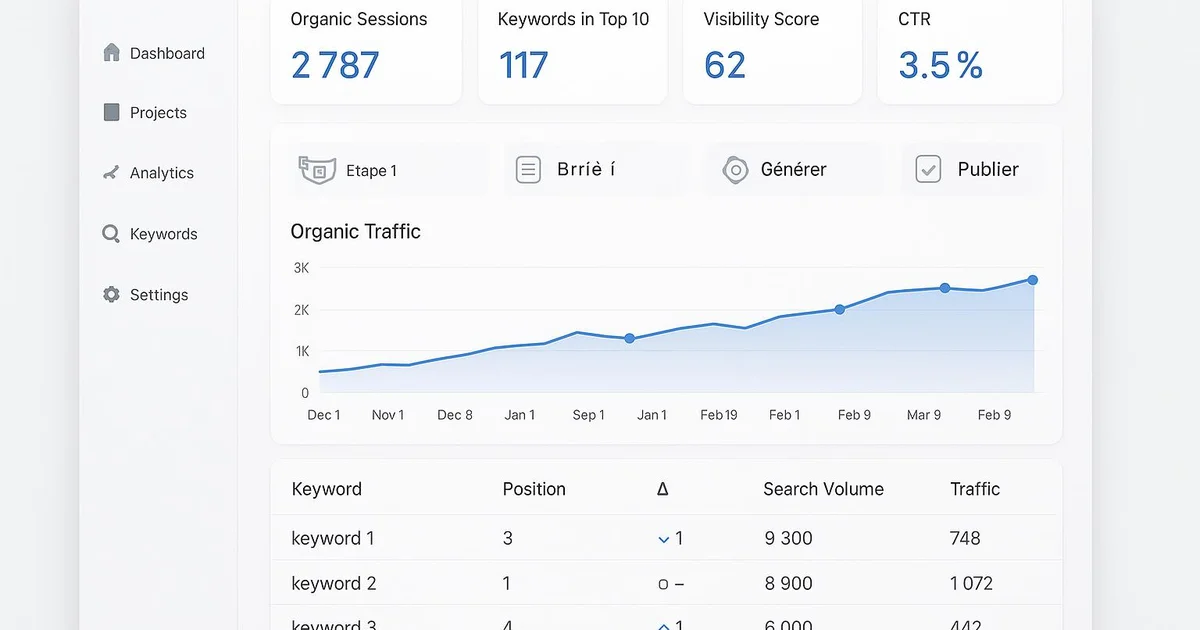
Publishing closes the cycle but does not end the work. Publishing to WordPress automatically assumes content arrives formatted, with its tags, images and internal linking already in place. This is where much of the framework's time savings occur. A well-designed automated publish transfers the article into WordPress via the API, applies the right template, inserts the meta description, configures Yoast or RankMath fields and schedules the go-live. The goal is to eliminate repetitive manual manipulations, sources of errors and wasted time. But publishing is only the start of the measurement loop. Each page must be tracked in Search Console: impressions, average position, click-through rate. This data lets you identify content to rework and validate or invalidate topical map hypotheses. SEO remains an empirical field: you form hypotheses, publish, measure, adjust. The framework then becomes an iterative cycle rather than a linear chain. Lessons from measurement flow back into the topical map and refine subsequent briefs. This feedback loop distinguishes a mature system from a mere content factory.
- Publish via the WordPress API with pre-filled tags and fields
- Verify display and linking after go-live
- Track impressions, position and CTR in Search Console
- Identify content to rework after a few weeks
- Feed lessons back into the topical map and briefs
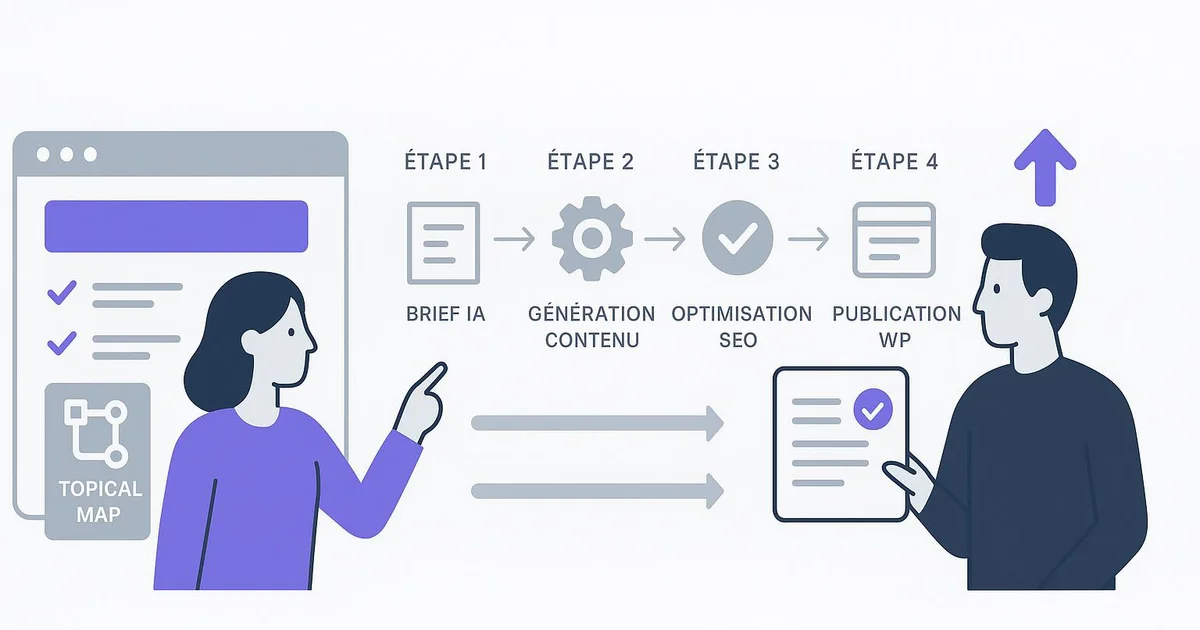
Selfhook implements exactly this 5-step framework. From a topical map defined in the tool, Selfhook generates standardized briefs, then produces content via its AI generation while respecting the planned entities and structure. The built-in SEO audit then checks Yoast criteria, internal linking and GEO signals before validation. Finally, automated WordPress publishing transfers the formatted article to your site, Yoast fields and meta description included. Each step remains documented and auditable: you keep a human control point where judgment matters, while eliminating repetitive manipulations. Performance tracking closes the cycle to refine subsequent productions.
Selfhook centralizes content generation, SEO/GEO optimization, WordPress publishing and tracking in a single workflow.
See all features →FAQ
Does an SEO automation framework replace a writer?
No. The framework automates repeatable tasks — structuring, draft generation, formatting, publishing — but keeps human control points. Editorial judgment, fact-checking and strategic angle remain human tasks in a well-designed chain.
How long before you see results with this framework?
It depends on the topic, domain authority and competition. First signals are generally measured in Search Console over several weeks to a few months. The framework accelerates production, not ranking itself, which remains gradual.
Is generated content penalized by Google?
Google evaluates content quality and usefulness, not its production method. Content that is generated then controlled, factual and relevant can perform. Unverified mass content, however, carries a higher risk.
Is a topical map mandatory before starting?
It is strongly recommended. Without thematic mapping, automation produces isolated articles that build little authority. The topical map gives coherence and linking to the whole, a key factor in observed performance.
Operational checklist
Common mistakes
Automating without a topical map
Producing isolated articles without thematic mapping scatters effort and builds little domain authority.
Generating from a single keyword
Without a detailed brief, the AI generator improvises, increasing the risk of hallucinations and shallow content.
Following Yoast blindly
A Yoast green light optimizes formal criteria but ensures neither editorial quality nor ranking.
Publishing without a measurement loop
Ignoring Search Console prevents identifying hypotheses to correct and freezes the framework into a mere content factory.
Over-standardizing
Articles that are all identical become detectable as mass content and lose perceived value.
Action plan
- 1
Map your domain
Build a complete topical map: pillar entity, clusters, intents and linking. This is the foundation of the entire framework.
- 2
Standardize your briefs
Create a brief template per content type, integrating mandatory entities, heading structure and GEO constraints.
- 3
Generate with quality control
Feed generation with the complete brief, then check semantic coverage, facts and readability before validation.
- 4
Optimize on-page
Adjust tags, internal linking and GEO signals. Use Yoast or RankMath as indicators, not absolute truth.
- 5
Publish and measure
Publish automatically to WordPress, then track performance in Search Console to feed the improvement loop.
Key takeaways
An SEO automation framework imposes order and validation criteria, not just tools.
The topical map is the foundation: without it, automation produces incoherent volume.
Brief quality determines downstream generation quality.
On-page optimization and internal linking are full steps, not final touch-ups.
Measurement in Search Console turns the linear chain into an iterative improvement cycle.
Humans keep control of judgment; automation handles the repeatable.
Artisanal production vs SEO automation framework
| Criterion | Without framework | With framework |
|---|---|---|
| Reproducibility | Depends on individuals | Documented and transferable |
| Scalability | Hard beyond a few articles | Sustainable across hundreds of pages |
| Semantic coherence | Irregular | Structured by the topical map |
| Result measurement | Diffuse | Isolable per step via Search Console |
| GEO compatibility | Random | Standardized from the brief |
Sources
- Google Search Console — Primary source for measuring impressions, average position and CTR per page.
- Yoast SEO documentation — Reference on on-page optimization and readability criteria for WordPress.
- Semrush — Volume data and SERP analysis to feed the topical map.
- Google Search Central — Official guidelines on content quality and usefulness.
An often-overlooked point: the feedback loop must flow back to the topical map, not just the brief. When a page underperforms, the cause is frequently structural — a poorly split cluster or a misidentified intent — rather than editorial. Rewriting the article without revisiting the mapping treats the symptom, not the cause. A mature framework therefore periodically audits the topical map itself in light of Search Console data, which distinguishes a learning system from a mere frozen production chain.
Related cluster articles
Reference guides
Automate with Selfhook
Conclusion
An SEO automation framework is not a magic wand, but a discipline. By structuring production into five reproducible steps — topical map, brief, generation, optimization, publishing — you transform artisanal production into a measurable, scalable system, while keeping humans where judgment matters. The key remains the measurement loop: each publication feeds the next decisions. Selfhook implements this framework end to end, from thematic mapping to automated WordPress publishing, with documented, auditable steps. To go further, see our automated SEO workflow guide and our topical map guide. Start small, measure, then industrialize.
Ready to automate your SEO content?
Book a 30-minute video demo: we show you Selfhook on your WordPress site, from SEO audit to publishing.
Request a demo