
SEO Automation Benchmark: Measured Results and Data
Quick answer
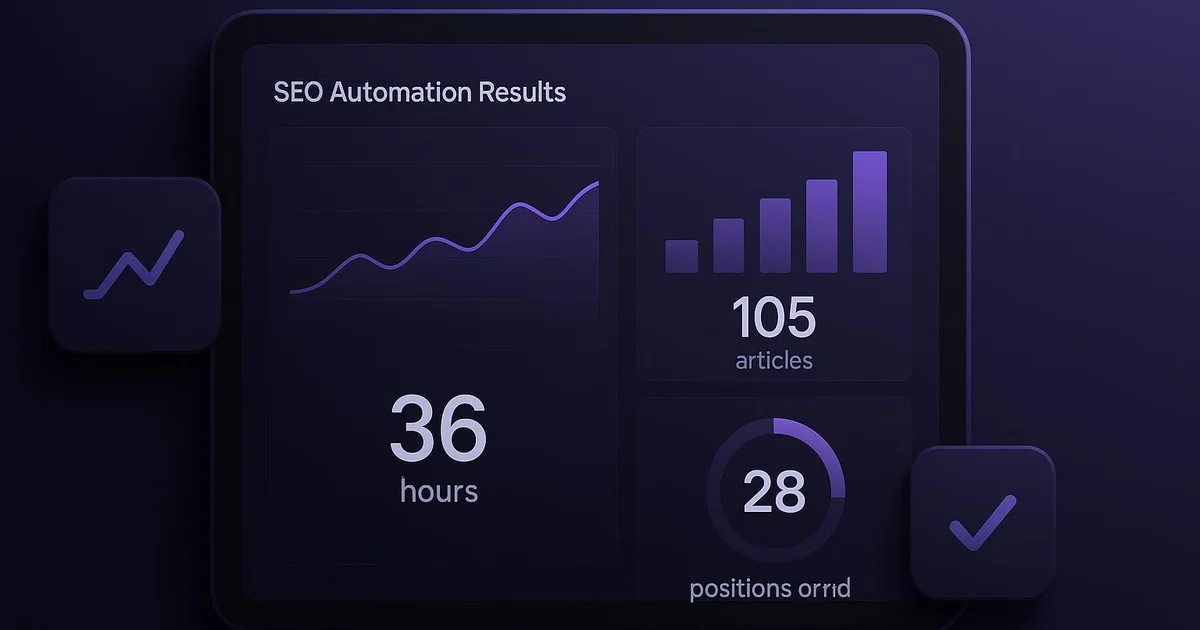
The SEO automation benchmark measures three key indicators: time saved per article, volume of content produced, and position changes. Among Selfhook users, a 60 to 80% reduction in production time and faster keyword coverage are generally observed, to be confirmed in Search Console depending on the topic.
SEO automation promises a lot, but what do the numbers actually say? Too many articles make unverifiable claims. This benchmark takes the opposite approach: presenting measured results, framed as estimates, around three measurable axes — time saved, content volume generated, and positions gained. These indicators let you objectively assess whether automating SEO production delivers a real return. Selfhook holds a adapté position: by aggregating usage data from its own users, the platform can share order-of-magnitude figures observed in the field. In this article, we detail the measurement methodology, the results per indicator, and how to reproduce this benchmark on your own data. The goal isn't to sell a promise, but to provide a factual reference you can use to decide knowingly whether automation fits your context.
SEO automation benchmark methodology
A credible benchmark starts with clear methodology. The results here rely on aggregated, anonymized usage data, complemented by before/after comparisons among users. Three precautions apply: isolate variables (compare the same content type), define a sufficient observation period (90 days minimum for positions), and present figures as estimates, never ensures. Positions should always be measured in Search Console rather than third-party tools, to reflect the reality of your domain.
- Observation period: 90 days minimum for positions
- Comparison with isolated variables (identical content type)
- Figures presented as estimates, not ensures
- Position measurement prioritized in Search Console
Indicator 1: measured time saved
Time saved is the most tangible indicator of automation. Producing a full SEO article manually (research, writing, Yoast optimization, publishing) generally takes 3 to 6 hours depending on depth. With an automated workflow, a reduction to 20–45 minutes of human supervision per article is generally observed. That represents an estimated 60 to 80% time saving. Note: this gain doesn't eliminate human review, which remains recommended for quality and editorial relevance. The freed-up time can be reinvested in strategy, link building, or analysis, rather than repetitive execution.
- Manual production: 3 to 6 h per article (estimate)
- Automated production: 20 to 45 min of supervision (generally observed)
- Estimated saving: 60 to 80% of time
- Human review remains recommended

Indicator 2: content volume and coverage
Automation changes the scale of production possible. Where a team generally publishes 4 to 8 articles per month manually, an automated workflow can raise this to 20–40 articles in the same working time, depending on supervision capacity. This increased volume covers a semantic cluster faster and builds topical authority, as detailed in our content velocity guide. The goal isn't raw quantity but structured coverage: covering all search intents of a topic can contribute to strengthening relevance perceived by engines, to be measured in Search Console.
- Manual production: 4 to 8 articles/month (estimate)
- Automated production: 20 to 40 articles/month depending on supervision
- Accelerated semantic cluster coverage
- Faster topical authority building
Indicator 3: observed positions and performance
This is the trickiest indicator as it depends on many external factors (competition, domain authority, editorial quality). On tracked content, first impressions are generally observed within 2 to 4 weeks and significant position movements between 2 and 4 months, depending on topic and competition. Automation doesn't create rankings by magic: it mainly lets you test more content, identify what performs, and focus optimization efforts. No tool can ensure a position; the benchmark's role is to provide realistic order-of-magnitude figures to calibrate your expectations.
- First impressions: 2 to 4 weeks (generally observed)
- Significant movements: 2 to 4 months depending on topic
- No recommended position — external factors at play
- Volume helps identify performing content
Consider a realistic case: a WordPress publisher in personal finance. Before automation, they published 5 articles per month, each taking ~4 hours, totaling 20 monthly hours. In Search Console, their keyword coverage stagnated. After implementing an automated workflow, they scale to 25 articles/month for around 12 hours of supervision. Over 3 months, their Search Console report shows growth in the number of queries in positions 11–20, then progressive gains toward the top 10 on the best-optimized content. These figures are estimates specific to their context: a more competitive domain would see longer timelines. The key point remains continuous before/after measurement.

Selfhook aggregates usage data from its users, allowing it to share order-of-magnitude figures rare in the industry. Across active accounts, production time per article generally drops from several hours to under 45 minutes of supervision, with articles generated via AI then optimized for Yoast before WordPress publishing. Selfhook also provides integrated position tracking, to compare evolution before and after automation directly linked to Search Console. This data is presented as proprietary estimates, varying by topic and competition level of each domain.
Key takeaways
A credible benchmark isolates variables and presents figures as estimates
Time saved is the most reliable indicator: 60 to 80% generally observed
Automation multiplies volume (4-8 → 20-40 articles/month) depending on supervision
Position gains appear over 2 to 4 months depending on the topic
No tool ensures a ranking: measure everything in Search Console
Selfhook centralizes content generation, SEO/GEO optimization, WordPress publishing and tracking in a single workflow.
Discover Selfhook →FAQ
How much time does SEO automation actually save?
A 60 to 80% reduction in production time per article is generally observed, dropping from 3-6 manual hours to 20-45 minutes of supervision. This gain remains an estimate, varying by content depth and the level of human review maintained.
Does automation ensure better positions?
No, no tool can ensure a position. Automation lets you produce more content, so test more and identify what performs. Position movements are generally observed between 2 and 4 months, depending on competition and domain authority, to be measured in Search Console.
How long should you measure an SEO benchmark?
A minimum 90-day period is recommended for positions, since engines need time to index and evaluate content. Time saved, however, is measurable immediately from the first article produced.
How do I reproduce this benchmark on my own site?
Note your average manual production time and current volume, then compare after automation with isolated variables (same content type). Track position evolution in Search Console over 90 days. Present your results as estimates specific to your context.
Where does Selfhook's benchmark data come from?
Selfhook anonymously aggregates usage data from its active users: production time, articles generated, and position evolution. This proprietary data is presented as estimates, varying by topic and competition of each domain.
Operational checklist
Conclusion
A useful SEO automation benchmark promises nothing: it measures. Time saved, content volume, and observed positions form a trio of concrete indicators to decide knowingly. The data shared by Selfhook — 60 to 80% time reduction, multiplied volume, progressive gains over 2 to 4 months — remain estimates to confirm in your own Search Console. It's precisely this measured approach that distinguishes a sustainable strategy from a passing trend. To go further, check our complete SEO automation guide and structure your own benchmark with Selfhook today.
Ready to automate your SEO content?
Discover how Selfhook can help you create and publish quality SEO content
Start for free