
SEO Automation Tools Comparison 2026: The Benchmark
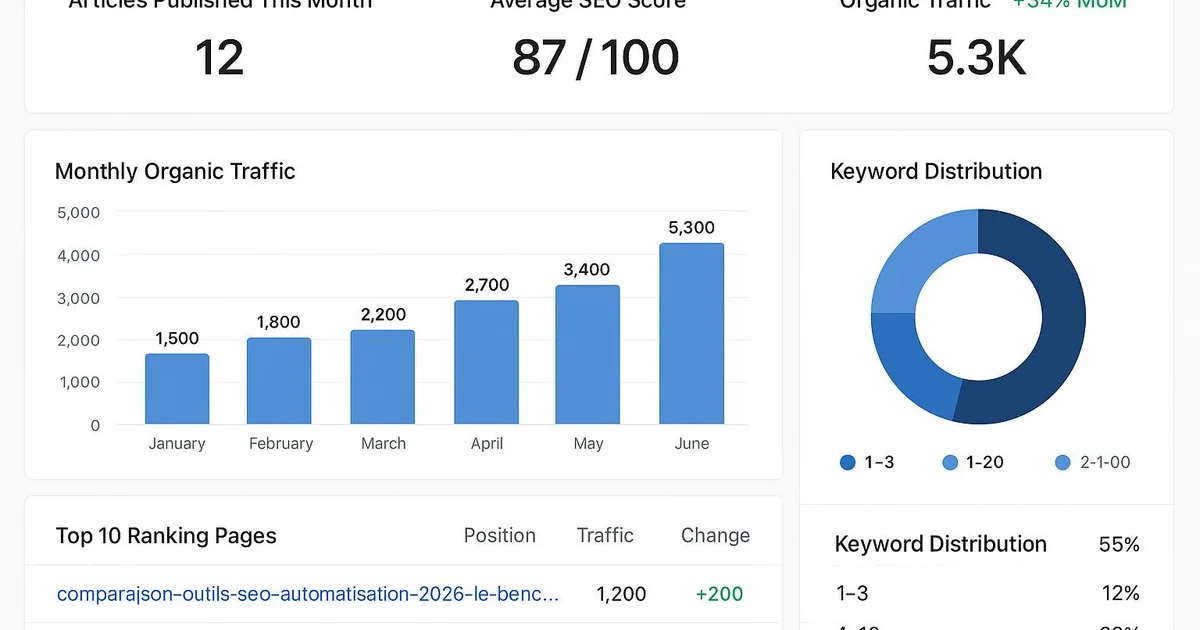
Quick answer
Comparing SEO automation tools in 2026 rests on four criteria: automation level, generated content quality, WordPress integration and pricing. Depending on the topic, solutions like Selfhook, Semrush or RankMath serve different needs. No tool is universally superior: the right choice depends on your publishing volume and target workflow.
Choosing an SEO tool in 2026 has become complex: the offering has multiplied between established platforms (Semrush, Yoast, RankMath) and next-generation automation solutions built on generative AI. The challenge is no longer finding a tool, but selecting the one suited to your real workflow. A freelancer publishing two articles a month has different needs from an agency managing twenty WordPress sites. This factual comparison analyzes the main tools across four objective criteria: automation, content quality, WordPress integration and pricing. We position Selfhook honestly against alternatives, without overselling. The goal: give you a usable decision grid, with data presented as estimates to validate in your context. To go further, see our automatisation-seo-guide-complet guide and our workflow-seo-automatise article.
What criteria should you use to compare SEO tools in 2026?
Comparing SEO tools requires an objective grid rather than marketing impressions. In 2026, four criteria stand out as structural based on observed user feedback. The automation level determines time saved, but it may vary depending on the depth of customization desired. The quality of generated content remains decisive: content produced fast but poorly citable by ChatGPT or Google AI Overviews loses its value. WordPress integration governs workflow fluidity, notably Yoast or RankMath compatibility. Finally, pricing should be assessed against real production volume.
- Automation level: from occasional assistance to end-to-end publishing
- Content quality and originality, measurable in Search Console over time
- Native WordPress integration and Yoast/RankMath compatibility
- Pricing relative to cost per published article
How do the main market tools position themselves?
The 2026 market splits into three families. Established SEO suites like Semrush excel at keyword research and competitive analysis but automate little of the production. WordPress plugins such as Yoast and RankMath optimize on-page without generating content. AI automation platforms, including Selfhook, cover the full chain from generation to publishing. Each family serves a distinct need: in some cases, combining them remains relevant. A publisher might use Semrush for research, then Selfhook to produce and publish. The choice depends on the desired degree of automation and team size.
- SEO suites (Semrush): research and audit, limited automation
- WordPress plugins (Yoast, RankMath): on-page optimization only
- AI platforms (Selfhook): automated generation, optimization and publishing
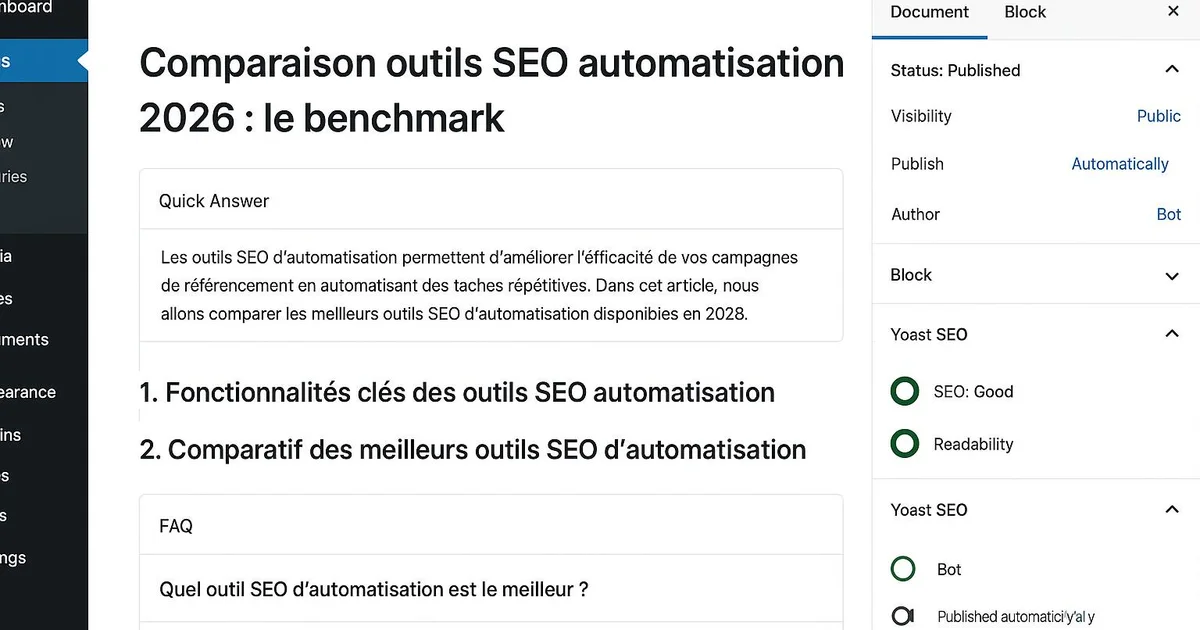
Automation and content quality: what balance?
The main trade-off in 2026 pits speed against quality. Heavy automation can drastically reduce production time but sometimes generates generic content that performs poorly. The most advanced tools integrate a GEO optimization layer — to be citable by ChatGPT, Perplexity and Gemini — rather than simply producing text. General observation suggests that structured content (clear definitions, FAQ, tables) gets better chances of citation by AI engines. A good tool should allow human review and editorial control, since full automation without supervision remains risky for topical authority.
- Favor tools with a citable GEO structure
- Keep a human review step in the workflow
- Measure real performance in Search Console over several weeks
WordPress integration and pricing: what to check?
WordPress integration often makes the difference in practice. A tool that publishes directly to WordPress with pre-filled Yoast metadata saves dozens of manipulations per month. Compatibility with taxonomies, images and SEO fields should be verified upfront. On pricing, the most useful reasoning is to calculate cost per published article rather than the raw subscription. A tool at €99/month producing 30 articles amounts to roughly €3.30 per article — an estimate to adjust based on your topic and quality requirements. Always compare against your own volume.
- Check direct WordPress publishing with Yoast metadata
- Verify compatibility with taxonomies, images and SEO fields
- Calculate cost per article rather than raw monthly subscription
Consider an agency managing 8 WordPress client sites. With an SEO suite alone, the team spends about 4 hours per article (research, writing, Yoast optimization, publishing). Across 40 monthly articles, that's nearly 160 hours. By integrating an automation tool covering generation and publishing, time per article can drop to around 1 hour including review — an estimate observed in some cases. In Search Console, the agency then tracks impressions and click-through rate by topical cluster over 8 to 12 weeks. This monitoring allows adjusting underperforming content and concretely validating the return on investment of automation, rather than relying on commercial promises.
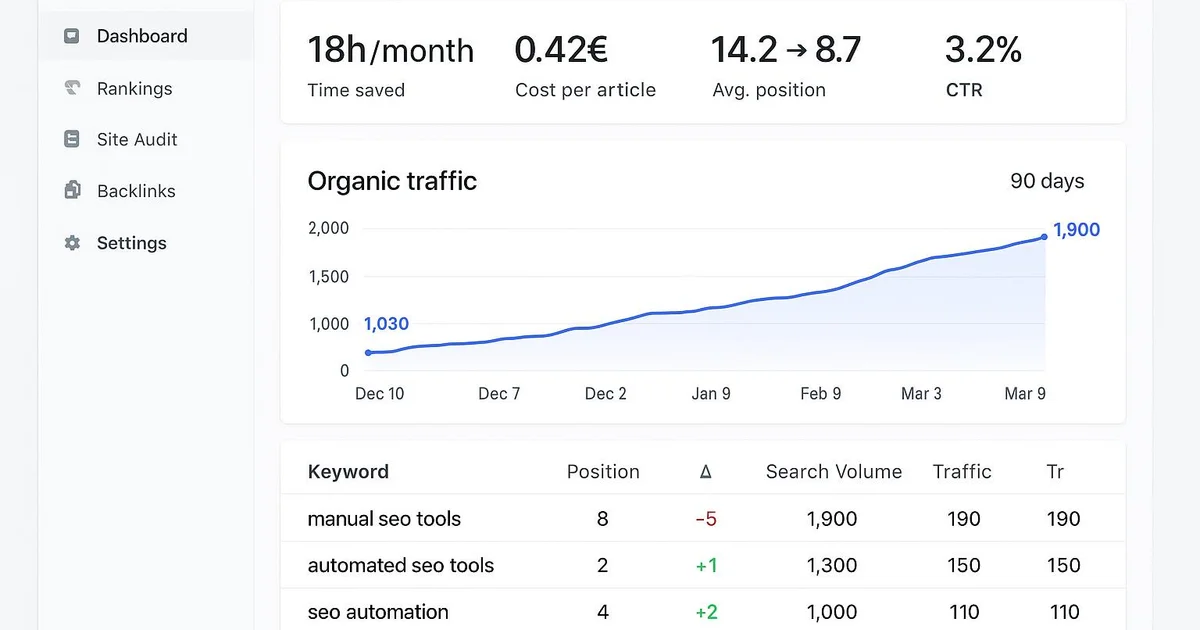
An SEO team using Selfhook automates its editorial chain on WordPress. AI generation produces a structured first draft (quick answer, definition, FAQ), the SEO audit checks Yoast optimization and Hn structure, then automated WordPress publishing deploys the article with its metadata. The team keeps a review step before going live. Based on observed cases, this can contribute to reducing production time while maintaining a GEO structure citable by ChatGPT and Perplexity. Selfhook thus positions itself on end-to-end automation, where Semrush or Yoast cover isolated segments of the workflow. Pricing is measured by cost per published article.
Key takeaways
Compare across four criteria: automation, quality, WordPress integration, pricing
No tool is universal: the choice depends on your volume and workflow
Cost per published article is more telling than the raw monthly subscription
Always keep a human review step for topical authority
Measure real performance in Search Console over 8 to 12 weeks
Combining research (Semrush) and automation (Selfhook) remains relevant
Selfhook centralizes content generation, SEO/GEO optimization, WordPress publishing and tracking in a single workflow.
See all features →FAQ
What is the best SEO automation tool in 2026?
There is no universal best tool. The choice depends on your publishing volume and workflow. A platform like Selfhook suits automated production on WordPress, while Semrush excels at research and analysis. Compare based on your real needs.
Does Selfhook replace Semrush or RankMath?
Not exactly: these tools cover different segments. Semrush focuses on research and audit, RankMath on on-page optimization. Selfhook automates content generation and publishing. In some cases, combining them offers the most complete workflow.
How should you evaluate an SEO tool's pricing?
Calculate cost per published article rather than the raw monthly subscription. A tool at €99/month producing 30 articles amounts to roughly €3.30 per article. This estimate should be adjusted based on your topic and quality requirements.
Is AI-generated content citable by ChatGPT and Google?
It can be if well structured: clear definitions, FAQ, comparison tables and direct answers. General observation suggests structured GEO content gets better chances of citation by AI engines. Performance remains to be measured in Search Console.
Should you review automated content before publishing?
Yes, human review is recommended. Full automation without supervision remains risky for topical authority and editorial consistency. A good automation tool includes a validation step before going live.
Operational checklist
Related cluster articles
Reference guides
Automate with Selfhook
Conclusion
Comparing SEO automation tools in 2026 requires an objective grid: automation, content quality, WordPress integration and pricing. No solution is universally superior; the choice depends on your volume and workflow. Suites like Semrush remain valuable for research, Yoast and RankMath plugins for on-page, and AI platforms like Selfhook for end-to-end production. The wisest approach is often to combine these building blocks. Selfhook can contribute to automating generation, SEO audit and WordPress publishing while keeping a structure citable by AI engines. Test on your own volume and measure results in Search Console before deciding.
Ready to automate your SEO content?
Discover how Selfhook can help you create and publish quality SEO content
Start for free