
Featured Snippets with Search Console: Actionable Strategy
Quick answer
Featured snippets are won by targeting queries where you already rank in positions 2-10 in Search Console, then restructuring content (short answer, lists, tables) to directly match intent. This approach can contribute to earning position 0, to be measured in Search Console over a few weeks.
Already on page one for several queries but the featured snippet keeps slipping away? Good news: Google Search Console holds exactly the data to target these opportunities. Instead of guessing, you identify queries where you rank 2-10 with solid impressions — then restructure your content to answer intent in an extractable way. This article gets straight to the point: which queries to target, how to find them in Search Console, and how to format content to maximize your chances. Selfhook automates part of this work by detecting those 2-10 queries and structuring content to aim for the snippet. Pair it with your Search Console quick wins for measurable impact.
Definition
A featured snippet is an answer excerpt shown by Google above the organic results (position 0), which pulls part of a page's content directly to answer a query.
How do you find queries with snippet potential?
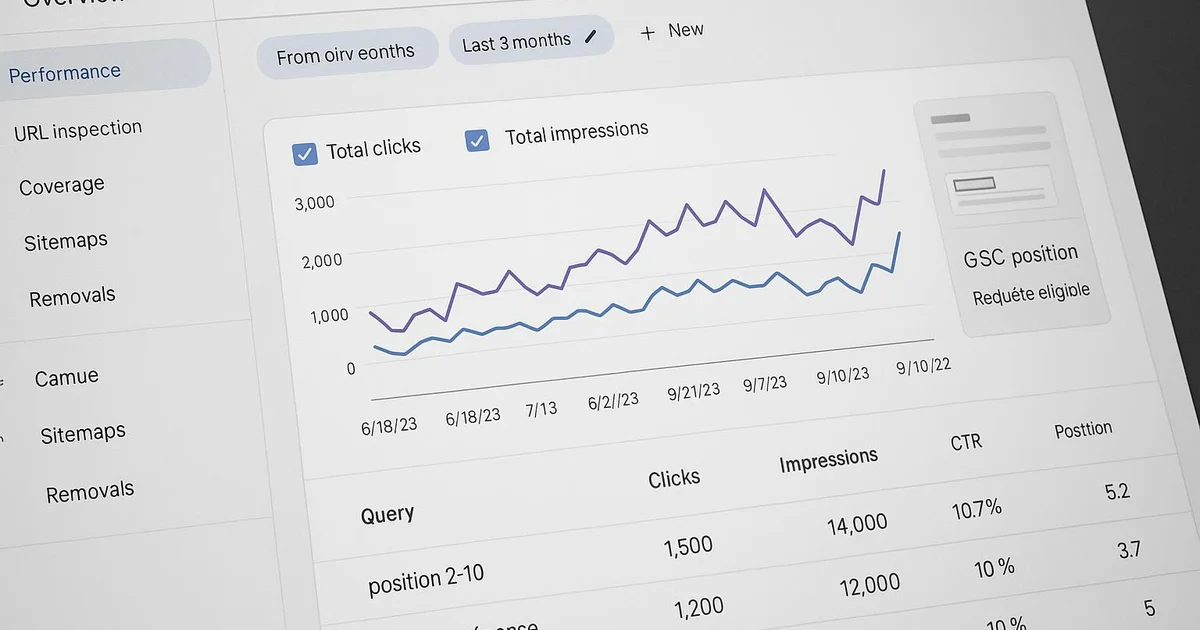
Open the Performance report in Search Console and enable the Position and Impressions columns. Filter queries with an average position between 2 and 10: these are your priority candidates, since Google already deems you relevant. Add an impressions filter (for example above 100 over 90 days) to discard marginal queries. Then focus on intents that frequently trigger a featured snippet: direct questions, definitions, comparisons, step-by-step guides. Phrasings like "how to", "what is", "why" or "best X" are statistically more likely to display an excerpt, depending on the topic. Export this data and cross-reference it with the URLs that rank. A query in position 3 with 500 monthly impressions and a snippet already held by a competitor represents high potential gain: you can contribute to dislodging it by answering better. First check on Google whether a featured snippet actually exists for the query — otherwise optimization won't unlock anything. Finally prioritize by effort: some pages just need an added answer paragraph, others a structural rework. This cross-reading of position, impressions and snippet presence is the foundation of the entire strategy.
- Average position between 2 and 10
- Impressions above a relevant threshold (e.g. 100 over 90 days)
- Question, definition, comparison or step-based intent
- Featured snippet already present in results (manually verified)
Which content formats win the featured snippet?
Google extracts clearly structured blocks. To maximize your chances, align your answer format with the snippet type you're targeting. For a paragraph snippet, place a concise 40-60 word answer right after the H2 that rephrases the question — start with the subject, like a definition. For a list snippet, use clean ul or ol tags with short, parallel items; step lists work well for "how to" queries. For a table snippet, build a real comparative HTML table. Don't pile formats on the same query: identify the one Google already displays and mirror its structure while providing a more complete answer. Yoast or RankMath help you check readability and the presence of a question-based H2. Avoid answers buried in long paragraphs: extractability relies on clarity. A good GEO reflex: this same clear structure is also more easily cited by ChatGPT, Perplexity or Gemini, which overlaps with optimizing content for LLMs. Systematically add the exact question as a heading, then the direct answer below. In many cases, this simple repositioning of existing content is enough to become eligible for position 0 without rewriting the whole page.
- Paragraph snippet: 40-60 word answer under a question H2
- List snippet: ul/ol tags with short, parallel items
- Table snippet: structured comparative HTML table
- Mirror the format of the snippet already held by the competitor
How do you track and measure your gains in Search Console?
Once content is optimized, tracking happens over time. In Search Console, monitor the average position evolution for each targeted query: a move from 4 to 1 is the first signal. Cross-reference with click-through rate (CTR): winning a featured snippet often changes CTR, sometimes up, sometimes down depending on whether users get their answer without clicking. This behavior must be measured case by case, as it varies by topic. Compare before/after periods over 4 to 8 weeks: Google takes time to recrawl and reassess the structure. Build a recurring dashboard listing your target queries, their position, impressions and "snippet won / lost / stable" status. Automating this Search Console reporting saves you from redoing the manual filtering each month. Beware: a featured snippet is never permanently secured. Google may reassign it to a competitor who answers better, or remove it if intent shifts. So build in a regular review: re-identify new 2-10 opportunities, check lost snippets, adjust answers. This continuous loop — detect, optimize, measure, iterate — turns the featured snippet strategy into a durable process rather than a one-off win.
- Track average position per targeted query
- Analyze CTR evolution after winning the snippet
- Compare before/after periods over 4 to 8 weeks
- Regularly review lost or reassigned snippets
Selfhook connects to your Google Search Console and automatically detects queries where your site appears in positions 2-10 with significant impressions. For each opportunity, its SEO audit identifies the featured snippet type displayed (paragraph, list, table) and its AI generation engine restructures existing content: adding a question H2, inserting a 40-60 word answer, building an extractable list or table. Everything is optimized for Yoast then pushed via automated WordPress publishing. You keep editorial control while Selfhook removes manual filtering and repetitive reformatting, which can contribute to accelerating your conquest of position 0.
Selfhook centralizes content generation, SEO/GEO optimization, WordPress publishing and tracking in a single workflow.
See all features →Operational checklist
Action plan
- 1
Extract candidates
In Search Console, filter queries in positions 2-10 with relevant impression volume and export the list.
- 2
Qualify opportunities
Check on Google which queries actually display a featured snippet and note its format.
- 3
Restructure content
Add a question H2 and an extractable answer matching the targeted snippet format.
- 4
Publish and trigger recrawl
Update the page on WordPress and submit the URL via URL inspection in Search Console.
- 5
Measure and iterate
Track position and CTR over 4 to 8 weeks, then re-identify new 2-10 opportunities.
FAQ
How long does it take to win a featured snippet?
It varies by topic and crawl frequency. Changes are generally observed over 4 to 8 weeks after optimization. Submitting the URL via inspection in Search Console can speed up recrawling, with no recommended outcome.
Does a featured snippet always increase traffic?
Not necessarily. In some cases CTR rises, in others it drops because users get their answer without clicking. This must be measured in Search Console case by case, depending on the query and intent.
Do you need to rank first to get the snippet?
No. Google can select an excerpt from a page in positions 2-10 if it better matches intent. That's precisely why those positions are priority targets.
Which answer format should you choose?
Mirror the format of the snippet already displayed: short paragraph, list or table. If no snippet exists for the query, optimization alone won't make one appear.
Common mistakes
Targeting queries with no existing snippet
Optimizing a query where Google shows no excerpt mechanically can't unlock anything.
Burying the answer in a long paragraph
Extractability relies on a short answer clearly isolated under a heading.
Ignoring the displayed snippet type
Offering a paragraph when Google shows a list sharply reduces your chances of being selected.
Not measuring after optimization
Without tracking position and CTR in Search Console, you can't know what works.
Treating the snippet as permanent
Google can reassign it at any time, hence the need for regular review.
A WordPress publisher focused on personal finance spots a query "how to calculate your debt-to-income ratio" in position 4 in Search Console, with around 1,200 impressions over 90 days and a list snippet held by a competitor. They add an H2 using the exact question, then an ol list of 4 short steps right below, followed by a 55-word paragraph answer. After submitting the URL for inspection, the recrawl happens within about ten days. Over the following 6 weeks, the page moves to position 1 and wins the list featured snippet. Estimated impressions rise by about 30% and CTR improves slightly. The publisher then replicates the method across 8 other 2-10 queries identified in the same report.

Related cluster articles
Automate with Selfhook
Conclusion
Winning featured snippets is no lottery when you start from Search Console data: you target queries where you already rank 2-10, mirror the existing snippet format, then measure over several weeks. The key is consistency — detect, optimize, measure, iterate. To avoid manual filtering and reformatting each cycle, Selfhook automates opportunity detection, content structuring and WordPress publishing. Combined with your Search Console quick wins and optimizing content for LLMs, it's a durable and measurable strategy.
Ready to automate your SEO content?
Book a 30-minute video demo: we show you Selfhook on your WordPress site, from SEO audit to publishing.
Request a demo