
Building topical authority quickly in SEO
Quick answer
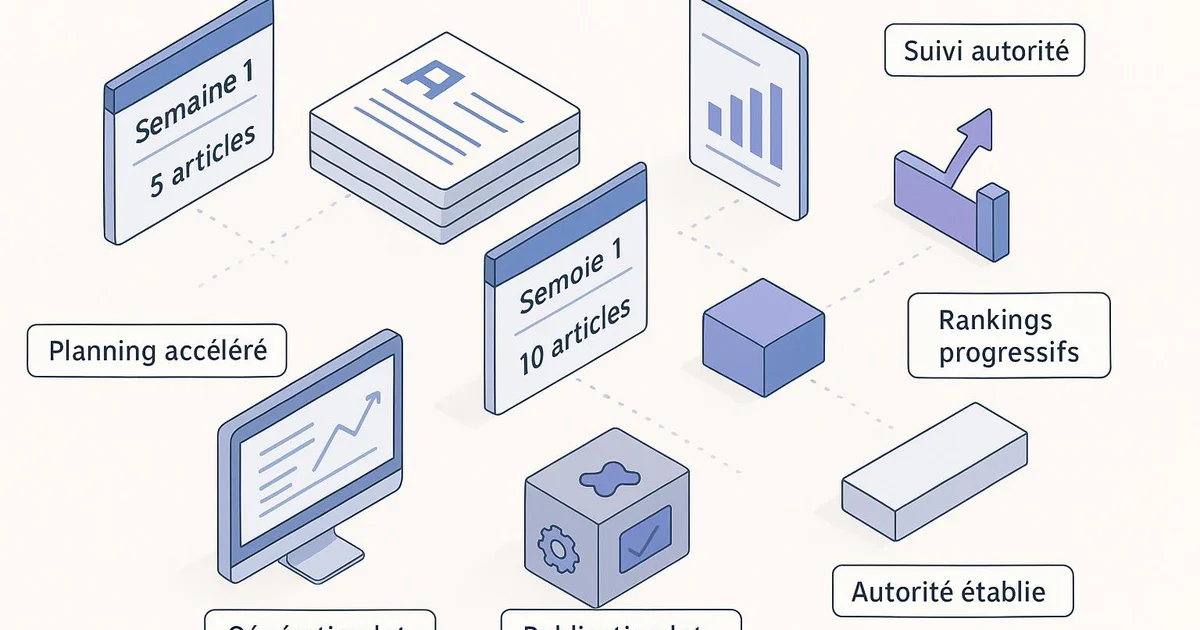
Building topical authority quickly relies on a complete topical map, high publishing velocity and consistent semantic coverage around a subject. Publishing interconnected article clusters within weeks, rather than spread over a year, can contribute to faster thematic recognition by Google, provided editorial quality is maintained.
Topical authority has become a pillar of content strategies, yet its reputation as a long project discourages many publishers. It's often said that installing credible thematic authority in Google's eyes takes 6 to 12 months. That estimate isn't wrong in absolute terms, but it mostly describes a traditional production pace limited by human writing capacity. The interesting question is therefore not "can we cheat?" but "what actually takes time, and what can be compressed without degrading quality?". In this article, we analyze the components of topical authority, what influences its acquisition speed, and how tools like Selfhook allow entire clusters to be published within weeks. The goal isn't to promise an automatic result, but to distinguish structural levers from real constraints, and to measure the effects in Search Console.
Definition
Topical authority is the level of credibility a site accumulates on a given subject by covering that theme broadly, deeply and consistently. It is generally observed through better rankings across an entire cluster of related keywords.
What makes topical authority 'fast' to build?
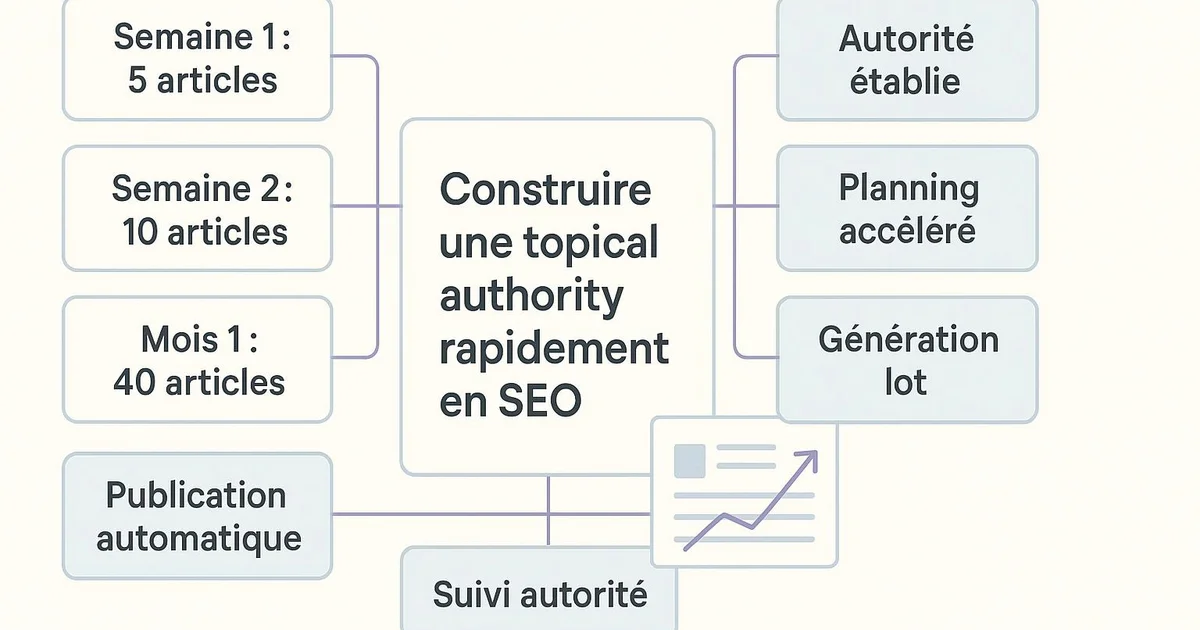
The speed of acquiring topical authority depends on several variables that must be distinguished. The first is coverage completeness: Google evaluates, to some extent, whether a site treats a subject in its entirety or only in fragments. A cluster of 20 articles covering the peripheral questions of a theme sends a more complete signal than a single isolated article. The second variable is semantic consistency and internal linking, which connects content and clarifies the thematic structure. The factor that varies most, however, is publishing velocity. Publishing one article per week mechanically spreads coverage over several months. Publishing ten to twenty articles per week can, in some cases, reach a critical mass within weeks. It's not speed itself that matters, but reaching the threshold of perceived completeness sooner. One incompressible constraint remains: Google's evaluation time. Indexing, crawling and trust-building follow their own timeline, independent of your publishing pace. It is generally observed that production can be strongly accelerated, while algorithmic recognition retains inertia. The effective strategy is therefore to compress what depends on you — production and structure — without overestimating your control over the rest.
How to structure a topical map to accelerate results?
The topical map is the battle plan of any thematic authority built quickly. It means mapping all the sub-topics, questions and search intents linked to a central theme before producing a single article. This step, detailed in our topical map SEO guide, avoids two common pitfalls: coverage gaps and redundancies that dilute the signal. A well-built topical map is generally organized around a central pillar page and cluster pages connected by logical internal linking. Each cluster page targets a precise intent and links back to the pillar, which helps Google understand the subject's hierarchy. Tools like Semrush or Search Console help identify related keywords and the questions actually asked. Coverage density matters as much as volume. A cluster of 15 coherent articles can, depending on the theme, produce a stronger signal than 40 articles scattered across vaguely related subjects.
- Identify a central subject with measurable traffic potential
- List sub-topics and peripheral questions (People Also Ask, related queries)
- Define a single intent per cluster page to avoid cannibalization
- Plan internal linking before writing, not after
- Prioritize depth on a theme over dispersion
Does content velocity really accelerate topical authority?
Content velocity — the number of articles published over a given period — is the most directly actionable lever to compress the calendar. The observed hypothesis is this: if Google waits for complete coverage to grant authority, reaching that completeness faster can bring forward the moment when the site becomes eligible to rank better. This isn't a ensure, but a correlation noted across several editorial strategies. Velocity, however, carries a risk: quality can degrade if production is industrialized without control. A cluster of 20 shallow or poorly optimized articles for Yoast doesn't provide the same signal as a dense, relevant cluster. Velocity is only an advantage if it preserves depth, optimization and internal consistency, as we explain in our analysis of the content velocity advantage. The GEO dimension must also be considered. Engines like ChatGPT, Perplexity and Google's AI Overviews more readily cite sources that cover a subject in depth. Solid topical authority therefore increases, in some cases, the probability of being cited by these engines. Quickly publishing a coherent, citable set serves both classic SEO and generative visibility. Measurement remains essential: to track in Search Console and via mentions in AI answers.
Selfhook helps compress a topical authority project that would normally take several months. Concretely, after defining a topical map, Selfhook generates cluster articles with AI, optimizes them for Yoast or RankMath, then publishes them directly on WordPress with coherent internal linking. A publisher can thus move from two articles per week to ten or twenty, while keeping a controlled editorial structure. Automated WordPress publishing and integrated SEO audit reduce operational time, while keeping a human in the loop to validate relevance. The goal is to reach the completeness threshold faster, then measure the effects in Search Console.
Selfhook centralizes content generation, SEO/GEO optimization, WordPress publishing and tracking in a single workflow.
See all features →Traditional vs accelerated approach to topical authority
| Criterion | Traditional approach | Accelerated approach |
|---|---|---|
| Publishing pace | 1-2 articles/week | 10-20 articles/week |
| Time to cover a cluster | 6-12 months | A few weeks |
| Main risk | Loss of momentum | Quality if poorly controlled |
| Completeness signal | Gradual and spread out | Reached earlier |
| Operational effort | High and recurring | Concentrated and tooled |
A WordPress publisher in the wellness sector targeted a 'sleep and recovery' cluster. At a classic pace, they published two articles per week, planning eight months to cover 60 subjects identified in their topical map. By switching to tooled production generating 15 optimized cluster articles per week, the whole set was published in about five weeks. In Search Console, several cluster pages began generating impressions after six to eight weeks, with observed progress on the pillar page once the internal linking was complete. The figures are estimates specific to this case and depend heavily on the niche's competition, but they illustrate the calendar compression effect.
FAQ
Can topical authority be built in a few weeks?
Production and structure can be compressed into a few weeks, but recognition by Google retains its own inertia. In some cases, reaching complete coverage faster brings forward the moment when the site becomes eligible to rank better. The effects remain to be measured in Search Console.
Does content velocity harm quality?
Not necessarily. The risk exists if production is industrialized without editorial control or optimization. High velocity only provides an advantage if each article keeps depth, relevance and proper Yoast or RankMath optimization.
How many articles are needed for a credible cluster?
It depends on the theme and competition. A cluster of 15 to 30 coherent, well-linked articles is often enough to cover a subject in depth, which matters more than raw volume scattered across loosely related subjects.
Does topical authority help being cited by AI?
In some cases, yes. Engines like ChatGPT, Perplexity and Google's AI Overviews more readily cite sources that treat a subject in depth. Solid thematic coverage can therefore contribute to generative visibility.
Key takeaways
Distinguish what can be compressed (production, structure) from what keeps its inertia (Google evaluation)
Build a complete topical map before producing a single article
Prioritize depth and consistency over scattered volume
Use velocity as a lever without sacrificing Yoast/RankMath optimization
Solid topical authority can contribute to AI citations (ChatGPT, Perplexity, AI Overviews)
Systematically measure effects in Search Console
Related cluster articles
Reference guides
Automate with Selfhook
Conclusion
Building topical authority quickly isn't about bypassing Google's mechanisms, but about intelligently compressing what depends on you: the topical map, production and internal linking. Content velocity, applied methodically and without sacrificing quality, can bring forward the moment a site reaches perceived completeness on a theme. Results remain variable depending on competition and theme, and should always be measured in Search Console. Tools like Selfhook make this compression operational by generating, optimizing and publishing entire clusters on WordPress. The effective strategy combines pace ambition with editorial rigor, rather than one at the expense of the other.
Ready to automate your SEO content?
Discover how Selfhook can help you create and publish quality SEO content
Start for free