
Topical Authority WordPress: How to Build Lasting Thematic Authority with AI
SEO in 2026 is no longer played out article by article. Google — and now AI engines like ChatGPT Search or Google AI Overviews — evaluate your site as a whole: are you a reference on your topic? That is the principle of Topical Authority. And it has become the most powerful SEO lever for WordPress sites that want to rank durably, without relying solely on backlinks.
What is Topical Authority?
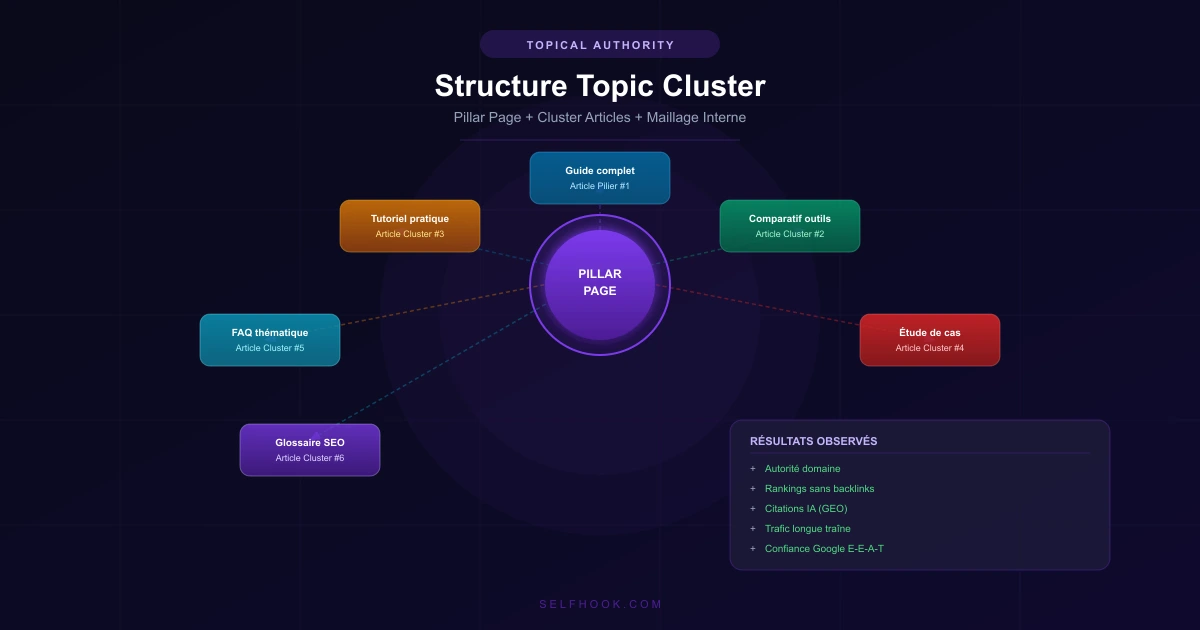
Topical Authority is a site's ability to be recognized as an expert and exhaustive source on a given subject. The more deeply and broadly you cover a topic — with in-depth articles, practical guides, comparisons, FAQs — the more authority Google assigns you on that subject. And the more it trusts you to rank on new keywords in that topic, without additional backlinks. A topic cluster consists of several interdependent elements:
Pillar Page
Comprehensive guide on the central topic — 3,000+ words, H2s covering all sub-topics.
Cluster articles
10 to 50 specialized articles treating each sub-topic in depth (800–2,000 words).
Structured internal linking
Each cluster article points to the pillar page. The pillar page links back to clusters.
Semantic consistency
Same lexical field, same named entities, logical progression between articles.
Why Topical Authority Is Crucial in 2026
Two major developments have made Topical Authority the essential SEO lever of 2026:
- The Helpful Content Update penalized thin content sites without real expertise
- Google evaluates the entire domain, not article by article
- AI engines (ChatGPT, Gemini, Perplexity) cite recognized expert sources
- Backlinks alone are no longer enough without thematic consistency
- Topical authority accelerates indexing of new articles
How to Build an Effective Topic Cluster on WordPress
Building a topic cluster starts with precise semantic mapping. Choose a topic where you can realistically become a reference — neither too broad ("digital marketing") nor too narrow ("Yoast meta title for gardening articles"). Then create your pillar page: a comprehensive guide of at least 3,000 words covering all sub-topics. Then develop cluster articles, each treating a specific sub-topic with its own long-tail keyword.
Automating Content Cluster Production
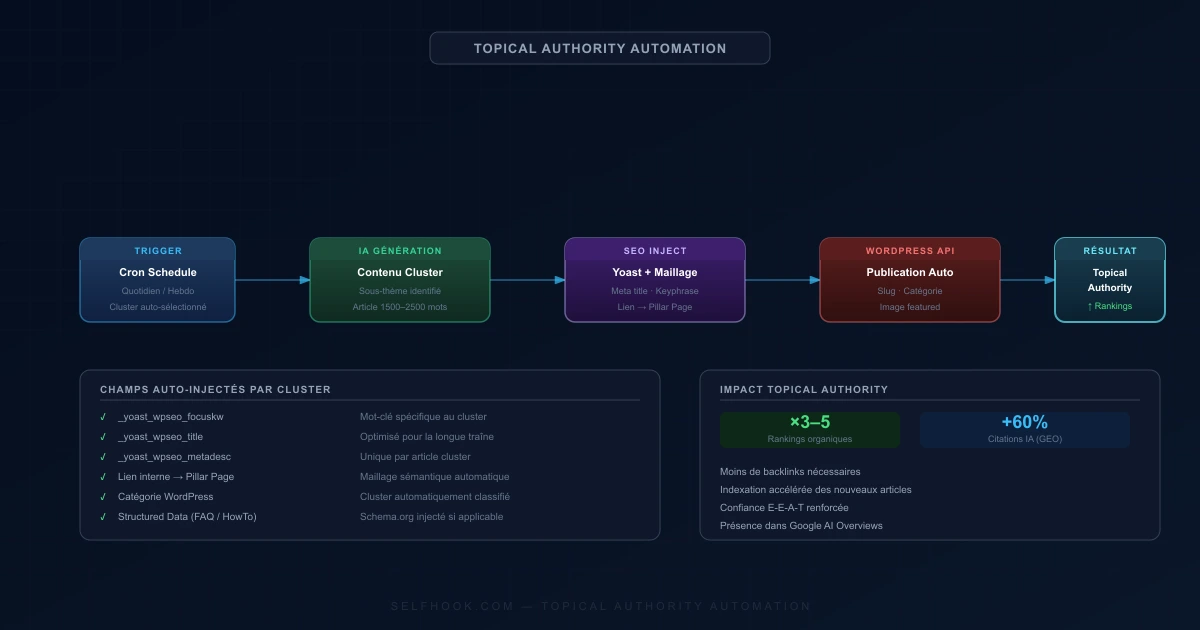
Building solid Topical Authority requires publishing 50 to 200 articles around the same topic. Manually, that's several months of full-time work. That's exactly where Selfhook comes in: automating the production of cluster articles, with internal linking and Yoast fields injected at each publication.
1. Map the clusters
Identify the pillar page and list 20–50 sub-topics to cover. Each sub-topic becomes a long-tail keyword.
2. Plan production
Define a cadence: 3–5 articles per week. Impossible manually. Automatable with Selfhook.
3. Generate with context
Each cluster article is generated with the primary keyword, the link to the pillar page, and the topic's lexical field.
4. Inject internal links
The internal link to the pillar page is automatically inserted at publication via the WordPress API.
5. Track authority
Monitor rankings on cluster keywords: an overall rise confirms growing authority.
Topical Authority and GEO: The Direct Link
Topical Authority and GEO (Generative Engine Optimization) are intimately linked. AI engines don't cite the top Google results — they cite sources that have authority on a subject. By building solid Topical Authority, you simultaneously maximize your Google ranking and your chances of appearing in responses from ChatGPT, Google AI Overviews, Perplexity or Gemini:
- AI engines favor sources that comprehensively cover a subject
- A well-structured pillar page is more often summarized in AI Overviews
- Internal linking helps AI crawlers understand content hierarchy
- Thematic depth reinforces E-E-A-T signals perceived by LLMs
Mistakes That Sabotage a Topical Authority Strategy
Creating the pillar page without clusters
A pillar page alone is not enough. Authority is built through the combination of pillar + clusters + internal linking.
Choosing too broad a topic
"Digital marketing" is too vague. "WordPress content automation" is actionable. The more precise the scope, the faster authority grows.
Neglecting internal linking
Without internal links between articles and the pillar page, Google doesn't perceive the cluster structure. It's the essential binding element.
Publishing too slowly
Publishing 1 article per month does not build authority. You need density. That's exactly what automation enables.
Topical Authority: Comparison of Approaches
| Approach | Volume | Time to results | Backlinks | SEO Impact |
|---|---|---|---|---|
| Without Topical Authority | 10–20 articles | — | Intensive backlinks | Low |
| With manual Topical Authority | 50–100 articles | 6–18 months | Moderate | Medium |
| With automated Topical Authority | 50–200 articles | 2–6 months | Minimal | Very strong |
Selfhook is designed to produce cluster articles at scale, with internal linking and Yoast fields automatically injected at each publication.
- Automatically generate cluster articles around your topic
- Inject internal links to your pillar page at each publication
- Plan a regular publishing cadence (daily, weekly)
- Optimize each cluster with Yoast SEO fields (keyphrase, meta, slug)
- Manage multiple topics in parallel from a single dashboard
- Track indexing and performance by cluster
FAQ — Topical Authority WordPress
How many articles are needed to build Topical Authority?
There is no absolute number, but practice shows that covering 30 to 50 articles around a precise topic produces visible effects in 3 to 6 months. The most important factor is semantic density and consistency, not just volume.
Does Topical Authority work for a new site?
Yes, and it is often more effective than for an established site. A new site that chooses a precise topic and covers it exhaustively from the start can rank on many keywords without backlinks, thanks to topical authority perceived by Google.
What is the difference between Topical Authority and semantic silo?
A semantic silo is an optimized internal linking method. Topical Authority is broader: it integrates content depth, exhaustive topic coverage, E-E-A-T signals, and impact on AI engines (GEO).
Can Topical Authority be automated without losing quality?
Yes, provided generation is properly configured: unique angle for each article, specific focus keyphrase, internal link to the pillar page, and lexical field consistent with the topic. Tools like Selfhook are designed to respect these constraints.
How long before seeing results?
First effects (accelerated indexing, appearing on long-tail keywords) are visible in 4 to 8 weeks. Effects on domain authority and rankings on competitive keywords take 3 to 6 months. Topical Authority is a lasting investment, not an immediate lever.
Topical Authority Checklist
Conclusion
Topical Authority is the most durable SEO strategy and the most resistant to algorithmic updates. By exhaustively covering your topic with well-structured and interlinked cluster articles, you build authority that Google — and AI engines — recognize and reward. Automation makes this strategy accessible, even for small teams. The combination of editorial expertise + automated production is the winning formula for 2026.
Ready to automate your SEO content?
Discover how Selfhook can help you create and publish quality SEO content
Start for free