
WordPress AI Overviews: A Practical Guide to Get Cited

Quick answer
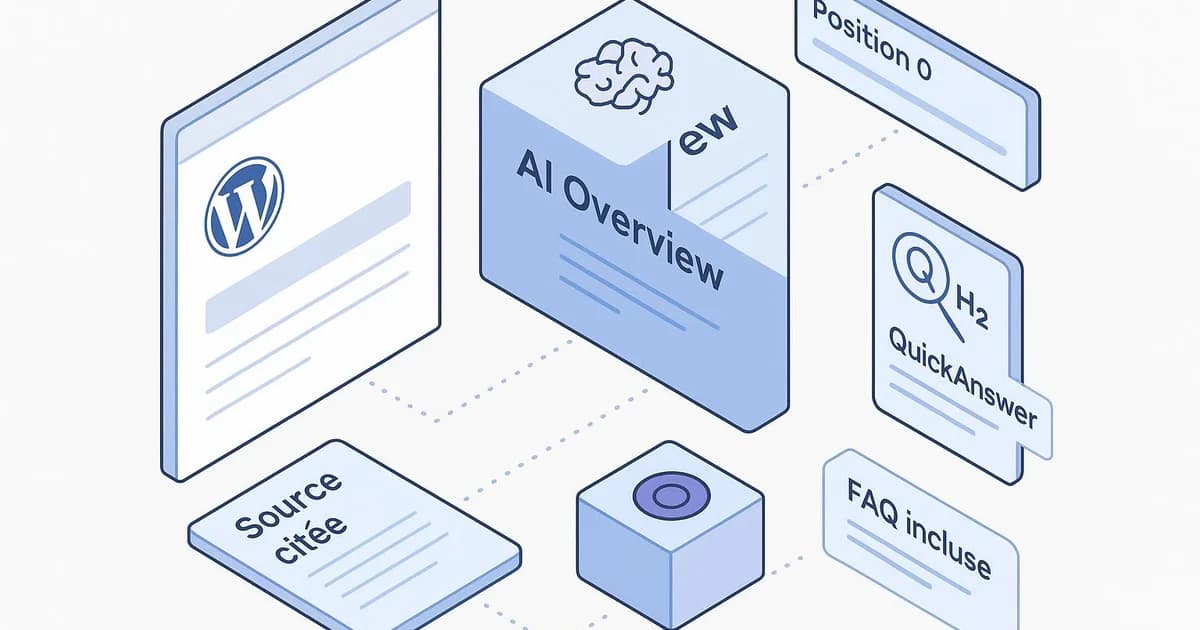
WordPress AI Overviews means structuring your WordPress articles to be featured in Google's AI-generated summaries. In practice: a short answer at the top, clear H2 headings, sourced data points, and Schema markup via Yoast or RankMath. This approach can contribute to improved visibility, to be measured in Search Console depending on your topic.
You publish regularly on WordPress, yet your articles never show up in Google's AI summaries? The issue isn't always content quality: it's often about structure. AI Overviews favor pages that answer clearly, quickly, and with verifiable data. On WordPress, this translates into very concrete choices: where to place the answer, how to phrase your H2s, which plugin to use for markup. This practical guide shows you step by step how to prepare your WordPress content to be cited by Google's AI. We'll cover which plugins to use (Yoast, RankMath), how to organize a page in the Gutenberg editor, and what data to include. Selfhook automates part of this work by generating WordPress articles already structured for AI Overviews, but every technique remains applicable manually.
Definition
AI Overviews are the AI-generated summaries displayed at the top of Google search results, synthesizing multiple sources to directly answer a query.
How do AI Overviews work on a WordPress page?
Google's AI Overviews read your page like any crawler, but they look for precise passages to reuse in their summary. On WordPress, this means the way you organize your Gutenberg blocks matters as much as the text itself. The AI typically spots a concise answer placed early in the article, explicit headings, and figures attributed to a source. Google has stated its systems rely on its classic index: your indexation in Search Console therefore remains the starting point. Without clear structure, even an excellent WordPress article may not be selected.
- Place an answer paragraph (40-80 words) right after the first H2
- Use Gutenberg 'Heading' blocks for a clean H2/H3 hierarchy
- Enable Yoast readability analysis to check sentence clarity
- Verify the page's indexation in Google Search Console first
Which WordPress plugins should you use to optimize for AI Overviews?
On WordPress, two plugins cover most of the optimization work for AI Overviews: Yoast SEO and RankMath. Yoast lets you set a meta title, a meta description, and above all automatically generate Schema markup (structured data) that Google uses to understand content type. RankMath offers similar features with a more granular Schema module, useful for FAQs and how-to articles. For questions and answers, an FAQ block marked up as FAQPage Schema can contribute to Google isolating your answers. No plugin ensures a citation, but clean markup makes it easier for the AI to understand.
- Yoast SEO: automatic Article Schema + 'content type' setting
- RankMath: FAQ and HowTo Schema module, enabled per article
- Dedicated FAQ plugin or native block: generate FAQPage markup
- Check rendering with Google's Rich Results Test tool
How do you structure a WordPress article to be cited by AI?
The ideal structure for a WordPress article optimized for AI Overviews follows a simple logic: answer first, details after. In the Gutenberg editor, start with a short-answer block, then expand with H2s phrased as real questions (the same ones your readers type). Each section should stay self-contained and scannable. Add figures presented as estimates and cite your sources by name (Semrush, Search Console, a dated study). Finally, link your articles together: an internal link to your complete GEO WordPress guide reinforces what Google calls topical authority, meaning your observed thematic authority on a subject.
- Short-answer block at the top, before any development
- H2s phrased as concrete questions (keyword variants)
- Figures framed as estimates, with a named source
- Internal links to other articles in the GEO WordPress cluster
With Selfhook, structuring for AI Overviews is built into content generation. When you launch article creation, Selfhook automatically produces a quickAnswer under 80 words placed at the top, H2s containing keyword variants, and passages with figures presented as estimates. The built-in SEO audit then checks readability and Yoast-compatible markup before automated WordPress publishing. The result: every published article meets the criteria observed in AI Overviews without manual work. You keep editorial control, but the structure that makes content citable by Google, ChatGPT, or Perplexity is applied by default to each piece.
Selfhook centralizes content generation, SEO/GEO optimization, WordPress publishing and tracking in a single workflow.
See all features →FAQ
Do AI Overviews replace classic SEO on WordPress?
No. AI Overviews rely on Google's index, so solid classic SEO remains essential. Optimizing for AI adds to your SEO work, it doesn't replace it. Always check your indexation in Search Console first.
Should I choose Yoast or RankMath for AI Overviews?
Both work well. Yoast is simpler for beginners and handles Article Schema smoothly. RankMath offers finer control over FAQ and HowTo markup. The choice mostly depends on your comfort level with structured data.
Will a well-structured WordPress article always get cited?
No, no structure ensures a citation. Selection depends on many factors specific to Google. A clear structure can contribute to increasing your chances, but the result should be measured in Search Console depending on your topic.
Where should I place the short answer in a WordPress article?
Ideally right after the first H2, in a distinct paragraph block of 40 to 80 words. This early position on the page makes it easier for Google's AI and engines like Perplexity or ChatGPT to spot it.
Yoast vs RankMath for AI Overviews optimization on WordPress
| Criterion | Yoast SEO | RankMath |
|---|---|---|
| Article Schema | Automatic, simple | Automatic, configurable |
| FAQ / HowTo Schema | Basic | Advanced dedicated module |
| Readability analysis | Complete and guided | Present, less detailed |
| Ease of use | Very accessible | More technical |
| Free version cost | Functional | Functional, more modules |
Operational checklist
Related cluster articles
Automate with Selfhook
Conclusion
Optimizing WordPress for AI Overviews isn't about a magic trick, but about concrete structural choices: answer at the top, clear H2s, Schema markup via Yoast or RankMath, sourced data, and internal linking. No method ensures a citation, but these practices can contribute to improving your visibility, to be measured in Search Console depending on your topic. To go further, check out our complete GEO WordPress guide and our article dedicated to SEO optimization for AI Overviews. Selfhook automatically applies this structure to every article generated and published on WordPress, saving you time while respecting the criteria observed on the AI side.
Ready to automate your SEO content?
Book a 30-minute video demo: we show you Selfhook on your WordPress site, from SEO audit to publishing.
Request a demo