
How to Get Cited in ChatGPT from WordPress
Quick answer
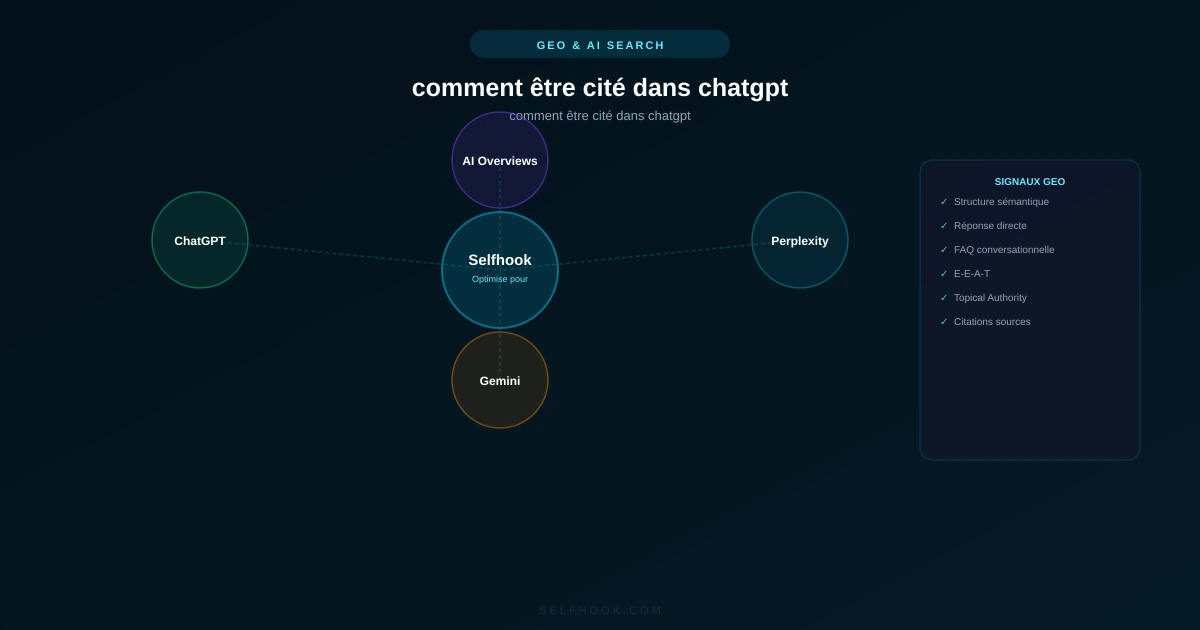
Getting cited in ChatGPT from WordPress means publishing structured, factual and easily extractable content: direct answers at the start of each section, FAQ schema markup, clear definitions and topical authority. With Yoast or RankMath for markup and a consistent heading structure, your WordPress content becomes more easily citable by AI engines.
ChatGPT and other AI engines are changing how people access information. Instead of clicking ten results, they get a synthesized answer that may cite certain sources. The question is no longer just "how do I rank on Google?" but "how do I get cited in ChatGPT?". For a WordPress publisher, the good news is that the levers are concrete: content structure, schema markup via Yoast or RankMath, direct answers and topical authority. In this article, we detail how to turn your WordPress articles into citable sources, with examples in the WordPress interface and API. Selfhook can speed up this work by generating content already structured for AI citations. Let's see step by step how to maximize your chances of appearing in ChatGPT's answers.
How does ChatGPT choose which sources to cite?
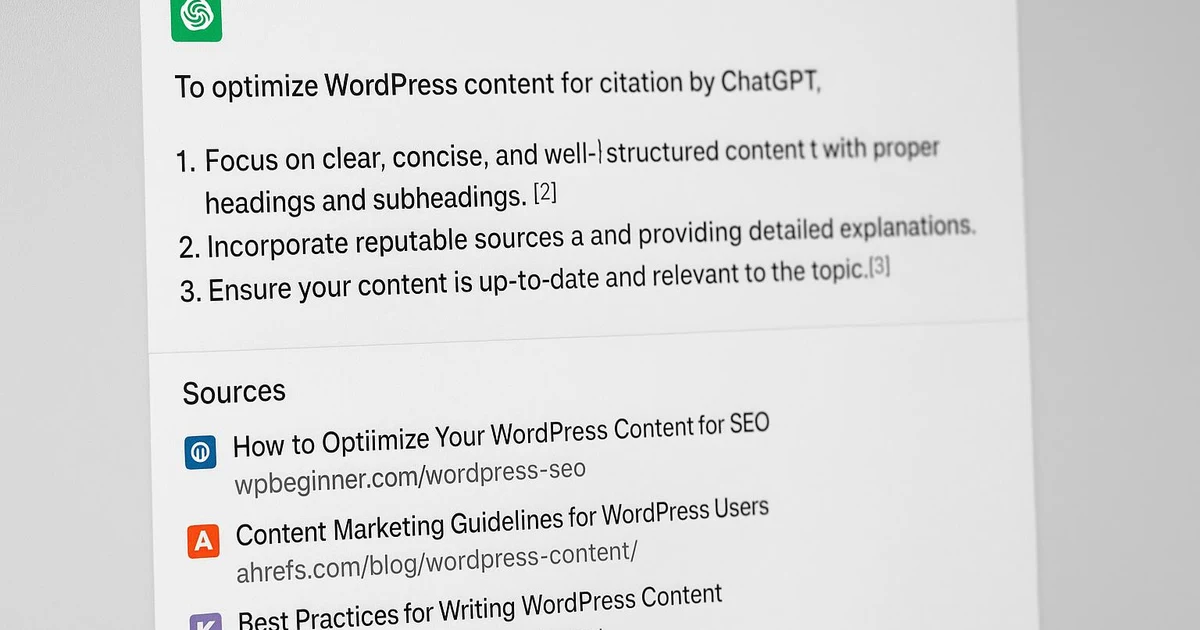
ChatGPT relies on indexable content and, through its search mode, on engines like Bing or partners. To be selected, WordPress content must be clear, factual and easily extractable. AI engines generally favor passages that directly answer a question. On WordPress, this means answer blocks placed at the top of each H2 section, explicit definitions and data presented in a citable way. Yoast and RankMath help structure these elements through heading tags and schema.
- Direct answers placed at the start of sections, identifiable as standalone snippets
- Schema markup (Article, FAQPage) generated via Yoast or RankMath
- Factual content with sources and data presented as verifiable estimates
Why is WordPress content structure decisive?
Poorly structured content is hard for an AI engine to extract. On WordPress, the heading hierarchy (single H1, H2 as questions, H3 for details) creates a logical map of the content. Native Gutenberg blocks — lists, tables, quote blocks — make extraction easier. A question in H2 followed by a 40-60 word answer is a format ChatGPT can reuse as-is. Yoast SEO flags readability and structure issues, helping keep paragraphs short and scannable.
- Use a single H1 and H2 headings phrased as natural questions
- Insert Gutenberg lists and tables to make data extractable
- Keep paragraphs short (2-4 sentences) controlled by Yoast analysis
How to mark up FAQs and schema on WordPress?
Schema markup helps engines understand the nature of your content. On WordPress, RankMath offers an FAQ block that automatically generates FAQPage schema, and Yoast includes FAQ and How-To blocks in Gutenberg. A well-marked-up FAQ section increases the likelihood that ChatGPT identifies a reusable question-answer pair. You can check the rendering with Google's Rich Results Test, then track impressions in Search Console to measure the effect on the relevant topic.
- Add an FAQ block via RankMath or Yoast to generate FAQPage schema
- Use the How-To block for tutorial content like this one
- Validate the markup with Google's Rich Results Test
Does topical authority influence AI citations?
Yes, topical authority can contribute to your credibility in the eyes of AI engines. Covering a topic in depth through a cluster of interlinked WordPress articles signals expertise. ChatGPT tends to favor consistent and complete sources on a domain. On WordPress, organize your content into topical silos with contextual internal links — for example to our topical-authority-wordpress and geo-wordpress articles. This consistency is measured over time via associated queries in Search Console.
- Create a cluster of interlinked articles around a pillar topic on WordPress
- Contextual internal linking to topical-authority-wordpress and geo-wordpress articles
- Regularly update content to maintain perceived freshness
Take a WordPress publisher in the gardening niche. They publish an article "When to prune roses?" and place, right below the H2, a 50-word answer: "Rose pruning is generally done in late winter, from February to March depending on the region." They add a RankMath FAQ block with three related questions, then check the schema in Google's testing tool. Three weeks later, in Search Console, they observe an estimated rise in impressions for "prune roses" queries. Meanwhile, when querying ChatGPT in search mode, their article appears among the cited sources. This scenario illustrates the combined effect of a direct answer and clean markup.
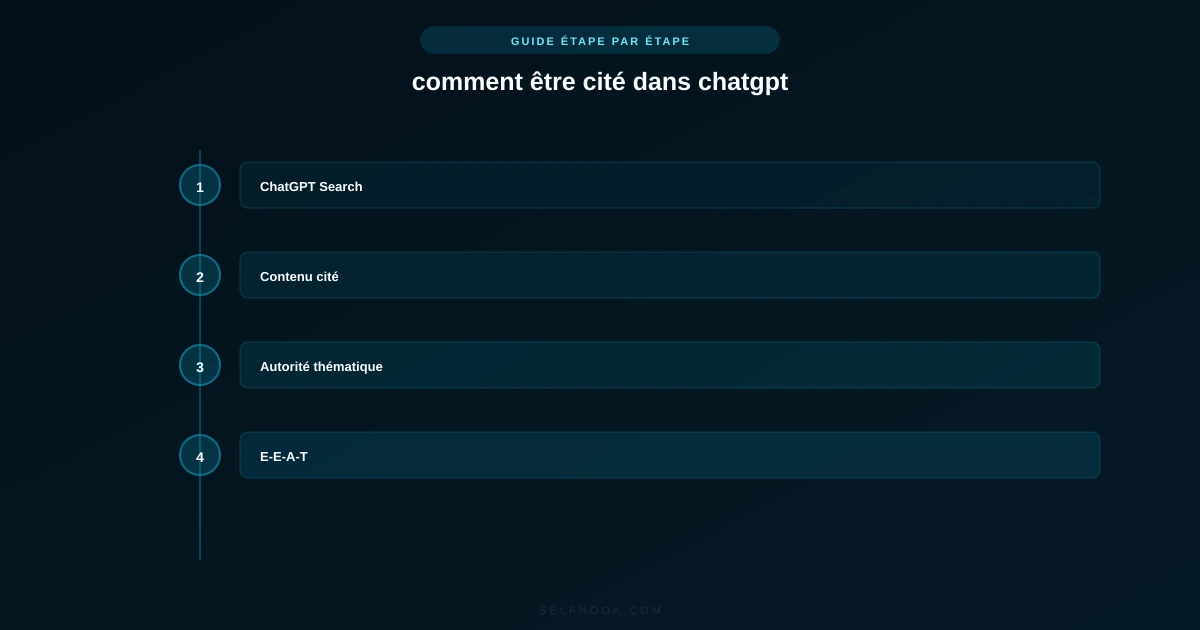
With Selfhook, you directly generate WordPress content structured for AI citations: each article includes a direct answer at the start of a section, a citable definition, a marked-up FAQ and a comparison table. AI generation produces the content, the SEO audit checks the heading structure and Yoast optimization, then automated WordPress publishing puts the article online with the right schema. For our gardening publisher, Selfhook would produce the "When to prune roses?" article already optimized for ChatGPT, with FAQ and internal linking to the cluster, in minutes rather than hours of manual formatting.
Key takeaways
Place a 40-60 word direct answer at the top of each H2 section on WordPress
Mark up your FAQs with RankMath or Yoast to generate FAQPage schema
Structure your H2 headings as natural questions identifiable by ChatGPT
Build topical authority through clusters linked by internal linking
Measure the effect in Search Console and by testing your queries in ChatGPT
Selfhook centralizes content generation, SEO/GEO optimization, WordPress publishing and tracking in a single workflow.
See all features →FAQ
Can you ensure being cited in ChatGPT?
No, no method ensures a citation. ChatGPT selects its sources based on evolving criteria. However, structured, factual and marked-up WordPress content can contribute to increasing your chances of being cited, to be measured over time.
Which WordPress plugins help get cited by AI engines?
Yoast SEO and RankMath are the most useful: they handle schema markup, FAQ and How-To blocks, and structure analysis. They don't ensure citation but make your content more extractable by ChatGPT and Perplexity.
Is FAQPage schema essential for AI citations?
It is not essential but strongly recommended. FAQPage schema helps engines identify reusable question-answer pairs. On WordPress, you add it in a few clicks via the RankMath or Yoast FAQ blocks.
How long before seeing an effect on citations?
It varies depending on the topic and site authority. The first signals are generally observed in Search Console after a few weeks. AI citations can appear progressively as the content is indexed and recognized.
Does topical authority replace backlinks?
No, the two are complementary. Topical authority strengthens the consistency of your topic coverage on WordPress, while external links remain a credibility signal. Combining both is generally more effective.
Operational checklist
Related cluster articles
Reference guides
Automate with Selfhook
Conclusion
Getting cited in ChatGPT from WordPress relies on concrete levers: direct answers, schema markup via Yoast or RankMath, question-based heading structure and topical authority built through clusters. No method ensures a citation, but these practices can contribute to making your content more extractable and credible in the eyes of AI engines. Measure your progress in Search Console and by testing your queries directly in ChatGPT. To save time, Selfhook generates WordPress content already structured for AI citations, with built-in FAQ, definitions and comparison tables. Combine method and automation to durably strengthen your visibility in generative engines.
Ready to automate your SEO content?
Discover how Selfhook can help you create and publish quality SEO content
Start for free